
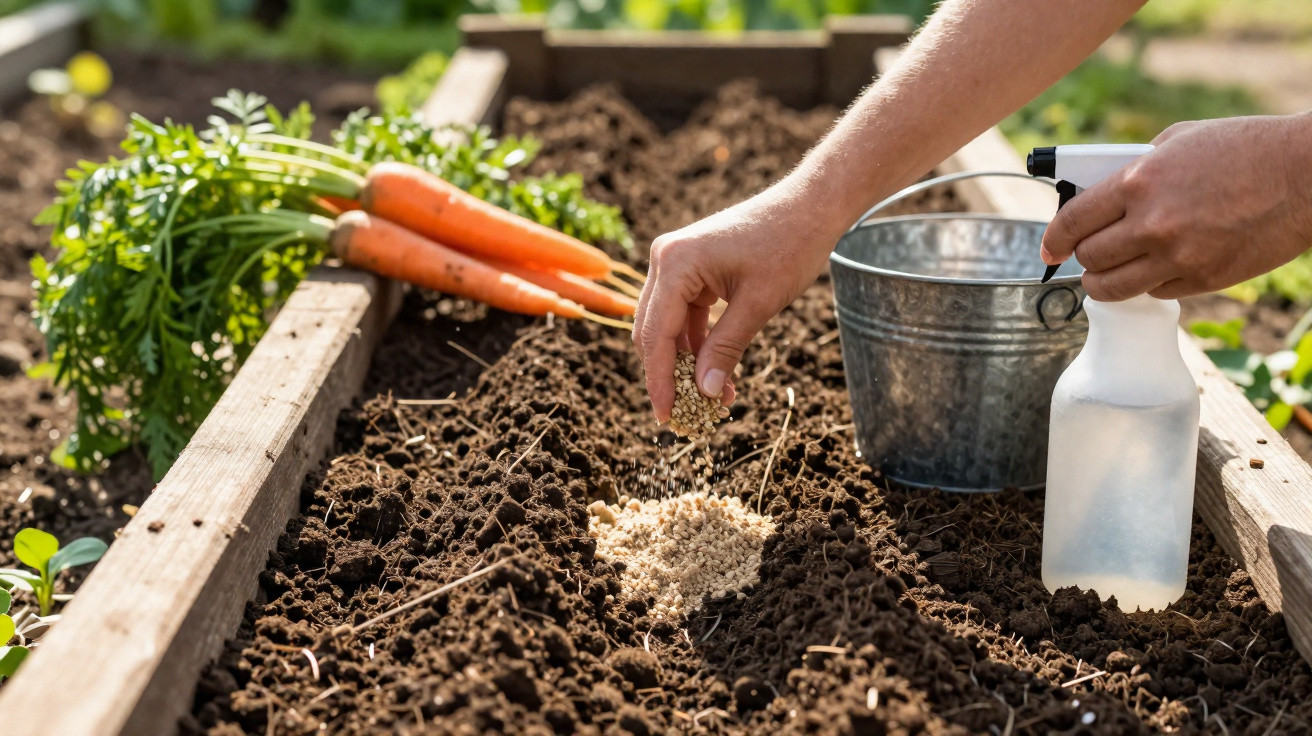
It’s a lot easier than most people think.
Plenty of amateur gardeners eventually give up on carrots in frustration: the seed goes in far too thickly, thinning them out is back-breaking and irritating, and you still end up tipping twisted, forked roots into the harvest box. Yet you can prevent most of that chaos at sowing time with one simple tweak - no special products required, just a bucket of dry sand.
Why carrots so often grow crooked, forked and disappointing
Carrots are one of those vegetables that react extremely strongly to small mistakes in the soil. Three issues, in particular, are behind the infamous forked roots:
- Sowing too densely: too many seeds land in the same spot, so the roots compete right next to one another.
- Compacted ground: stones, clods or heavy soil force the root to spread sideways.
- Mistakes when thinning: if seedlings are thinned too late or too roughly, the plants stay stressed and become misshapen.
The tricky part is that carrot seed is incredibly fine and hard to spread evenly. Most gardeners unknowingly sow in little “clumps”. Later, you’re left painstakingly pulling out whatever is too close together. If you don’t do that thoroughly, you harvest carrots that look more like abstract art than veg.
"The key to straight carrots is spacing - from day one, not only when thinning out."
The sand trick: the simple mixing ratio for professional-looking rows
Choose high-quality seed - possible from March onwards
Before sand comes into it, the basics still matter: decent seed. Early in the year, as soon as the first mild spring days arrive, it’s worth checking the garden centre. You’ll find early, robust varieties, often also available as organic seed. These tend to germinate reliably and produce healthier plants that are less prone to disease.
This approach works with all common carrot types - from quick, early bunching carrots to late, storage varieties. If you want to try several types, it’s better not to mix the varieties together; sow them one after another in separate rows.
The crucial recipe: 1 part seed, 10 parts sand
The core idea is simple but highly effective: mix the tiny seeds with dry sand. This ratio is tried and tested:
- 1 part carrot seed
- 10 parts dry, ideally fine sand
The sand really does need to be dry and free-flowing, with no lumps. Washed play sand or additive-free building sand is ideal. Once mixed, each seed is dispersed through the sand so that, as you scatter it, it naturally drops with spacing built in.
"The sand acts like a natural carrier: it replaces expensive seed tapes - just far more cheaply."
The “magic mix”: how to make your carrot ‘seed tape’ in a bucket
Mix thoroughly until no ‘nests’ of seed remain
Put the sand into a bucket or bowl first, then add the carrot seed. Now comes the key step: mixing. Stir with your hand or a spoon until the seeds are no longer sitting in little clusters but are evenly distributed throughout.
A quick check: scoop up a small handful and let it run through your fingers. If you can see grains of sand and, here and there, an individual seed, the texture is right. If seeds fall in little bunches, the mix wasn’t thorough enough - or the sand is still slightly damp.
Why this puts an end to forked roots
With traditional sowing, lots of seeds drop into the drill within just a few centimetres. Underground, that creates a tangle of roots that push and distort one another. With the sand mix, each seed lands with a small gap to the next.
That means your carrots get their own “private space” in the soil from the start: no crowding, no twisting - and far fewer roots that split or grow crooked.
Perfect sowing: shallow drills, clear spacing, relaxed gardening
Make drills only 1 centimetre deep
Carrots germinate far better when they aren’t sown too deep. If the seed is buried deeply, seedlings waste energy getting to the surface - and some never make it at all. A depth of 1 centimetre is completely sufficient.
How to do it:
- Loosen the bed thoroughly and remove stones and large clods.
- Use the handle of a tool (for example, a rake or hoe) to draw a fine drill - no deeper than 1 centimetre.
- Let the sand–seed mixture trickle into the drill in a thin, even stream.
A handy bonus: pale sand stands out clearly against darker soil, so you can immediately see whether the line is even or whether there are gaps.
Leave at least 25 centimetres between rows
You also need space between the rows. A spacing of about 25 centimetres works well:
- It’s easy to hoe between rows later.
- Air circulates better, making fungal diseases less likely.
- Carrots can develop strong foliage and stable roots.
Once you’ve sown, gently pull soil back over the drill and lightly firm it with the back of a rake. This gives the seeds good contact with the soil so they can take up moisture effectively.
Watering until germination: keep it moist, but don’t drown it
A fine spray rather than a heavy watering can
Straight after sowing comes the delicate stage: moisture management. Too much water washes seed out of the drill; too little lets it dry out. A very fine rose or a spray attachment is best, so water lands softly on the surface.
Water so the soil stays evenly moist but never turns to slurry. Check with a finger: the top layer shouldn’t dry out completely, but it also shouldn’t feel sticky and saturated.
Patience: germination takes 10 to 20 days
Carrots are among the slower germinators. Depending on soil temperature, it takes roughly 10 to 20 days before you see the first green tips. During this period, the soil needs consistent moisture.
"If moisture swings too much during germination - bone dry today, swamp tomorrow - you risk gaps in the row."
If very heavy rain is forecast, cover the sowing briefly with fleece to stop the sand–seed mix from being washed out. On warm, dry days, the bed must not dry out; otherwise, seedlings can die underground before they ever appear.
The moment it clicks: no thinning, straight carrots, a full harvest box
Skipping the tedious thinning out
As soon as the fine carrot foliage appears and starts to strengthen, the main advantage becomes obvious: the rows space themselves correctly. No seedling is pressed right up against the next, and the gaps look as neat as if you’d used seed tape.
The dreaded chore - kneeling over the bed and pulling seedlings one by one - disappears. What used to take close to an hour simply isn’t necessary. You can spend the time on other beds, on new perennials, or just on a coffee break in the garden.
Straight, healthy carrots when you lift them
At harvest time, the method really proves itself. The carrots sit straight in the soil and are easy to grasp and pull. Instead of bent, forked roots, you’ll mostly lift long, slender carrots into the basket.
Because the plants had enough room from the start, they compete less for water and nutrients. That leads to:
- firm, crisp roots
- a smoother surface
- less rot and fewer pressure marks
Additional professional tips: soil, companion planting and common mistakes
The right soil for flawless roots
Even with a perfect sand mix, heavy, stony soils remain challenging. If your garden soil is very clay-rich, loosen the bed deeply and work in plenty of well-rotted compost plus a little sand. That way, roots can grow straight down without obstruction.
Fresh manure isn’t suitable for carrots. It quickly encourages forked roots and can promote disease. Better: apply manure to the bed the year before, and in the carrot year use compost only.
Combine carrots wisely - use companion planting
Carrots pair well with onions or leeks in the same bed. The scent of alliums confuses the carrot fly, while the smell of carrots can, in turn, disrupt pests that target onions. The bed benefits both ways.
If you want to use the space even more efficiently, sow quick crops such as radishes between the rows. They’ll be harvested before the carrots need the room, and they also mark the rows visually while the carrots are still underground.
Typical pitfalls with the sand method
- Sand that’s too damp: seeds clump together and the benefit is lost.
- Drills that are too deep: seedlings struggle to reach the surface.
- Uneven mixing: one part of the bucket contains lots of seed, another almost none.
- Inconsistent watering: alternating drought and flooding disrupts germination.
If you keep these points in mind - and remember the simple ratio of one part seed to ten parts sand - you can make your carrot bed look almost like a professional plot, with very little effort.



Comments
No comments yet. Be the first to comment!
Leave a Comment