
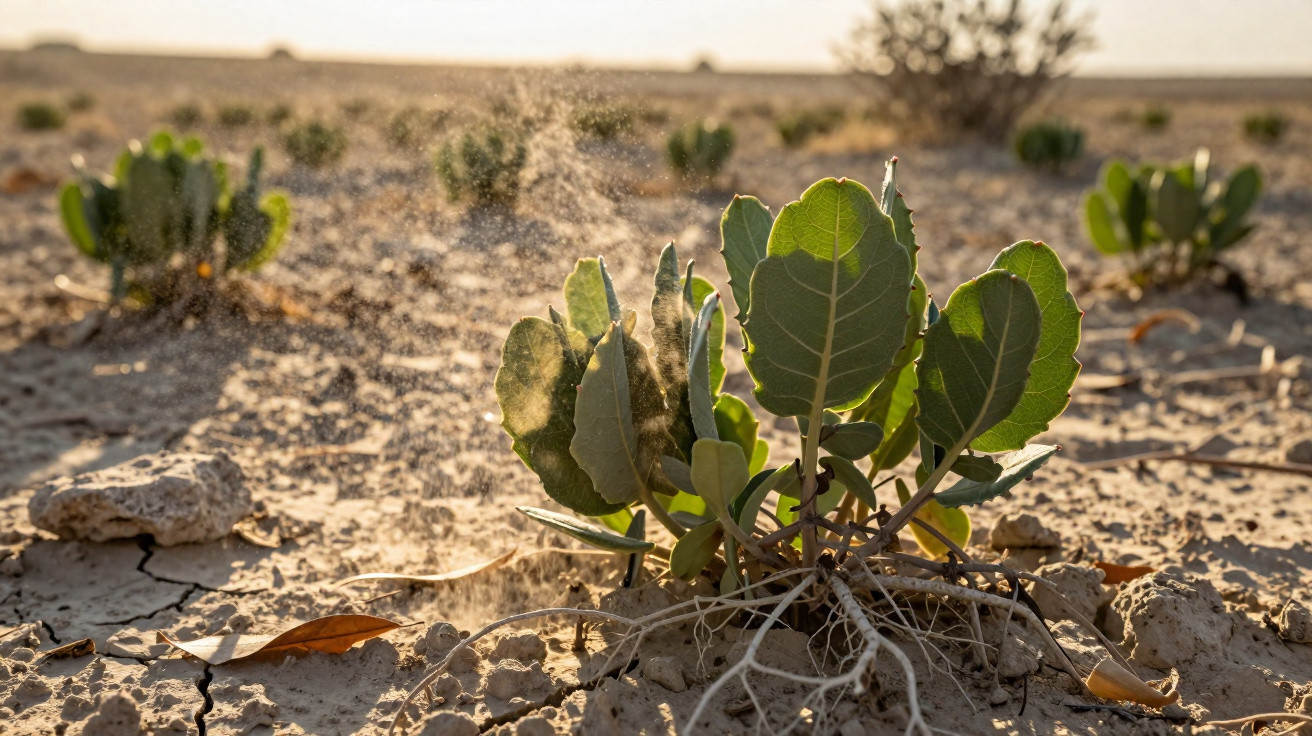
Plants are able to take up nutrients straight from atmospheric dust via their leaves, rather than relying only on their roots, a new study reports.
The work recasts a fleeting dust episode as an immediate food source and reshapes understanding of plant nutrition in arid, nutrient-poor environments.
Dust delivers micronutrients
In Mediterranean shrubland, shrubs whose leaves were dusted ended up with substantially higher amounts of iron and other micronutrients than neighbouring plants left untreated.
In Israel’s Judean Hills, Anton Lokshin of Ben-Gurion University of the Negev connected that enrichment to minerals that were released and then taken up on the leaf surface itself.
Most of the increase was concentrated in shoots, with roots showing little change, strengthening the argument that the dust was entering through foliage rather than via the soil.
That distinction raises a key question: did the nutrients actually pass into living tissue, or were they simply sticking to the outside of the leaves?
Chemical fingerprints of dust
To distinguish genuine uptake from leftover residue, the researchers followed rare earth elements-trace metals that carry source-specific chemical patterns.
In dust-treated plants, those patterns shifted away from the local soil signal and towards the signature of the dust that had been applied.
The dust’s own chemical fingerprint was detected in leaves, whereas plants exposed to dust only through their roots showed little change.
This chemical trail made simple surface contamination an unlikely explanation and supported the idea that nutrients crossed the leaf boundary.
What turned a dusty layer into nourishment was the chemistry at the leaf surface, not just the particles. All three shrubs had mildly acidic leaf surfaces and released organic acids-small acids that help dissolve minerals that are otherwise difficult to break down.
In a laboratory simulation, a thin moisture film on the leaf surface freed iron, manganese, zinc, magnesium, nickel, and copper far more quickly than water alone.
Because the surrounding soil was alkaline, many of those same nutrients were harder to release belowground.
Roots lagged behind
Placing dust near the roots had a much smaller effect, even when the same material was positioned right beside the plants.
In soil, particles were diluted, nutrients were bound to minerals, and microbes had opportunities to interact with them before the shrubs could take up much.
Leaves bypassed that bottleneck because each grain contacted plant tissue first and dissolved within a thin acidic film.
This difference helps explain why a dust storm can matter within a single day, rather than only over long periods of soil development.
Where airborne minerals matter most
When the findings were scaled beyond the field site, they pointed to regions where airborne minerals could form a meaningful part of plant nutrition.
The team estimated that dust-borne iron can provide up to 17 percent of the supply that would otherwise come from soil in the western United States.
In the eastern Amazon, Saharan dust already makes the transatlantic journey, and leaf uptake accounted for up to 12 percent of soil-derived phosphorus supply.
These hotspots appeared where high dust loads coincided with soils that hold scarce nutrients particularly tightly.
An increase in dusty days
Yearly averages also masked the largest fluctuations, because dust usually arrives in short bursts rather than as a constant drizzle.
For Mediterranean dust days, the authors found that daily iron and phosphorus inputs through leaves can match or exceed supply from soil.
Copper rose to about half of daily soil inputs, while manganese increased by a smaller but still noticeable fraction.
“This suggests a shift from the traditionally soil-centric view of nutrient acquisition toward a vegetation-mediated pathway,” said Lokshin.
Limitations in plant growth
Despite higher nutrient levels, the study’s three-month field season did not show a rapid move towards larger plants.
Initial plant sizes were not the same, weather conditions varied, and phosphorus can be redistributed quickly within tissues rather than accumulating where it enters.
High dust loads can also cut photosynthesis by shading leaf surfaces or partially blocking stomata, the tiny pores responsible for gas exchange.
The results confirm that the pathway exists, even if this experiment did not show strong short-term growth effects.
Dust in nutrient-poor places
Phosphorus is most critical where ecosystems already operate under scarcity, and parts of the Amazon illustrate this clearly.
There, ancient tropical soils can be so depleted in phosphorus that forest productivity is directly limited.
That shortage helps explain why even a modest airborne addition could be important once leaves can intercept it.
In nutrient-poor landscapes, the canopy becomes part of the nutrient supply, rather than depending solely on the soil.
Future research directions
Globally, dust already transports vast quantities of mineral material across land and ocean each year.
If warming, land degradation, or desert expansion change these flows in future, leaves may either gain or lose a nutrient source that has been underappreciated.
Most vegetation models currently route atmospheric nutrients straight into soils, overlooking the canopy pathway highlighted by the team.
Including that pathway could improve projections of plant growth, nutrient stress, and carbon storage in dusty regions.
This study presents leaves as active surfaces that capture dust, dissolve it, and transfer part of it into plant nutrition.
The next task is to determine which species, climates, and dust events make this hidden route most influential-or make it costly.






Comments
No comments yet. Be the first to comment!
Leave a Comment