
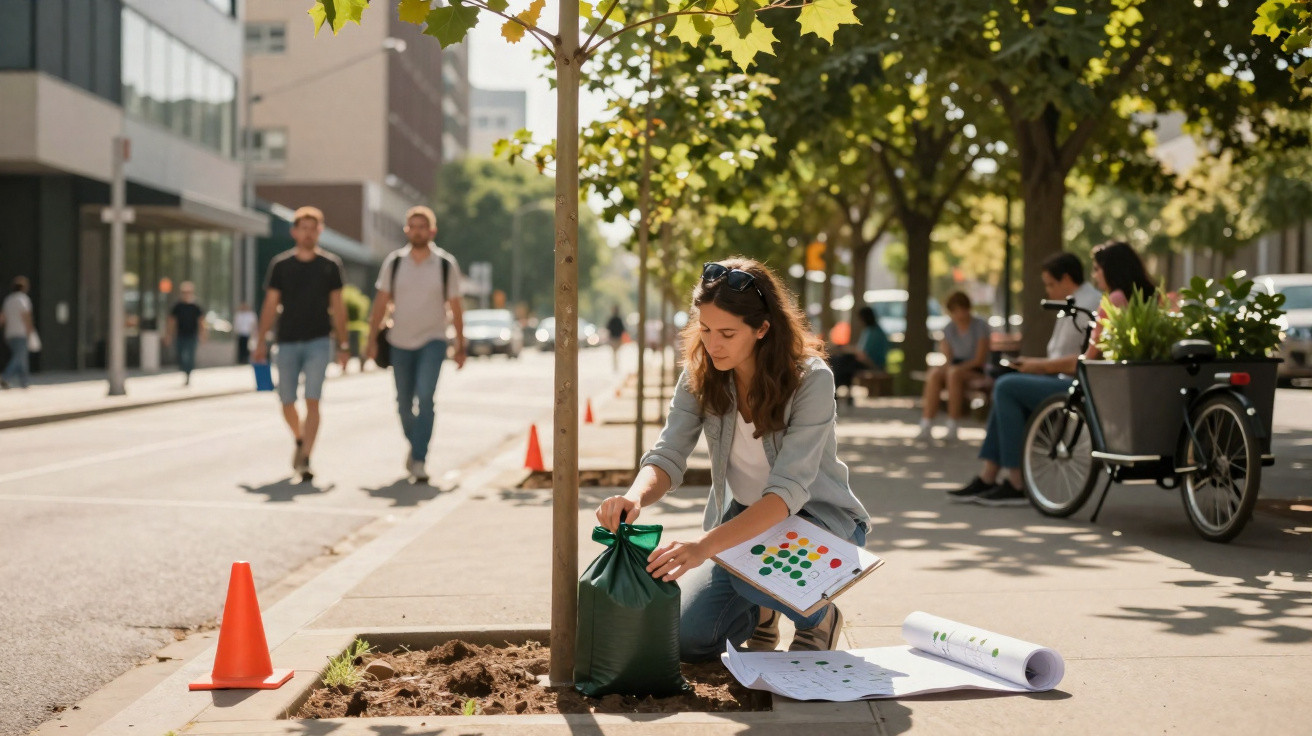
Stand beneath a sprawling, old tree on a blisteringly hot afternoon and you quickly grasp what many city planners are only beginning to recognise: shade is not an ornament. It performs a vital function.
Across a street or a whole block, trees lower temperatures, intercept stormwater before it pours into roads and drains, and filter pollution from the air people actually breathe.
A newly published study, produced by more than 60 scientists from dozens of countries, argues that most cities still struggle to treat trees as the infrastructure they so plainly represent.
The research group is led by Manuel Esperon-Rodriguez of Western Sydney University and Bangor University, with Mark G. Tjoelker of Western Sydney University listed as the senior author.
Trees need time to grow
Putting a sapling in the ground can take twenty minutes. Developing a genuine canopy - the kind that measurably cools a neighbourhood - takes decades.
That means when a mature tree is removed, the loss is not simply one tree. A city gives up thirty or forty years of accumulated shade, wildlife habitat and carbon storage, and there is no quick way to replace that.
Even so, trees repeatedly lose out. Developers remove them because it is quicker and cheaper, and the penalties for unlawful clearance are often too small to deter anyone.
Municipal spending frequently covers the ceremonial planting moment, but not the years of watering, pruning and pest control that determine whether the tree survives.
The researchers call for tougher enforcement, meaningful tax incentives for landowners who retain mature trees, and minimum canopy standards embedded in law rather than left to voluntary action.
They also propose that major infrastructure schemes - projects that typically level everything in their way - could be rethought to expand canopy cover instead of wiping it out.
Not every neighborhood gets the shade
In wealthier areas, in almost every location the researchers examined, streets tend to be noticeably greener than in poorer districts.
At the same time, lower-income neighbourhoods are often the ones facing the most severe heat and the worst air quality.
In short, trees frequently end up concentrated in the places where they are needed least.
Reducing that imbalance requires more than a citywide average that can conveniently mask the hottest, most exposed streets.
Greening neighborhoods without displacing residents
The authors recommend setting goals at the neighbourhood level, rather than relying on broad citywide targets.
They also argue that residents - including Indigenous communities - should help decide what is planted and where, instead of having greening decisions imposed from a planning office.
They add a caution: large-scale planting without a wider strategy can lead to green gentrification, lifting rents and pricing out the very people the trees were supposed to help.
In the researchers’ view, the only genuine solution is to link tree policy directly with housing policy, rather than leaving them as two separate silos that rarely coordinate.
Trees barely show up in climate policy
Considering how much trees contribute, it is striking how little they feature in the major climate and biodiversity agreements that direct funding and political momentum.
The authors want that changed, with urban forests explicitly included in national climate plans, biodiversity strategies and the commitments countries make under frameworks such as the Paris Agreement.
Funding is still the major obstacle. Estimates place the global annual cost of nature-based climate solutions - including urban forests - at well over US$500 billion.
Much of today’s financing pays for the ribbon-cutting moment of planting and then ends, while the decades of maintenance that decide whether trees live or die remain unfunded and, often, overlooked.
The study highlights newer approaches - such as green bonds, biodiversity credits and monitoring programmes like Tree Cities of the World - as ways to close that long-term funding gap, rather than treating trees as a one-off purchase.
Many cities fail to keep record of trees
One of the most unexpected points is not about politics, but about practical management. Many cities do not maintain reliable records of their own trees.
As a result, no one consistently tracks which newly planted saplings survive their first few summers, which species are under stress, or how unevenly canopy cover is distributed across the city.
Without that evidence, cities are effectively guessing whether their tree strategies work.
The scientists argue for more affordable and more precise tools - including satellite imagery and AI-supported monitoring - to address the data shortfall, particularly in less wealthy cities.
City trees should be diversified
The team also draws attention to a quieter vulnerability: repeating the same small set of species street after street. It may look orderly, but it leaves the whole system exposed.
A single pest or disease arriving at the wrong moment can remove a city’s canopy in one sweeping outbreak.
Instead, the researchers say, cities should broaden the mix of species they plant. Non-native trees can be part of that, where they are well suited to a warmer, drier future.
At the same time, they emphasise that native trees should remain a priority, with choices guided by each place’s ecological conditions and cultural context.
An urgent problem
Urban trees are not a luxury that can be funded only after the “real” priorities are met.
They already function as public-health measures, climate protection and a tool for neighbourhood fairness - whether or not budgets acknowledge them in those terms.
The authors frame this as immediate rather than distant. Cities continue to expand, and heatwaves continue to intensify.
As a result, the choices made now - about which trees remain standing and which neighbourhoods retain their shade - will quietly determine how liveable those cities feel for decades, long after today’s decision-makers have moved on.
Comments
No comments yet. Be the first to comment!
Leave a Comment