
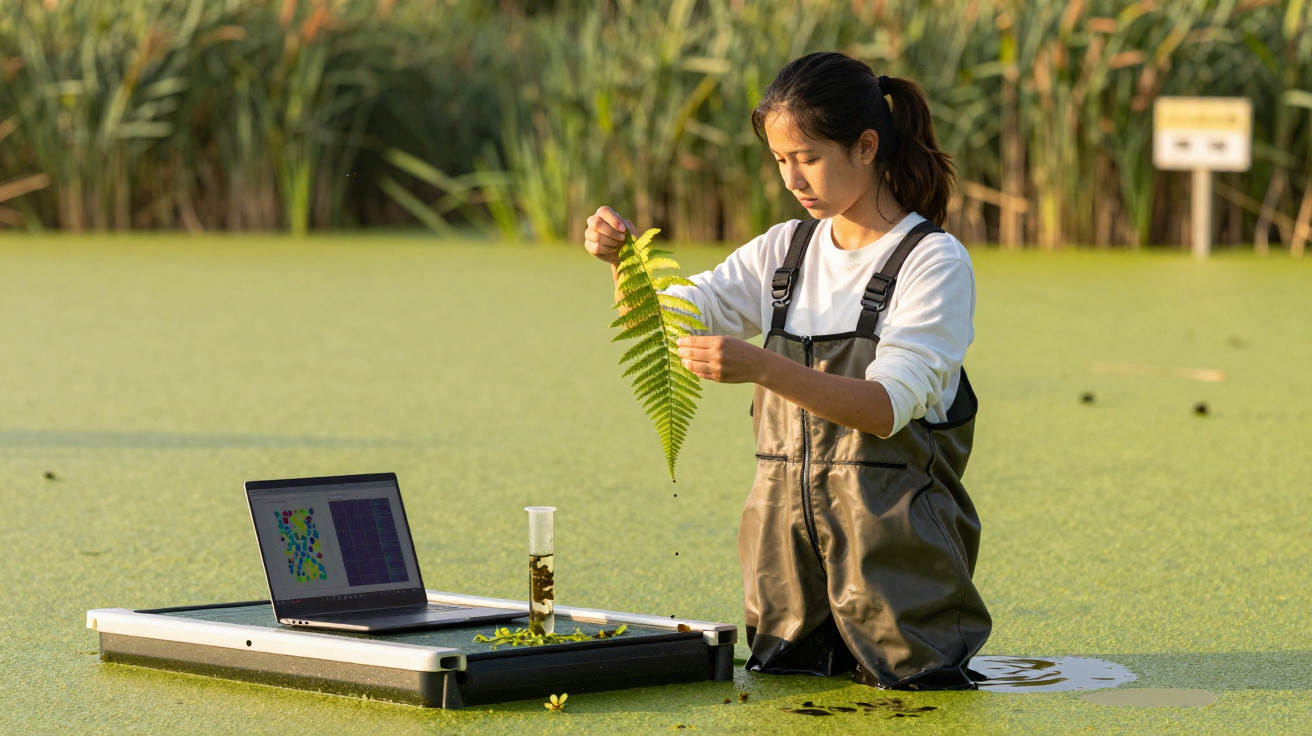
Some weeds are merely irritating. Salvinia molesta is closer to a full-scale takeover. This floating fern can double its biomass in only 36 hours. When left alone, it can cover ponds and slow-moving rivers with a dense green mat.
That mat shuts out sunlight from the water beneath. It also depletes oxygen, and the organisms below begin to struggle. The plant is now established in freshwater in more than 60 countries. It is listed among the world’s 100 most invasive species. The sheer pace of its spread suggested there was something unusual going on under the surface.
Salvinia molesta smothers lakes
For years, a basic question lingered: what makes Salvinia molesta so consistently effective at spreading?
Its speed alone has worn down water managers around the world. A pond can appear clear one week and be choked the next.
The path to an answer started with a long-standing mix-up. For a very long time, the plant had been described as the wrong thing.
Decades of mistaken identity
A research group led by Associate Professor Fay-Wei Li at the Boyce Thompson Institute (BTI) and Cornell University closely examined the plant’s genome. Erin Sigel of the University of New Hampshire worked with him.
For decades, S. molesta was labelled an allopentaploid. In other words, it was thought to be a hybrid carrying five sets of chromosomes originating from multiple parent species.
The genome revealed something else entirely. The plant is actually a diploid hybrid, with only two sets of chromosomes. Each set comes from a different parent species - and both of those parents are still unknown to science.
Finding those parents is now an open search. Somewhere, two “ghost” ferns left their genetic signature on this invader.
“The misidentification of S. molesta has stood for decades,” Li said. “Getting it right matters, not just for evolutionary biology, but for understanding how this plant became so successful as an invader.”
Cannot reproduce sexually
At the centre of the story is the fact that the two chromosome sets inside the plant do not match.
“They carry different numbers of chromosomes and several major structural differences,” explained Yanã Rizzieri, first author of the study and a postgraduate student in Li’s lab.
“When the plant tries to undergo meiosis, those differences prevent proper chromosome pairing. No viable spores form. The plant cannot reproduce sexually.”
That means the standard route is cut off: no spores, no seeds, and no sexual offspring.
Cloning its way everywhere
What the plant can do, however, is grow rapidly and break apart. Small fragments can detach from the parent plant and develop into entirely new plants.
Each of those new plants is a genetic duplicate. If a single fragment reaches a new pond, it can trigger a full invasion.
Every plant that follows is a clone of the original. It is an unusual way to take over waterways - and an alarmingly efficient one.
Almost no genetic difference
To test this explanation, the team sequenced 100 individual plants. The samples were taken from five populations across the south-eastern United States.
They found genetic diversity had almost vanished. Within each population, plants were nearly indistinguishable.
Most differences between individuals appeared in just one plant. That pattern is characteristic of a clonal population spreading outward from a single founding plant.
New variation only appeared through occasional copying errors accumulating over time. There was no sexual reproduction to reshuffle the genetic deck.
Salvinia molesta offers hope
This clonal lifestyle also comes with a practical advantage: the invasive population largely shares one genetic blueprint.
So, if a treatment consistently suppresses the plant in one location, it should perform similarly elsewhere. If it works in Louisiana, the same strategy should carry over.
For anyone dealing with an invasive species, that is unusually heartening. In a real sense, the opponent is effectively the same plant everywhere.
A control method validated in one waterway ought to translate to another. Managers can trial once and deploy broadly, rather than relying on guesswork from site to site.
Fern genomes surprise
The researchers also analysed a close relative, S. cucullata, for comparison. This small aquatic fern has the smallest genome of any known fern - only 250 million base pairs.
The comparison was intentional. Placing the invader alongside its most streamlined cousin offered a clear contrast for tracking how fern genomes change.
They combined long-read sequencing with Hi-C chromatin mapping. Together, these approaches allowed chromosome-level assemblies to be built for both ferns.
The findings then defied expectations. Neither fern fit the standard textbook picture.
Genome size shifts
S. cucullata has a genome about 14 times smaller than ours. Yet it contains 68 chromosomes, close to four times more than researchers had estimated.
S. molesta shows the opposite pattern. Its genome is ten times larger than S. cucullata’s, but it has only 46 chromosomes.
Those 46 chromosomes fall into two distinct subgenomes. The two lineages diverged from one another roughly 25 million years ago.
What it means for ferns
“Our findings show that the evolution of Salvinia genomes is very dynamic, more like that in flowering plants than in most ferns that have large genomes,” said Sigel.
In most ferns with large genomes, change tends to be extremely slow. Salvinia, by contrast, appears to follow more active rules.
Here, genome size and chromosome number became disconnected. A larger genome did not translate into more chromosomes - overturning a common assumption.
The results challenge a long-standing model of fern genome evolution. They also position Salvinia as a powerful system for exploring how reproduction influences genome structure.
And they link the plant’s biology directly to its threat: the same faulty pairing that prevents sexual reproduction helped create an invader built to copy itself and spread relentlessly.




Comments
No comments yet. Be the first to comment!
Leave a Comment