
Sarah looked out at the strip of earth behind her new home and felt beaten before she’d even lifted a finger. Dandelions and crabgrass covered every last bit of it, with roots that seemed as stubborn as her monthly mortgage. After weeks without rain the ground had set hard, almost like cement, and she could already imagine her back complaining at the very idea of turning it over. From the other side of the fence, her neighbour laughed and talked about “years of soil prep” and “the right tilling equipment”. Sarah, though, had come across another approach-one that promised a dramatic change without the ache. Was it really possible to turn this disaster into a vegetable garden in a single afternoon?
Why Traditional Digging Makes Everything Worse
When soil is compacted and full of weeds, many gardeners treat it like a fight they have to win. They hire a rotavator, pick up new spades, and spend whole weekends trying to “sort out” the ground. The twist is that all this effort often backfires, because intense digging wrecks the fragile soil structure that has taken years to form.
Last spring my neighbour Mike spent three separate weekends double-digging his veg patch, yanking out every weed by hand. By July, the weeds were back with a vengeance, and the soil had tightened up again into something closer to pottery clay. At the same time, the no-dig bed I put in over that very same weekend was already giving me tomatoes that made his look genuinely second-rate.
The key is to cooperate with nature rather than wrestle it. Digging is basically pressing reset on the entire world beneath your feet. Helpful fungi lose their underground webs, earthworms retreat to somewhere less disturbed, and dormant weed seeds get mixed up and brought to the surface-like a plant lottery you never wanted to enter.
The Afternoon Transformation Method
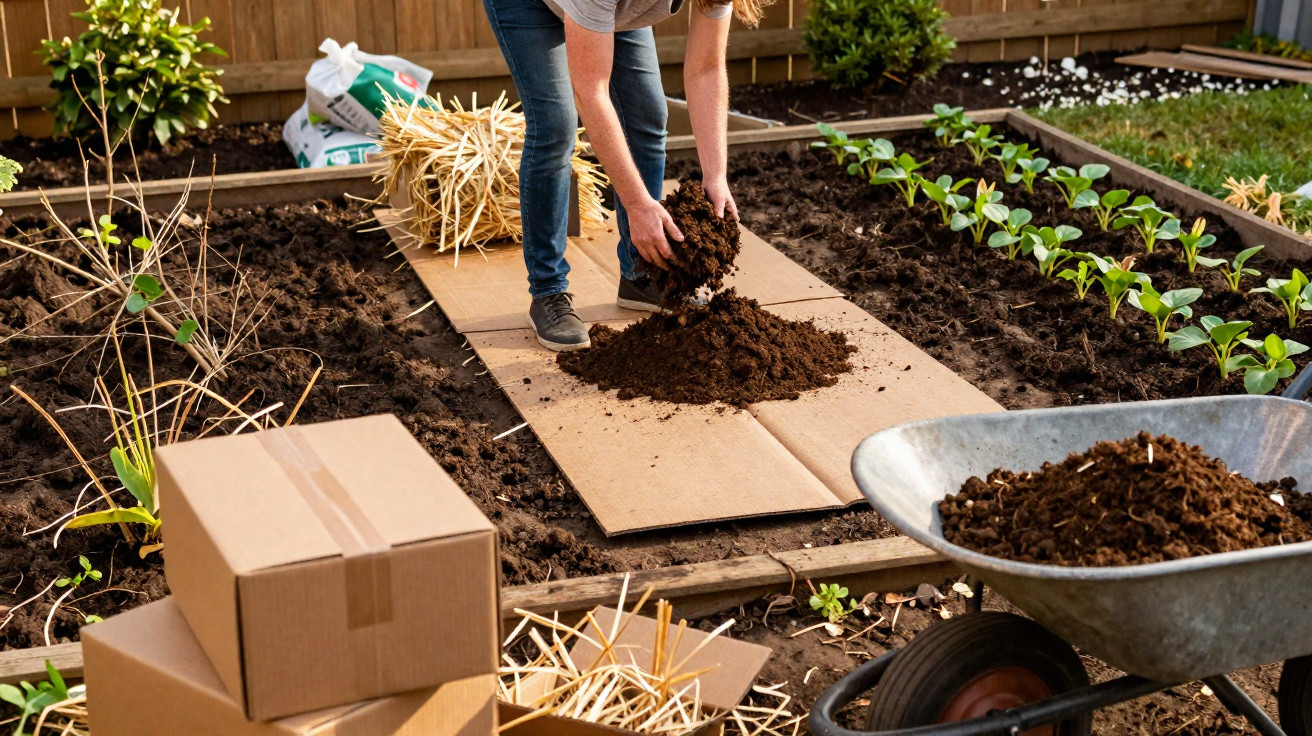
What works instead is straightforward: build layers of organic matter right on top of the problem area. Begin with cardboard to block light and smother what’s already growing, then heap on compost, well-rotted manure, and a mulch layer. The cardboard functions as a biodegradable weed barrier, while the layers above create an ideal environment for planting.
If we’re honest, most of us have attempted “shortcuts” that just turned into different kinds of hard work. The appeal of no-dig gardening is that the low-effort option really does deliver better results. Rather than battling weeds one by one, you overwhelm them with so much good material that they simply can’t compete.
“I was skeptical until I saw my first no-dig bed produce twice the yield of my traditional plots. The soil practically takes care of itself now.” – Master Gardener Janet Chen
Your afternoon shopping list:
- Large cardboard sheets (appliance shops will often give these away)
- About 1.5–2.3 m³ of good-quality compost
- Well-rotted manure or worm castings
- Straw or leaf mould for the top layer
- A hosepipe to soak everything thoroughly
Beyond the Initial Setup
The most impressive part unfolds in the months after you’ve finished layering. Below the surface, armies of microorganisms get to work breaking down the materials, and earthworms arrive as if you’ve offered them the best plot in town. Within a few weeks you’ll start to notice the shift-the soil turns springy and dark, and it happens without you needing to put a spade in the ground.
| Key point | Detail | Value for the reader |
|---|---|---|
| No digging required | Layer materials directly on compacted soil | Saves time and prevents back strain |
| Instant weed suppression | Cardboard blocks existing weeds permanently | Eliminates hours of weeding labour |
| Self-improving system | Soil gets better each year without intervention | Long-term productivity with minimal effort |
FAQ:
- Will the cardboard harm my soil? Not at all – it breaks down completely within 6-12 months, adding carbon to your soil while suppressing weeds.
- How thick should my layers be? Aim for 10–15 cm of compost and 5–8 cm of mulch on top. Think lasagne, not pancake.
- Can I plant immediately after building the bed? Yes! For seedlings, just push aside the mulch and plant directly into the compost layer.
- What if my cardboard has tape or staples? Remove any plastic tape, but small amounts of paper tape and staples won’t hurt anything.
- How long before I see real results? You can plant the same day, but the soil structure really improves after one full growing season.
Comments
No comments yet. Be the first to comment!
Leave a Comment