
The first dandelion appears as a tiny yellow provocation among your tulips.
You crouch, ease it out, and drop it into the bucket. Forty-eight hours later, more have turned up. With damp soil on your knees and aching fingers, it hits you that the border you pictured as a soft, colourful haze has become a long campaign: you versus weeds, week after week.
Sooner or later, nearly every gardener mutters the same thing: There has to be an easier way than this.
That’s often when someone, in an almost conspiratorial voice, brings up “ground covers” as though they’re a hidden advantage. Plants that do the weed-suppressing on your behalf, quietly, every day. It can sound too good to be true.
And yet, in a well-planted flower bed, it genuinely does work.
How ground covers quietly outcompete weeds
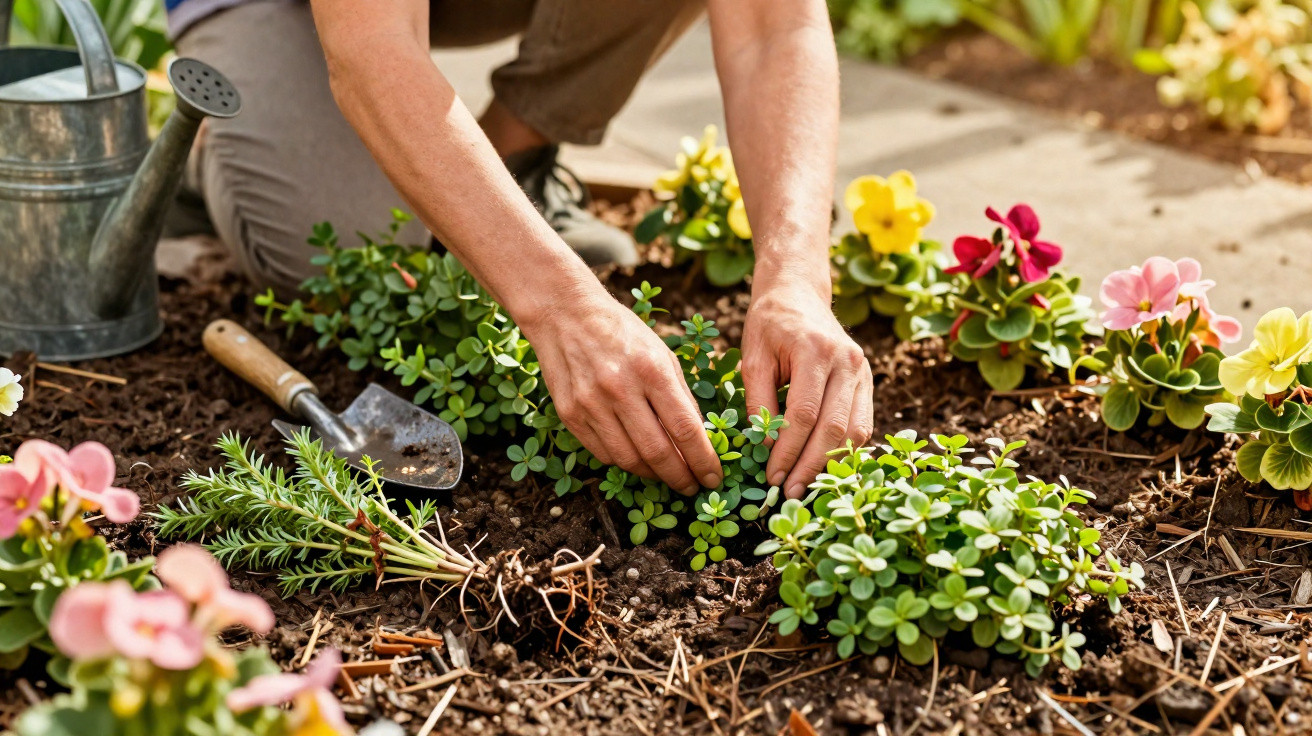
You usually spot it first from ground level. In one part of the bed, exposed soil stares back, dotted with pinprick weed seedlings. Elsewhere, a dense, low mat of leaves lies over the surface like a green blanket. Near the bare patch, your hand automatically goes for the trowel. By the leafy carpet, there’s almost nothing worth pulling.
That difference explains everything. Weeds thrive on vacant space: sunlight reaching open soil, moisture disappearing quickly, and seeds landing with no rivals. Ground covers reverse those conditions. They fill the gaps, cut off light at the soil surface, and take up moisture before opportunistic weeds can. They don’t make a fuss. They simply, steadily, come out on top.
Once you understand that pattern, it becomes impossible to ignore.
A gardener I met in Sussex walked me through her own “before and after” border. Four years back it was classic cottage-style exuberance: roses, delphiniums, and constant hoeing. She told me she spent “at least an hour a week” tugging chickweed and bittercress out of every gap. Then she underplanted the whole thing with hardy geraniums and a mix of creeping thyme-same perennials, same arrangement.
Now the soil is barely visible. Fine geranium foliage has knitted itself beneath the roses, while thyme tumbles between the stepping stones. We paced the entire border and counted perhaps three weeds. She removed them with two fingers, almost absent-mindedly. By her estimate, her weeding time fell by roughly 80%-not because weeds stopped arriving, but because they no longer had anywhere to take hold.
There’s also a small giveaway: after rainfall, the bed stays damp for longer. That’s the ground cover doing its job as well.
Looked at practically, ground covers suppress weeds in three main ways. First, they cast shade at soil level. Many weed seeds require light to germinate, and a tight canopy of leaves simply withholds it. Second, their roots create a web that captures water and nutrients before weeds can establish. Some weeds may still sprout, but they tend to be thin, weak, and quick to remove.
Third, the leaf layer softens the force of rain and watering cans. Bare soil gets battered, which can disturb and expose buried seeds. When the surface is protected by living foliage, the ground stays more crumbly, sheltered, and cooler. That lower temperature matters because many weed seeds germinate faster in warm, exposed conditions. Cover and complexity slow them down.
When gardeners refer to “closing the canopy”, this is exactly what they’re describing.
Choosing and planting the right living mulch
The real shift happens when you treat ground covers as living mulch-rather than scattering a few plants and hoping for the best. Begin by reading your bed properly: is it sunny or shaded, dry or consistently moist, heavy clay or sandy and free-draining? Then choose one or two ground covers that truly thrive in those conditions. Not merely tolerate them-love them.
In full sun, low-growing sedum, creeping thyme, or woolly yarrow can make tight, drought-tolerant mats beneath taller perennials. In partial shade, hardy geraniums, lamium, or Alchemilla mollis often do well. For deep shade beneath shrubs, sweet woodruff can work, or pachysandra where it isn’t invasive. Set plants closer than the label recommends, so their foliage meets within a year or two.
You aren’t ornamenting bare soil-you’re taking bare soil out of the system altogether.
On a small London terrace, a neighbour used exactly that approach to turn a narrow, weedy strip into something she didn’t need to hoe. She adored roses and hated the weeding. After a year battling couch grass and self-sown seedlings, she did one thorough dig, added compost, replanted her roses, and then installed ground covers in a deliberate grid: a row of hardy geranium ‘Rozanne’ at the base of the rose stems, then Nepeta ‘Walker’s Low’, with a narrow thread of creeping thyme along the front edge.
The first summer still meant some hand-weeding while everything settled in. By the second summer, the balance had changed. The geraniums had joined into one continuous sheet, the nepeta had filled out, and the thyme was spilling over the bricks. As she put it, “I still weed, but now it’s like tidying crumbs, not scrubbing the whole kitchen.” Her roses looked healthier too, because the soil wasn’t drying out as quickly.
Ground covers didn’t transform her garden into a “low maintenance” fantasy. They simply altered who had the advantage.
The reasoning is almost too straightforward, which is precisely why it’s effective. Exposed soil is an open invitation; covered soil is a closed door. When you fill the horizontal layer of a bed with low growers, you reduce the light reaching the ground and remove the landing spots for seeds. The result is fewer weed seedlings-and any that appear are forced to compete with established roots and shade from day one.
You also create a steadier microclimate. Ground covers moderate temperature swings, which supports the root systems of your main plants. Moisture lasts longer, so you water less and stress the bed less. Soil microbes and worms benefit from the consistency too, gradually improving structure. That resilience strengthens your chosen planting and undermines short-lived weed invaders.
Put simply, you make it easier for your plants to succeed and harder for anything else to get started.
Tips, mistakes, and the art of letting plants do the work
If you want ground covers to suppress weeds properly, approach it as a decisive move, not a token gesture. Start with one firm question: “Where do I never want to see bare soil again?” That may be the front of a border, the base of shrubs, or the space under roses. From there, design a pattern on purpose.
Plant in drifts or blocks rather than single, isolated specimens. Aim for three to five of the same plant, close enough that you can picture the leaves meeting by the end of the season. Water well during establishment and, if you can, slip a thin layer of organic mulch between plants in their first year. You’re giving them an early advantage over weeds. Once the foliage thickens, the plants become their own mulch-a living layer that shifts, flowers, and occasionally surprises you.
In practical terms, that’s the moment the “work” moves from your hands to the plants.
There are predictable pitfalls, and most people trip over at least one. You choose an ultra-vigorous spreader because it sounds perfect for weed suppression, then spend the next five years trying to stop it swallowing the path. Or you pick something purely for looks, only to find it dislikes your soil and sulks instead of spreading. Or you plant too thinly to save money, leaving precisely enough space for every opportunistic seed nearby.
There’s also a more personal trap: perfectionism. It’s easy to imagine that weed-free means “nothing unwanted ever shows up”. Real borders don’t behave that way. A few seedlings will always appear, particularly while the ground cover is still establishing. The difference is that they’re softer, quicker, and easier to pull. Let’s be honest: nobody truly spends every day on hands and knees among their perennials. Ground covers fit the reality of how you actually garden, not an imaginary life of constant vigilance.
That’s why they feel like relief rather than a gimmick.
“The day I stopped fighting for pristine bare soil and started planting over it,” a landscape designer told me, “was the day my gardens began to look better and demand less from me. The weeds didn’t disappear, but they lost their confidence.”
Treat ground covers as quiet partners, not mere filler. Pick varieties that behave well with the rest of your planting-ones that won’t smother delicate bulbs or climb into taller stems. Check their eventual height, how they spread (runners, seed, or clumps), and how they perform in your local climate. A plant that behaves politely in one area can be a bully in another, so advice close to home is worth more than glossy catalogues.
If you like having something simple to refer to when planning on a rainy evening, pin up a short checklist:
- Choose ground cover for your light and soil, not only for appearance.
- Plant densely enough that foliage meets within a season or two.
- Stick to one or two main ground-cover species per bed to avoid chaos.
- Weed thoroughly once before planting, then lightly as plants knit together.
- Keep a close eye in year one and remove any bullies early.
Living carpets, quieter beds, and a different kind of gardening
Once you’ve watched a border shift from patchy soil to a textured green carpet, it subtly changes how you experience your garden. Weeding stops feeling like an ongoing crisis and becomes occasional upkeep-more like rinsing a mug than scouring a burnt pan. The bed seems calmer, and so do you, standing there with a cup of tea rather than a bucket of tangled roots.
On a warm evening you may notice that soil beneath good cover feels cooler to the touch, as if it’s breathing a different air. That comfort helps the plants too: fewer stress spikes, fewer sudden wilts, and less bare earth baking hard and cracking after a dry week. Ground covers won’t solve everything, but they raise the baseline. Soil, plants, insects-and yes, you-get an easier ride.
Most of us have had the moment of looking at a bed and thinking, “This is more work than joy.” Ground covers nudge the balance back towards joy. They encourage layered thinking: shrubs and tall flowers for height, mid-level perennials for colour, and a living base layer that holds the whole scene together. Weeds will still try their luck, as they always have. But when the ground is already claimed by plants you chose, their odds fall sharply.
Perhaps the most interesting change isn’t simply fewer weeds. It’s noticing how much the garden shifts when you stop chasing emptiness and start choosing cover. That’s the sort of revelation people swap over the fence, or send in late-night messages that begin, “You know what finally worked for me…?”
| Key point | Detail | What it means for you |
|---|---|---|
| Ground covers block light at soil level | Dense foliage shades the ground, reducing weed seed germination | Fewer new weeds appearing between your flowers |
| Living mulch holds moisture and cools the soil | Leaf cover slows evaporation and stabilises temperature | Less watering, happier plants, and softer, healthier soil |
| Right plant, right place, right spacing | Choosing species that suit your conditions and planting close together | Ground covers knit in faster and genuinely outcompete weeds |
FAQ:
- Do ground covers completely eliminate weeds? Not entirely. They dramatically cut weed numbers and leave the remaining ones weaker and easier to remove, but you’ll still do occasional light weeding, especially in the first year.
- Will ground covers compete with my flowers for nutrients? They share water and nutrients, but in a healthy bed with decent soil or added compost, that competition is usually outweighed by cooler soil, better structure, and less weed pressure.
- How long do ground covers take to suppress weeds? Plan for a one- to two-season transition. Year one is establishment plus some weeding; by year two, as plants knit together, the weed burden typically drops steeply.
- Are all ground covers safe to use in small gardens? No. Some are so vigorous they can be invasive in certain areas. Always check local guidance and choose varieties known to be well-behaved where you live.
- Can I combine mulch and ground covers? Yes, and it can be very effective. A thin layer of organic mulch between young ground-cover plants in the first year gives them an advantage; later, their own foliage becomes the main mulch.




Comments
No comments yet. Be the first to comment!
Leave a Comment