
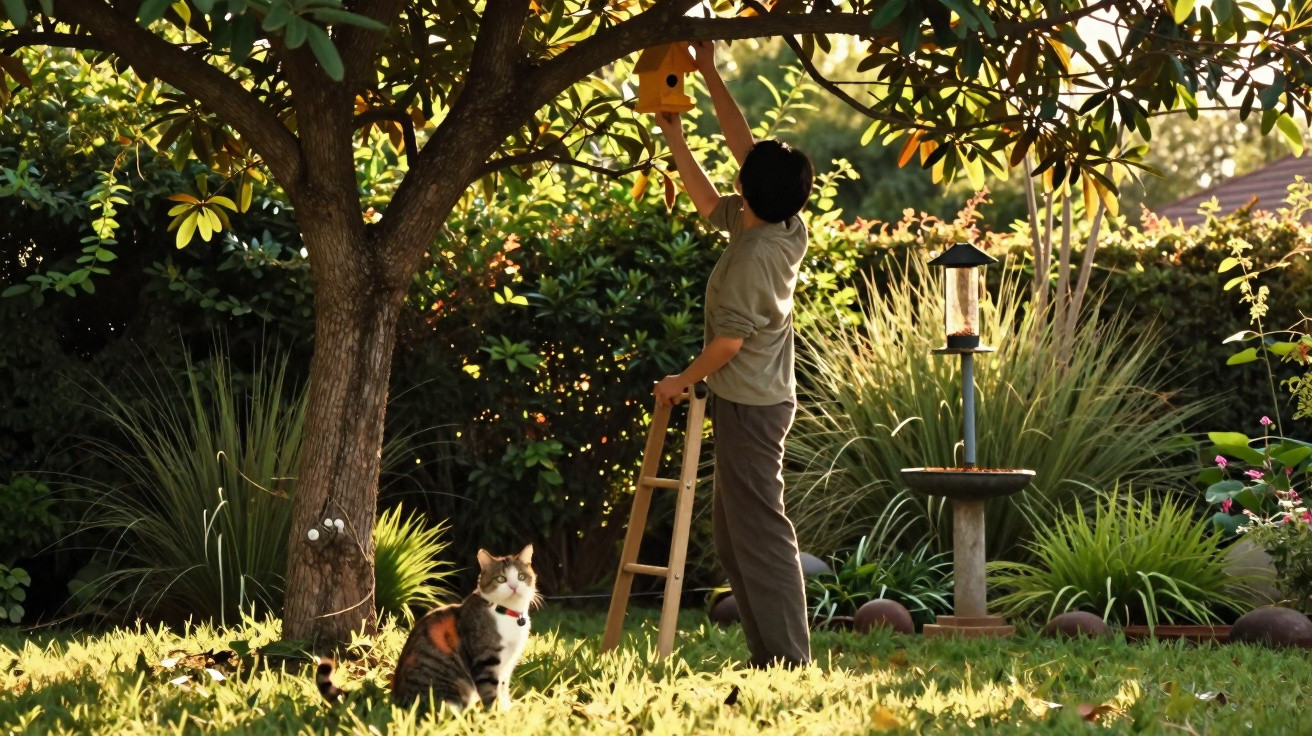
When fledglings are cheeping in the shrubs and your own cat pads out with its tail held high, hunting for prey, two passions collide. Many owners don’t want to stop outdoor access, but they also don’t want a massacre among blackbirds, tits and robins. With thoughtfully planned garden design, you can cut your cat’s hunting success dramatically without making it miserable.
Why your garden becomes so attractive to cats
Domestic cats may look relaxed, but their hunting drive is still there even when the food bowl is full. Some barely bother with birds, while others patrol their territory almost every day. The most sensitive period is March to July, when many species nest on the ground or low down in hedges.
A garden that’s too “tidy” often works in the cat’s favour. If leaf litter, long grass and dead wood are removed without exception, birds lose hiding places, cover and nesting materials. The result is more exposed nests, and young birds that have neither shelter nor escape routes-ideal conditions for a skilled predator.
“The tidier the garden, the easier it is for the cat-and the harder it hits the birds.”
So if you cut everything back hard at the start of the season and insist every corner looks “neat”, you can quickly turn your plot into something like an open hunting ground where your four-legged hunter meets very little resistance.
The “3-2-1 refuge”: turning a hunting zone into a safe haven
A highly effective approach is a tiered protected area, described here as a “3-2-1 refuge”. The principle is simple: create zones of dense, layered planting that breaks the cat’s line of sight and gives birds genuine places to retreat.
How to build a safe refuge for songbirds
Think of the structure as a small green fortress:
- Level 1 – dense ground cover: tough ground-cover plants such as sedges, cushion perennials or hardy geraniums create a tangled, hard-to-access underlayer.
- Level 2 – prickly shrubs: hedging made from blackthorn, hawthorn, wild rose, barberry or hazel forms an unpleasant barrier for cat paws.
- Level 3 – low trees: smaller trees or multi-stem shrubs interrupt sight lines for cats while also providing safer perches for birds.
This refuge works best when one part of the garden is kept as undisturbed as possible from mid-March to the end of July. In practice that means: no pruning sessions, no constant trampling through, and no major redesigns.
“A protected strip in the garden can be the difference between a bird paradise and a hunting territory.”
Small steps that help birds immediately
Even modest changes can significantly improve fledglings’ chances:
- leave at least 1 square metre of leaf litter under hedges and shrubs,
- keep a stack of branches and wood in a quiet corner,
- before the first mow, leave a wide band of longer grass uncut,
- leave old, hollow perennial stems standing over winter,
- cover beds with a thick layer of organic mulch.
These features shelter insects, worms and spiders-important food for young birds. At the same time, they make it harder for a cat to launch fast, precise attacks.
The one garden idea that reconciles cats and birds
The key tactic cat owners repeatedly report is this: instead of banning the cat outright, they “hide” the most sensitive areas from their own pet. You achieve that through a mix of dense planting, carefully placed nesting aids and a kind of invisible boundary within the garden.
“The cat should be allowed to hunt in the garden-just not where fledglings are sitting.”
When you deliberately build up one tree or a section of hedge as a “high-security bird zone”, many people find there are noticeably fewer prey items brought to the door even in the first year. Plenty of owners begin with a single “key tree”, watch how things develop, and then expand step by step.
Putting up nesting boxes correctly
Nest boxes can be a game-changer-provided they’re genuinely cat-safe. A few basic rules:
- choose a height of around 3 metres,
- allow distance from horizontal branches or ledges the cat could jump from,
- face the entrance hole east or south-east to avoid harsh midday sun and heavy rain,
- skip decorative perches-they make access easier,
- keep about 15 to 20 centimetres between the entrance hole and the box floor so a paw can’t reach the chicks.
Many mistakes come from good intentions: feeding stations or boxes are put where the view is nicest-and where a cat can jump comfortably. A nest box on a low wall or in a low hedge is practically an invitation to a hunter.
“The worst solution: placing a feeding spot or nest box within a cat’s jumping range.”
Gentle brakes for keen hunters
No one has to scare their cat or keep it indoors all the time in order to protect birds. But you can lower hunting success by limiting access in the highest-risk times and places.
Times when your cat is better kept indoors
Fledglings are most vulnerable in two windows: early morning and at dusk. That’s when they’re active and often still inexperienced-while cats are particularly alert. If you keep your cat in during these hours, the risk of hunting drops markedly.
A rough guide for the breeding season from March to July:
| Time of day | Recommendation for outdoor access |
|---|---|
| Early morning | keep indoors where possible |
| Midday / early afternoon | relatively low risk; outdoor access more justifiable |
| Evening dusk | keep indoors where possible |
Tools that reduce hunting success
A handful of practical add-ons can also help:
- a brightly coloured collar with a wide fabric ruff that alerts birds to the cat,
- deterrent guards on tree trunks to make climbing harder,
- scents cats dislike such as coffee grounds or citrus peel in particularly sensitive spots,
- targeted planting of strongly scented species cats tend to avoid,
- neutering, which often reduces roaming and territorial behaviour.
What matters is not punishing your cat if it does turn up with prey. From the cat’s perspective it’s normal behaviour-what it needs is a setting that offers fewer chances to succeed.
What else a “bird-friendly” garden delivers
A garden that provides cover for birds pays you back in several ways. Where vegetation is denser and dead wood is left in place, more insects thrive-bringing natural pest control with them. Many amateur gardeners notice after a year or two that they need to spray less or pick off fewer pests by hand.
There’s another benefit too: when children can hear and see birds regularly, they’re more likely to become interested in nature. Putting up nest boxes together or creating a refuge helps them learn species-and often makes them more critical later of a cat’s hunting “successes”.
The issue can become legally relevant where very large numbers of cats are kept in a neighbourhood and protected species are affected. In nature reserves and near valuable habitats, even tighter management of outdoor access is worth considering. In such locations, owners can use large, secure outdoor runs or “catios”-enclosed areas that let a cat be outside without hunting in the middle of breeding habitat.
If you know your animals well, you can tailor the mix of measures: a slow, older cat may need only a few densely planted corners, while a young, fit hunter may need stronger limits. The more carefully owners observe where their cat walks and which routes it uses, the more precisely protective zones can be planned.






Comments
No comments yet. Be the first to comment!
Leave a Comment