
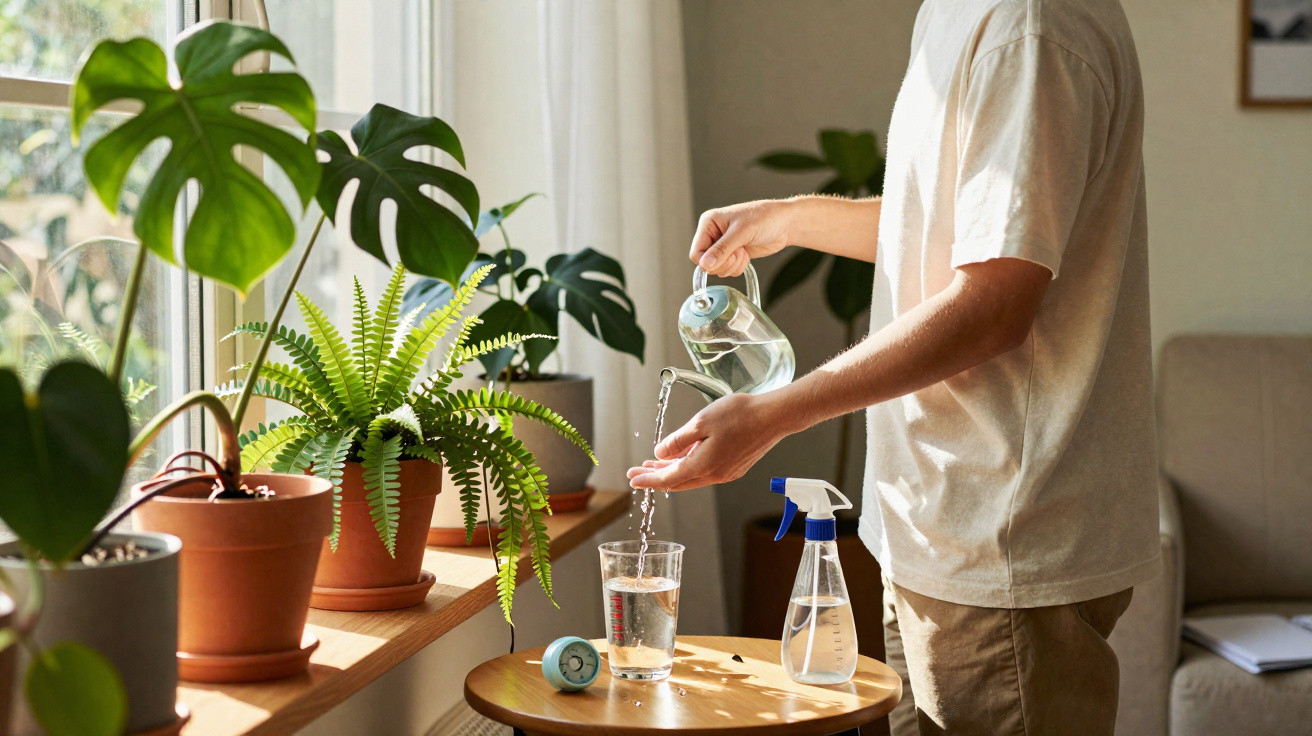
The evening ran on, the air in the living room felt dry, and the leaves of your monstera are hanging a little wearily from their stems. You wander into the kitchen, turn the tap on without thinking, wait two seconds until the water is “nicely cold”, and pour it straight into the pot. Done-plants watered, ticked off. Only when the leaf edges start turning brown a few days later do you briefly wonder whether you watered too much-or too little. And then you open Instagram again instead of thinking it through.
That autopilot is familiar. Tap water, straight from the tap, straight to the plants. It sounds practical, it sounds efficient. And it feels harmless-almost caring.
What if that exact reflex is one of the most common care mistakes with houseplants?
Cold water, warm mistake: what you’re doing to your plants
Houseplants sit in a fairly steady microclimate. Soil, roots, surrounding air-most of it hovers around your room temperature, roughly 20 degrees. When you then arrive with ice-cold tap water from the kitchen, the roots get a small temperature shock. Not a disaster like a wildfire-more like having an icy shower every morning while you’re still half asleep.
The plant slows down, briefly dials back its metabolism, and takes up nutrients more reluctantly. At first you often see nothing. But over weeks, the pattern acts like constant stop-start growth. Leaves stay smaller, new shoots look hesitant, and some species “punish” you with yellow patches that you might misread as a fertiliser problem.
A friend told me a classic story recently. His calathea-famous for being a little drama queen-suddenly started drooping. No change of position, no sun scorch, no pests. Just a new routine: he watered it as soon as he got home in the evening-straight with ice-cold tap water, because he thought “nice and fresh has to be good”. After a few weeks: brown edges, curled leaves, and the usual conclusion of “the plant doesn’t like me”.
Only when he began keeping water ready in a watering can at room temperature did things calm down. The damaged leaf tips didn’t become perfectly healthy again, but the new leaves arrived larger and smoother. That tiny shift-just changing the water temperature-was the game changer. No expensive specialist fertiliser, no complicated plant relocation, simply less cold shock.
Looked at plainly, the effect is logical. Roots are the most sensitive part of the plant. Cold water slightly constricts the fine root hairs, and uptake is briefly disrupted. When that’s combined with tap water that’s hard in many areas and contains lots of limescale, you get a sort of double load: thermal stress plus chemical irritation. You don’t feel it in your hand, but the plant “registers” it-and answers with slower growth, stress marks, or the classic phenomenon: it stays “fine” for ages, until it suddenly declines “for no reason”.
How to water properly: temperature, timing and small routines
The simplest change is to prepare your watering water before your plants are thirsty. Fill a watering can or glass bottle with tap water and leave it to stand for at least a few hours-overnight is better. That lets the temperature settle to the room, chlorine can dissipate, and you stop rushing from the tap to the pots with cold water. For sensitive plants such as alocasias, calatheas or orchids, it can feel like a gentle wellness upgrade.
If you like, touch the inside of the watering can: if it feels neutral-neither cold nor warm-you’re in a range most houseplants handle well. Some professionals even use a small aquarium thermometer and aim for the corridor between 18 and 24 degrees. Do you have to do that? Honestly, hardly anyone does it every day. But simply moving away from an icy stream helps more than many plant “hacks” on social media put together.
A lot of plant owners carry a nagging guilt: “I’m watering wrong, I forget them, I never do enough.” Often it’s closer to the opposite-watering happens too often, too unevenly, or in a stressed, rushed mode. Cold tap water then becomes part of that pattern: quick, incidental, without pausing to notice how the pot and soil actually feel. In winter especially, when the heating is blasting and the tap water feels extra cold, the effect is stronger. The plants are already in a rest phase, and then they get that frosty update from above.
A gentle trick: link watering to a calm moment. Sunday morning, music on, can filled, a slow walk through the flat. You’ll spot more easily where the soil is still damp, where leaves are drooping, and where a plant might be catching a draught. And you stop pouring cold water across every pot in one go just because the clock is pressuring you.
“Since I leave my watering water to stand for a day, my plants look like they’ve been on holiday,” wrote a reader who expanded her collection from three to twenty plants. “It’s such a tiny change, but the effect is huge. I never thought the temperature alone would make such a difference.”
A few practical points can help you make the new watering ritual stick in everyday life:
- Keep the watering can filled and ready-so you’re not tempted to use cold water straight from the tap.
- Leave water to stand overnight-especially for sensitive plants or in areas with hard tap water.
- Test with a finger: if the water feels “neutral”, you’re close to most houseplants’ comfort zone.
- Water less in winter, but more consciously-plants grow more slowly and react more strongly to cold shocks.
- For very sensitive species (calathea, anthurium, orchids), use filtered or stood water if needed.
More mindfulness, less stress: what this detail says about our day-to-day lives
How we handle water for our plants says a lot about how we live. Cold tap water straight from the tap is convenient-fast and always available. Much like many of our choices. One click, one swipe, one “I’ll just do it quickly”, and suddenly we’re standing with the wrong water at the right pot. The plant becomes a silent mirror of our pace, showing us-slowly and without drama-where we’re running on autopilot.
When you start preparing watering water, something else often shifts too. You enter your home differently. You suddenly notice which corner is too dark, which pot hasn’t produced a new shoot for months, and which plant is still sitting in its plastic inner pot. That small move-from the quick cold-water reflex to conscious watering-doesn’t only make your plants healthier. It makes your space feel more alive, and your routine a little softer.
And after a few weeks, you might find you actually look forward to picking up the watering can. That you pause for a second before you turn the tap on. That you stop treating your plants as décor and start seeing them as a quiet project that grows alongside you. Not perfect, not “Pinterest-ready”, but real. And strangely enough, the temperature of your watering water becomes a quiet promise: you don’t have to overhaul your entire life. Sometimes a few degrees warmer are enough to nudge things in a better direction.
| Key point | Detail | Value for the reader |
|---|---|---|
| Avoid temperature shock | Don’t pour ice-cold tap water straight from the tap onto warm roots | Less stress for the plant, steadier growth, fewer yellow and brown leaves |
| Prepare watering water | Leave water to stand for a few hours or overnight at room temperature | Simple routine with no extra cost, noticeably healthier leaf structure in many species |
| Choose mindful watering moments | Pick calm times, observe plants briefly, don’t water in passing | Reduces mistakes such as overwatering, cold shock and ongoing stress; more enjoyment in plant care |
FAQ:
- How warm should watering water be for houseplants? Ideal is roughly room-temperature water, between 18 and 24 degrees. It shouldn’t feel cold or warm-more “unremarkable”.
- Can cold tap water harm plants directly? One-off use won’t kill them immediately, but regular cold shocks stress the roots and can, over time, affect growth, leaves and root health.
- Is it enough to leave the water standing for a few minutes? For temperature, that achieves very little, especially in winter. A few hours is better; overnight is best, particularly for sensitive plants.
- Which plants react most sensitively to cold water? Mainly tropical plants such as calathea, alocasia, anthurium, orchids and many fern species. Young plants and cuttings are also more sensitive than hardy succulents.
- Do I need to buy expensive filtered water? In most homes, normal tap water that has stood and reached room temperature is enough. Filtered or rainwater is a bonus if your water is very hard or you keep extremely sensitive species.
Comments
No comments yet. Be the first to comment!
Leave a Comment