
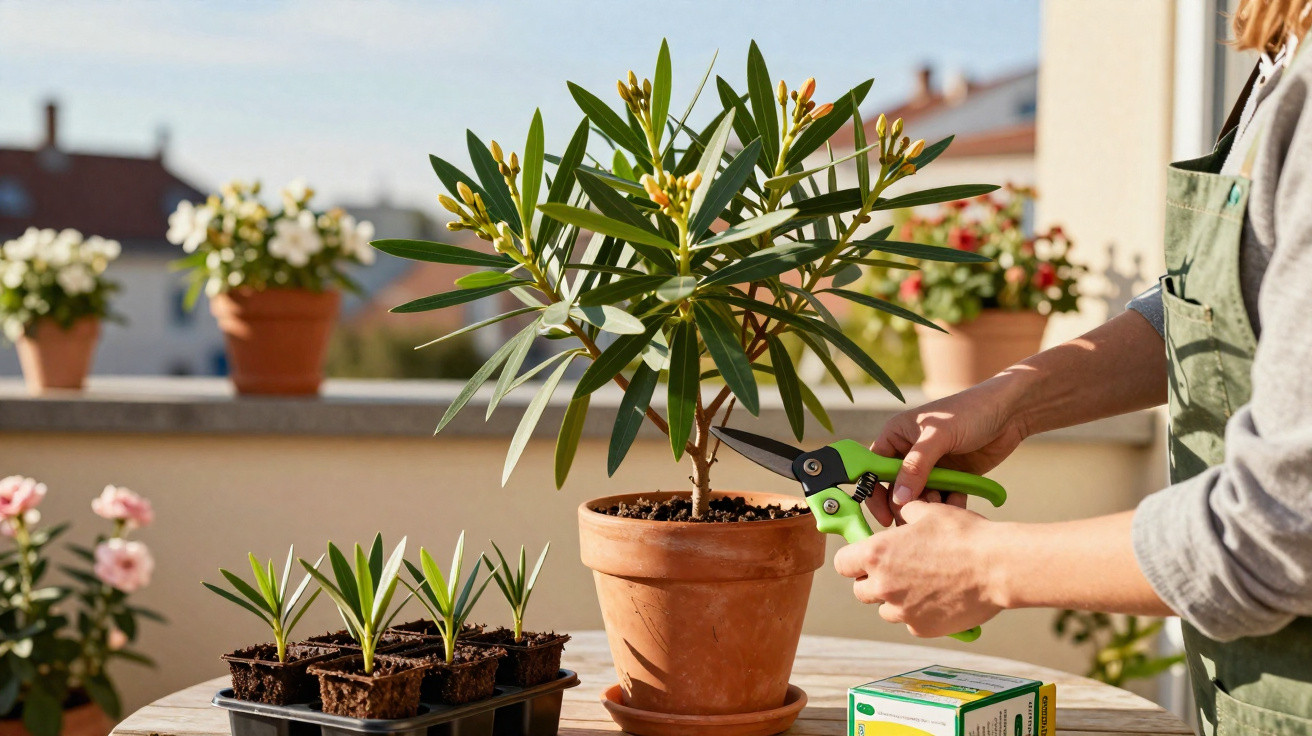
In April, oleander can look lush and green on a balcony or patio - yet there’s still no sign of flowers.
What many people unknowingly get wrong can wipe out the entire summer display.
The container has been cleaned, the compost looks fine, the shrub is growing strongly - and still, no buds appear. This exact situation frustrates amateur gardeners year after year. The reason for the missing flowers is often not a “classic” care mistake at all, but a missed date in the diary: one quick job that takes only minutes, yet decides whether you get months of blooms.
Oleander full of leaves, zero buds: the classic April problem
It’s a familiar sight: an oleander in a pot with glossy foliage, long shoots and a dense, dark mass of growth - but no flower buds anywhere. Many people water diligently, make sure it gets plenty of sun, and protect it from late frosts. Even so, the summer flowering ends up disappointing.
If you look closely, you can usually spot a few tell-tale warning signs:
- long shoots with very little branching
- a dark, tightly packed centre that lets little light through
- weak, soft growth at the tips
- lots of leaf growth, but no visible buds
At this point - usually in April - the plant effectively “chooses” whether to invest its energy in leaves or flowers. Oleander needs a clear signal, and it only gets that from a purposeful prune.
“If you don’t prune oleander in April, you unknowingly train it to be a foliage shrub - instead of the summer star of the balcony.”
The big brake in a pot: old shoots drain the energy
Oleander originates from the Mediterranean and flowers on fresh growth produced in the current year. In a container, that habit can easily work against you. The framework keeps stretching upwards, it doesn’t branch enough, and the plant gradually becomes woody and tired. A lot of its effort goes into old wood that has little appetite left for flowering.
This matters even more in a pot: root space is limited, so the plant’s total energy is limited too. If most of that energy is diverted into long, ageing structural stems, the shoot tips remain weak. The result is plenty of leaf mass - but few, or no, flower heads.
A second issue compounds the problem: hardly any light reaches the crowded interior. And where there’s no light and airflow, buds don’t form. The shrub stays green, but becomes reluctant to bloom.
Why pruning in April makes all the difference
As soon as nights reliably stay above around 10 °C, oleander is poised to start the new season. That’s the moment it belongs on your “spring check” list. If you act then, you actively steer it towards a better flower show.
A simple guideline is to shorten shoots by roughly one third. Doing so achieves several things at once:
- old, energy-hungry tips are removed
- the plant responds by producing lots of young side shoots
- these young shoots carry especially abundant flowers in summer
- the shrub becomes more compact, sturdier, and more open to light
“Oleander flowers on young wood. Every confident April cut is a direct invitation to the plant: ‘Set buds, not just leaves.’”
Step by step: how to prune oleander in spring
If you’re pruning for the first time, it can feel daunting. In practice, an April prune is straightforward and takes only a few simple actions. A repeatable routine helps:
- Prepare your tools: Use sharp secateurs and clean the blades with alcohol. This reduces the risk of fungal disease.
- Remove dead or damaged growth: Cut out dead stems, frost-damaged tips, and anything brown and brittle, right back to the base.
- Thin crossing branches: Where shoots rub against each other or block out the centre, remove one of them completely.
- Shorten long shoots: Cut the remaining main stems back by about one third, ideally a few millimetres above an outward-facing bud.
- Give a nutrient boost: After pruning, apply a fertiliser with an emphasis on potassium (look for the “K” in the NPK value on the label).
In the following weeks, the plant pushes fresh growth. Every new side shoot is a potential flower bearer for high summer.
If oleander still won’t flower after pruning: other causes
Sometimes the display remains thin despite cutting back. Then it’s worth checking a few other factors that are often overlooked.
Position and temperature
Oleander thrives in full sun. A partially shaded balcony rarely delivers a real burst of flowers. The best spot is a hot, fully sunny position with as much shelter from wind as possible. Cool, draughty corners - especially on north-facing balconies - slow growth down.
Feeding in a container
In pots, nutrients are used up quickly. If you only water, the shrub gradually runs short. A flowering fertiliser with higher potassium and a moderate nitrogen level supports bud formation without pushing the plant into pure leaf production.
Pot size and root space
If the container hasn’t been changed for years, the rootball can become compacted. Water and nutrients are then absorbed poorly. In that case, repot into a slightly larger container using fresh, free-draining compost for container plants, and add a drainage layer of expanded clay pellets or gravel.
Practical example: from problem plant to flowering star
A typical situation: an oleander sits on a sunny balcony for two summers, is watered regularly, overwinters frost-free - and yet flowers only sparsely. A closer look reveals an ageing shrub with plenty of old, hard stems and very little young wood.
After a decisive cutback of around one third, removal of dead shoots, and feeding with a fertiliser high in potassium, the picture changes noticeably. In the weeks that follow, many new, well-lit side shoots appear in the lower and middle sections - the foundation for far more flowers in the coming high summer.
“If you find the courage to use the secateurs, you’ll often be rewarded from July with far more flower trusses - even on older plants.”
Bonus tip: grow new oleander from the cuttings
The April prune comes with a useful extra: the trimmings are ideal for propagation. Young, semi-woody shoots root readily.
To produce new plants quickly:
- select shoot pieces about 15–20 cm long
- remove the lower leaves, leaving only the top third with foliage
- stand the cuttings in a large glass of water; a small piece of charcoal helps keep the water clearer for longer
- place somewhere bright and warm, but out of harsh midday sun
- once fine white roots appear, pot up into small pots with loose compost
With a little patience, one mother plant can produce several strong young plants, which can become keen-flowering container stars in the years ahead.
Risks, common mistakes, and how to avoid them
When pruning, avoid going too extreme. A complete hard cut down to a few stubs stresses oleander and can delay flowering by months. A moderate cutback in April is better, with a gentle tidy-up after the main flush if needed.
It’s also worth reading the fertiliser label. Products with very high nitrogen may produce deep green leaves, but they don’t automatically create buds. For container plants, fertilisers work well when potassium is at least as high as nitrogen.
If you have small children or pets, keep in mind that oleander is considered poisonous. Wear gloves when pruning and dispose of cuttings safely - don’t put them on an accessible compost heap.
Why an April check on your oleander pays off
A quick spring inspection, a clean cutback and a targeted feed are often enough to turn a “green bush” into a real summer magnet for eyes and insects. Repeating the routine each year keeps the shrub young, vigorous and willing to flower - even in a container on a compact city balcony.
That way, oleander becomes not just background greenery, but the main attraction on a patio or balcony, bringing colour from June well into autumn.

Comments
No comments yet. Be the first to comment!
Leave a Comment