
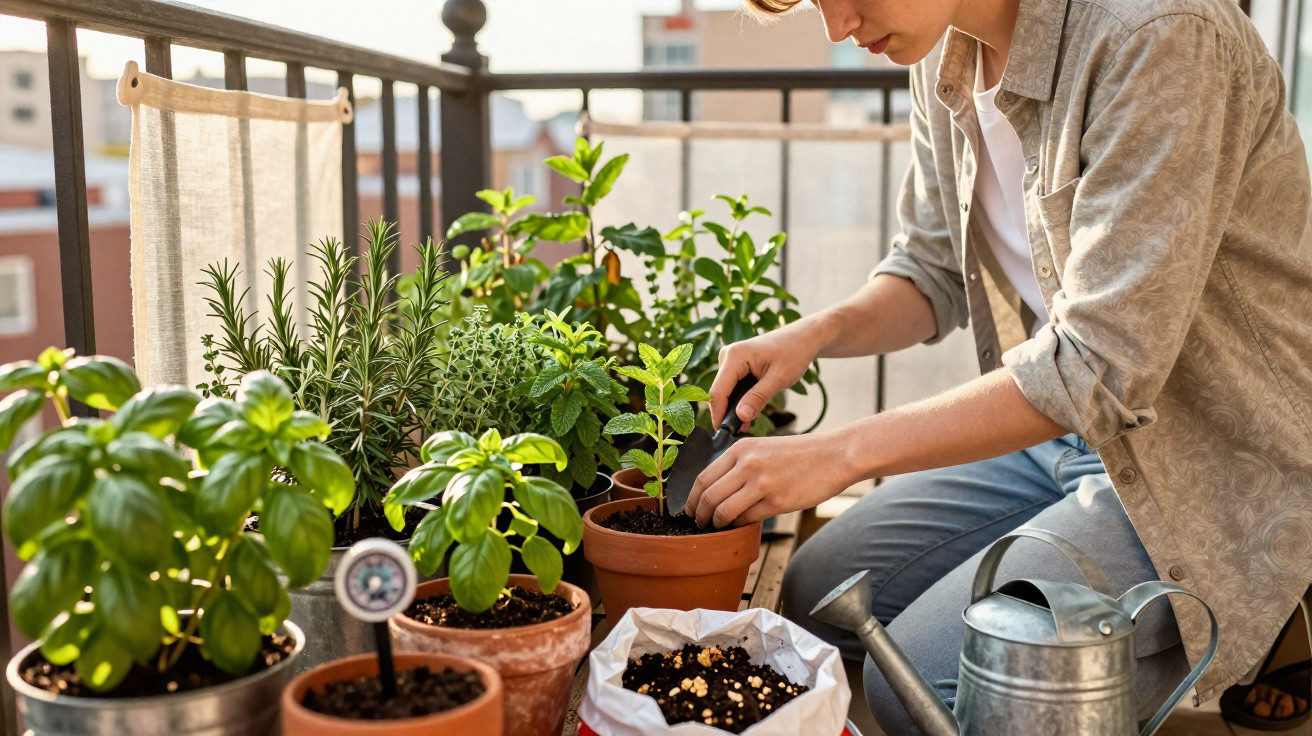
Basil is usually the first to give up. In the morning it still looks like it belongs in a cookbook photo; by evening it’s slumped over the rim of the pot as if someone has let the air out. Next to it, the thyme is hanging on, the tips crisp and dry, in soil that has turned either rock-hard or completely waterlogged. We water, shuffle the pots around, even talk to the plants - and still wonder why the neighbour’s herbs look like an Italian postcard while our balcony is stuck in survival mode. Eventually you catch yourself muttering, “Maybe it’s not me… maybe it’s the pot.”
And that’s the point: balcony herbs play by different rules. Almost nobody tells you that plainly.
Why potted herbs on the balcony so often struggle
If you’ve ever pushed your hand into a garden bed, you can feel the difference straight away. The soil is alive: springy, rich-smelling, warm. In a balcony pot, the growing medium is more like a restricted container - limited space, quickly leached, easily overwhelmed. Roots hit the sides fast, start circling, and never get the chance to search outward. At that point the plant is a bit like a person living in a cramped flat with poor windows: you can get by, but thriving is something else.
It’s a familiar balcony scene: May arrives, the first proper sunshine, and a weekend trip to the garden centre. You come home with basil, parsley, chives, rosemary - all in neat little plastic pots - tucked in the trolley next to the strawberries. At home they’re squeezed into one big bowl, packed tightly together. It looks brilliant on Instagram… for a few days. A fortnight later: basil with yellowing leaves, parsley flopping over, the soil dusty on top and soggy underneath. According to an internal survey from a major garden centre, most shop-bought herbs die within six weeks on a balcony. Not through negligence. It’s simply a system that was never designed for the long haul.
In a bed, herbs draw on what feels like endless backup: moisture spreads and redistributes, nutrients are available from deeper layers, and temperature spikes are softened. In a pot, everything is amplified. Sun can dry a small volume of compost within hours; heavy rain can wash channels through it; every watering flushes out nutrients. A pot is a mini ecosystem with a very delicate nervous system. Add heat trapped against walls, gusts of wind, and railings that reflect light - and it’s hardly surprising basil is the first to say, “That’s enough.”
What you can do so balcony herbs feel more like they’re growing in a bed
The most important change is also the least glamorous: choose larger, deeper containers. Skip purely decorative pots and go for proper volume. Aim for at least ten litres for a strong basil plant, and a larger tub still for rosemary or sage. Put a drainage layer at the bottom (expanded clay or coarse gravel), then fill with a blend of quality herb compost and ordinary garden soil, with a little sand mixed in for better drainage. The root zone gets more “horizon”. Suddenly growth doesn’t stop after five centimetres - roots can stretch out much more like they would in the ground.
Most people water herbs when they start feeling sorry for them - which is usually too late. Or they water every day out of duty - and drown the roots instead. Let’s be realistic: hardly anyone checks every pot with a finger each morning. A more workable approach is a simple routine and one quick test: push a finger two to three centimetres into the compost. If it’s dry at that depth, water thoroughly until it runs from the bottom. Then leave it alone again. No tiny sips, no constant damp. And after rainy days, empty the saucers - otherwise the roots end up sitting in a little swamp.
“Most herbs don’t die because people forget them - they die because people smother them with love,” an old market gardener once told me.
It sounds blunt, but it’s a helpful reality check. If you want balcony herbs to be genuinely resilient, focus on a few practical basics that have nothing to do with romantic notions of gardening:
- Mix up the positions: don’t put every herb into the same full sun spot. Mediterranean plants enjoy heat; parsley and mint do better in partial shade.
- Separate varieties: don’t plant thirsty herbs like basil with drier types like thyme in the same pot.
- Tidy regularly: pinch off flowers on basil and chives so the plant keeps putting energy into leaves.
- Feed lightly: use an organic fertiliser a few times per season, rather than constantly adding liquid feed to the watering can.
- Allow a bit of calm: not every brown tip is an emergency. Plants are allowed an off day.
The balcony as a small laboratory for thriving herbs
We rarely think of a balcony as “soil”. It’s treated more like a stage: furniture, fairy lights, a few containers. If you want herbs in pots to look as robust as they do in the ground, it helps to see the balcony as a little experimental garden lab. Where does the sun land, and when? Where does heat build up? Where does wind whip around the corner? Spend one day observing properly and you’ll notice: even a few square metres contain mini microclimates. The basil that collapses beside a hot wall may suddenly do brilliantly just two metres away, nearer the railing.
A lot of failed herb attempts come down to expectations that don’t match reality. We want supermarket basil to last for months, even though it’s bred and grown to peak at the point of sale - not two months later on a windy balcony. We put parsley in a south-facing blaze because “more sun must be better”. We promise ourselves we’ll plan it properly next year, and then May rolls around and we do the same spontaneous garden-centre weekend again. Spotting these quiet loops is often the real turning point.
Maybe the most honest shift is to treat herbs in pots less like decoration and more like small living things with limits. They respond when you give them room, when you stop cramming five varieties into one container, and when you treat mistakes not as personal failure but as part of learning. Once you do, it becomes genuinely satisfying to cut a handful of home-grown thyme that didn’t come from a heroic fight for survival - just from reasonably stable conditions. And you start telling other people about it, because a good harvest is always a small secret worth sharing.
| Key point | Detail | Benefit for the reader |
|---|---|---|
| Container size and soil volume | Large, deep pots with a drainage layer and structure-stable compost come closest to bed conditions | Better root growth, less stress, fewer losses in heat or heavy rain |
| Water and nutrient management | Finger test, thorough watering rather than constant damp, restrained feeding | Prevents root rot and deficiency symptoms, produces hardier plants |
| Positioning and variety choice | Match herbs to sun or shade, and separate thirsty herbs from dry-loving types | Longer-lasting herbs, bigger harvests, less frustration after failed attempts |
FAQ:
- Question 1 Why does my supermarket basil die so quickly? The plants are packed extremely tightly and grown for short-term performance. On a balcony, sun, wind and rapid swings in moisture stress them fast. Repot into a larger container, thin the clump, and keep it somewhere bright but sheltered - it will usually last much longer.
- Question 2 Which herbs are genuinely good for a balcony? Particularly robust are thyme, rosemary, sage, oregano, chives and mint. They cope well with pots when they have enough space and the right light. More sensitive are coriander and classic Genovese basil.
- Question 3 How can I tell if I’m watering too much? Common signs include compost that stays heavy and wet, yellowing leaves, and sometimes a stale smell. Water lingering in the saucer is another warning. In that case, pause watering and let the compost dry slightly.
- Question 4 Do I really need to feed herbs in pots? In containers, nutrients are washed out as you water. A modest dose of organic fertiliser one to three times per season is usually enough. Overfeeding makes plants soft and more vulnerable, especially basil.
- Question 5 Can balcony herbs survive the winter? Perennial herbs such as rosemary, thyme or sage can overwinter outdoors in frost-resistant, sufficiently large pots if they’re placed in a sheltered spot. Horticultural fleece or insulating the pot helps protect roots from freezing solid.
Comments
No comments yet. Be the first to comment!
Leave a Comment