
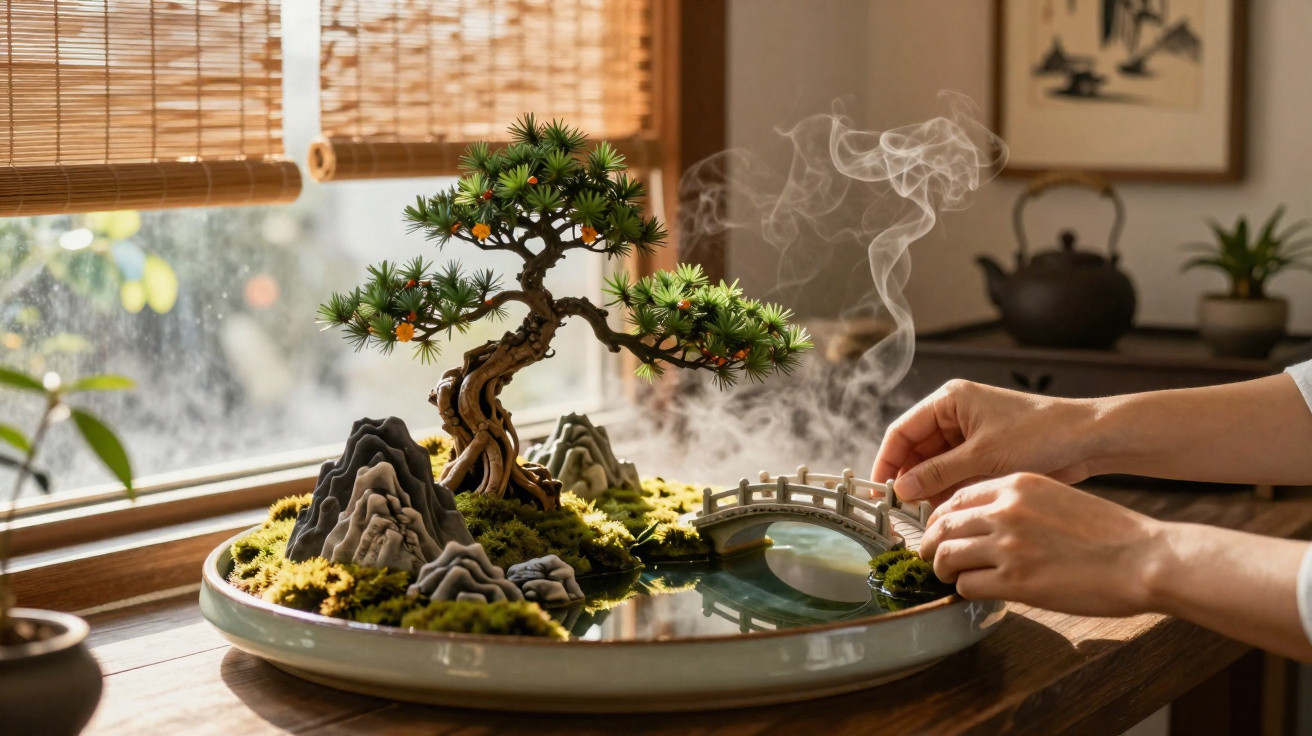
Penjing is a millennia-old art form that recreates entire landscapes in miniature. It’s widely seen as the root of many bonsai traditions, yet it remains clearly distinct. If you only picture tightly clipped bonsai trees, you miss the real enchantment: Penjing is about storytelling, building tiny worlds and stirring emotion-not merely displaying plants.
What Penjing really is – and why it’s more than ‘bonsai lite’
The word Penjing literally means “landscape in a pot”. In a single container, artists compose living scenes using trees, shrubs, rocks and water, often enriched with tiny houses or figures. Together, these elements form an image that can echo real mountain ranges, river valleys or even fairytale settings.
“At its core, Penjing tries to make the laws of nature visible within a tiny fragment – like a living painting.”
Compared with many bonsai arrangements, Penjing often feels wilder and less constrained-sometimes almost dreamlike. Where bonsai commonly centres on one tree shaped with strict discipline, Penjing thinks in complete tableaux. A horse on a path, a hut on a steep slope, a bridge over a stream: these kinds of details appear again and again.
Many pieces are intentionally imperfect: a leaning trunk, a boulder that looks oversized, or a tree growing “against all the rules”. That deliberate roughness helps it read as genuine nature-something you can guide, but never fully control.
A brief look at the history: from Daoists to hobby gardeners
Penjing’s origins reach back to the 1st century AD, and possibly earlier. Daoist scholars wanted to capture the power of vast landscapes inside a small vessel. For anyone without access to distant mountains and temples, the solution was to create a personal, scaled-down version at home.
Old stories even speak of “magical” landscapes that a sage could shrink to the size of a bowl. Later, Buddhist monks carried the idea to Japan, where it gradually evolved-over centuries-into the bonsai tradition. In China, Penjing continued to develop in parallel, but with a clearly different character.
To this day, masters of the craft are regarded as highly respected artists. Many train for a decade or longer in botanical gardens or under traditional masters before producing major works of their own.
The most important Penjing styles at a glance
China’s vast size is reflected in the look of its miniature landscapes. Regional schools such as Lingnan, Taiwan, Shanghai and Yangzhou each bring their own emphasis. Specialists usually group most works into three broad categories.
Shumu: the “forest in a pot”
In Shumu Penjing, trees take centre stage. They grow in a bowl or shallow tray, often as a small group, sometimes as a single specimen perched on a rock. Artists shape them through pruning, wiring and years of careful, incremental training.
- Emphasis on trunk movement, canopy and branch structure
- The silhouettes strongly echo familiar bonsai styles
- Ground elements-soil, moss and small stones-support the tree form without overpowering it
If you already have bonsai experience, many of the techniques will feel familiar. Even so, the overall image matters just as much: the tree shouldn’t only look “pretty”; it should suggest a narrative-surviving storms, or the age and weight of an ancient woodland giant.
Shanshui: mountains and water as the main characters
Shanshui Penjing is less about miniature trees and more about miniature scenery. In a shallow tray, carefully chosen stones are arranged, often with water around them. Small plants root in cracks or along the “shoreline”.
“Shanshui recalls traditional Chinese landscape painting – only in three dimensions and alive.”
The choice of stone can determine the entire piece: shape, texture, colour and veining need to work together. A single rock may stand in for a whole mountain range, and a groove can become a dramatic ravine. Water surfaces catch the light and introduce a sense of movement.
Shuihan: when everything comes together
Shuihan Penjing merges the previous two approaches. Trees, rocks, water, figures and sometimes small buildings combine into a rich, often highly narrative scene. The result can resemble a diorama-except that it lives and continues to grow.
Common elements include:
- a rock with a sparsely growing tree
- a stream course or small pond
- miniature figures of people or animals
- structures such as pagodas, bridges or huts
These arrangements often feel like film sets paused in time. Standing in front of one, you naturally start inventing stories: Who lives in the hut? Where does the path go? Why is the lone traveller on the mountainside?
Penjing in transition: living art rather than rigid rules
Because Penjing is made from living material, it never stands still. Branches extend, moss spreads, water evaporates. For that reason, many artists don’t treat a piece as “finished”, but as an ongoing process they steward over years.
Over recent decades, the range of approaches has expanded dramatically. The Chinese Penjing artist Zhao Qingquan describes how contemporary makers experiment more boldly: unusual plant species, abstract compositions and scenes that verge on surreal. Yet the central idea remains unchanged-drawing big feelings from small elements.
How you can try Penjing at home
If you’re imagining years of formal training, you’re only partly right. A top-tier work certainly demands deep experience. For a first attempt, though, curiosity, patience and a few basics are enough.
The basics: container, light, climate
Start with a shallow container that has drainage holes. It should be wide enough to build a small scene, and deep enough to give roots space. Also pay attention to:
- a bright position, ideally without harsh midday sun
- steady, fairly mild temperatures (many Penjing work well in bright indoor spaces or on sheltered balconies)
- a substrate that holds moisture without becoming waterlogged
If you’re unsure what to plant, choose species that are well proven in bonsai: small Ficus varieties, Chinese elm, or certain conifers. Mosses and small groundcovers can complement them.
The concept: choose the scene before the plants
A practical tip: decide on the story first, then select the plants. Do you want to evoke mountains? A riverbank? A stark rocky outcrop with a solitary tree?
| Theme | Possible elements |
|---|---|
| Mountain landscape | tall rocks, small conifers, minimal moss, a single figure on a slope |
| River valley | broad water surface, a winding “bank path”, several small trees, a bridge |
| Village idyll | small houses, flat stones as a path, deciduous trees, animal figures such as cows or horses |
Once the scene is clear in your mind, you can search more purposefully-at a garden centre or online-for suitable plants, stones and miniatures. Many shops now have dedicated bonsai or miniature sections with appropriate varieties and accessories.
Patience instead of perfection
Beginners often try to do too much too soon: pruning too aggressively, cramming too many elements into one tray, or constantly rearranging. A better approach is to move slowly, observe how the plants respond, and make only targeted adjustments.
“Penjing rewards a mix of stubbornness and calm – if you keep correcting, you steal the miniature garden’s sense of quiet.”
A small but effective trick is to photograph your arrangement regularly. In images, tilts, gaps or visual restlessness tend to stand out sooner than they do in day-to-day viewing.
What makes Penjing so compelling – and what to watch out for
Many people stick with Penjing because the care becomes surprisingly meditative. You focus on tiny details, put aside your phone and daily stress for half an hour, and then watch a scene shift over months. For children, it can be an engaging way into plant knowledge and design.
The hobby isn’t risk-free, though: mistakes in care can cause problems quickly. Waterlogging can rot roots, too much direct sun can scorch leaves, and poorly chosen figures can look cheap and throw the whole scene off balance. If you start small and build up gradually, you usually spot these pitfalls early-and learn how to avoid them.
It also pairs well with other interests: model-making enthusiasts bring skill with miniature figures and buildings, keen aquarists apply their feel for water-and-stone layouts, and photography fans stage a Penjing landscape as an ongoing subject project.
In the end, the art form thrives on each pot remaining a personal statement. Some people recreate a place from childhood; others build fantasy landscapes or revisit classic mountain motifs. Whether on a windowsill, a balcony or in a conservatory, Penjing brings a vast landscape into the smallest scale-and sharpens your eye for the real natural world outdoors.
Comments
No comments yet. Be the first to comment!
Leave a Comment