
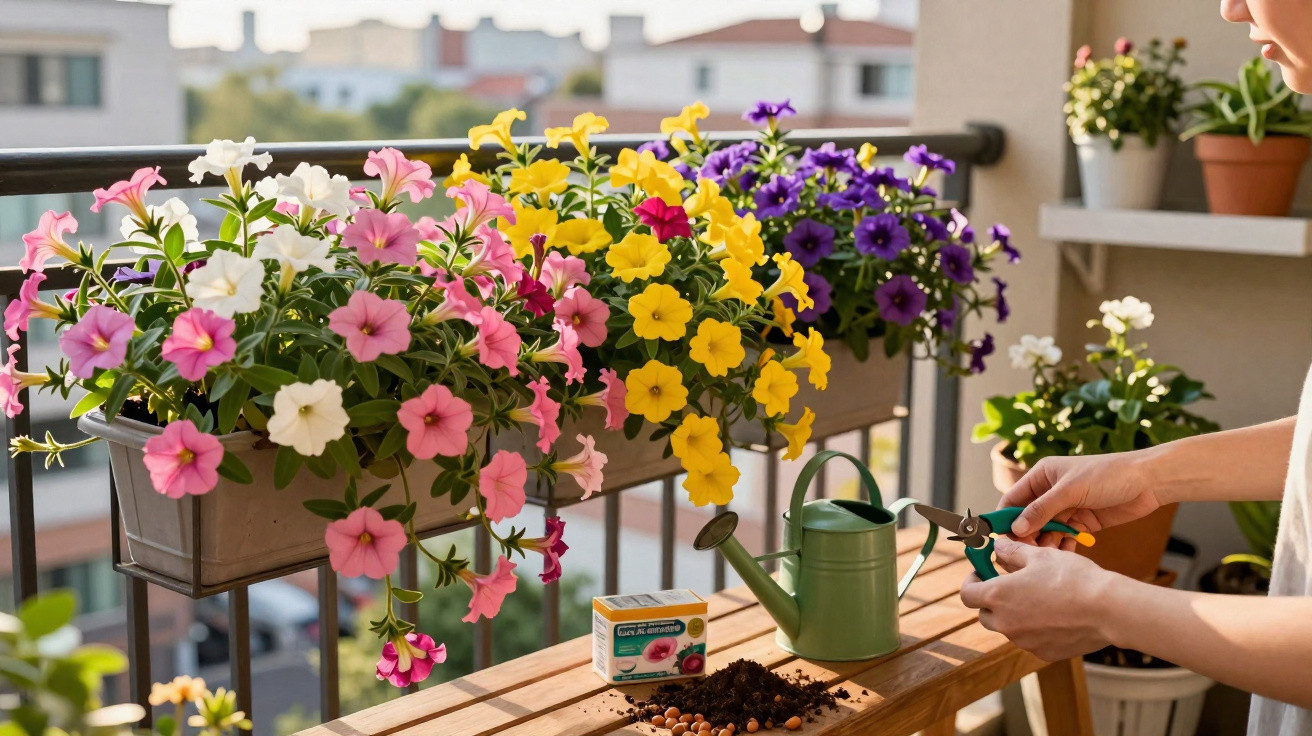
If you’re hoping for a dense, colourful cascade of flowers on your balcony in July and August, now is the moment to act. One particular trailing plant-still underrated in many garden centres-can turn ordinary window boxes into genuine fountains of bloom, as long as you plant it in the right window and look after it consistently.
The unassuming star plant: what’s behind the flower waterfall
Behind many of those lavishly overhanging balcony displays is a plant with a slightly clunky name: Calibrachoa. In garden centres it’s often sold as “Million Bells” or “Mini-Petunia”. It looks similar to petunias, but the flowers are smaller, far more numerous, and sit more densely along the stems.
Calibrachoa forms a compact, semi-domed mound. It typically grows to around 15–30 cm tall, while spreading more loosely to 30–60 cm wide. In window boxes and hanging baskets, that means stems that first extend sideways will, once long enough, tip over the edge and create the characteristic curtain of flowers.
“From spring through to the first frosts, Calibrachoa can produce hundreds of little bells-without any major fuss.”
A key advantage for anyone who prefers low effort: the plant is self-cleaning. Spent flowers dry up and drop off on their own, so you don’t have to keep pinching off dead blooms to maintain a tidy look.
Breeders introduce new varieties every year. Particularly popular are so-called “chameleon varieties”, whose flowers shift colour as the season goes on. One example is Superbells Magic Double Grapefruit: its double blooms move between yellow, apricot and pink, giving the impression that several different plants are flowering in the same pot.
The right planting time in spring
The most important point comes before you even put compost in the box: timing. Calibrachoa is sensitive to cold and originally comes from warmer regions. In Central and Northern Europe it’s therefore grown as an annual seasonal plant.
A simple rule of thumb:
- Plant only once there’s no risk of frost
- Night-time temperatures consistently above 8–10 °C
- depending on your area: usually mid-April to late May
Plant too early and you risk a growth check. Young roots struggle in low temperatures; the plants effectively “stall” and can take weeks to get going again. If, however, you fill the box shortly after the last frosts, the plants can use the whole of spring to establish.
At this stage they build a strong root system, and the shoots lengthen day by day. By July they’ll be clearly spilling over the edge, creating that much-loved “ball with a veil” effect seen in so many balcony photos.
Trial plantings suggest the following for a standard-width window box or a medium hanging basket:
- 3 to 4 young plants per container for a dense, fully filled look
- set plants with a little space between them so they can branch out sideways
Preparing the box: drainage instead of waterlogging
Calibrachoa enjoys moisture but hates sitting wet. Waterlogging quickly leads to root rot; then stems collapse and what was once a lush display can visually cave in.
What matters for the container:
- Large drainage holes in the base-drill extra if needed
- a drainage layer of expanded clay, gravel, or coarse grit at the bottom
- above that, a loose, airy compost, ideally a specialist window-box or hanging-basket mix
A basic, overly dense multipurpose compost from a discount shop often causes trouble. A better choice is a mix that lets water move down quickly while still leaving enough air around the roots.
| Aspect | Calibrachoa likes | Calibrachoa struggles with |
|---|---|---|
| Water | Evenly moist root ball | Persistent standing water in the saucer |
| Compost | Light, free-draining, nutrient-rich | Heavy garden soil, pure compost |
| Position | Sun to bright partial shade | Constant shade or strong wind corridors |
Summer care: how to keep the carpet of flowers intact
To stop the display “falling apart” after only a few weeks, Calibrachoa needs two things: enough nutrients and steady watering-reliable, but not excessive.
Watering properly – more often, but in moderation
In high summer, hanging baskets dry out extremely quickly. On very hot days, watering once a day often isn’t enough-yet the box mustn’t be left standing in water. A few straightforward rules help:
- Two-finger test: feel the top 2 cm of compost-water only when it’s dry.
- Water in the morning; on very hot days top up in the evening if needed.
- Empty the saucer after 20 minutes so no stagnant water remains.
Automatic watering systems or self-watering planters can make life much easier if you’re often out. If you travel regularly, larger containers are the safer option because they hold more water.
Feeding: fuel for continuous flowering
Calibrachoa is considered a heavy feeder. It produces flowers for months, and that requires a steady supply of nutrients.
A proven routine:
- When planting, mix in a controlled-release fertiliser or an organic base feed.
- From the third to fourth weekend after planting, add liquid feed for flowering plants every two weeks with your watering.
- If flowering noticeably drops off or leaves look pale, increase feeding slightly.
“If you feed consistently, you’ll be rewarded with an almost unbroken layer of flowers right through to the first frosts.”
A light trim for a second wave of flowers
By mid-summer-often around mid-July-some plants start to look tired. Shoots become very long, gaps appear in the middle, and flowering slows. That’s when a small, targeted trim helps.
Shorten several shoots by about 1 cm. This isn’t a hard cut-back, more a gentle “tidy-up”. The plant responds by branching again and forming fresh buds. Within a few weeks, the box looks full and colourful again.
Which varieties suit which balcony
In shops you’ll find a wide colour range: from pure white through yellow, orange and red to purple and near-black. Some varieties show a pale eye in the centre of the flower, while others look as though they’ve been painted with stripes.
Different sites suit different types:
- Full sun: strongly coloured, heat-tolerant varieties that don’t immediately flop in midday sun.
- Bright partial shade: pastel and bi-colour varieties, where fine markings show up better.
- Windy positions: more compact-growing Calibrachoa so stems don’t keep snapping.
Mixed plantings can be especially effective-for instance, combining a chameleon variety with a single-colour companion plant. The result is a lively, modern look that doesn’t resemble a generic “DIY-store window box”.
Tips for beginners and common mistakes
If you’re using Calibrachoa for the first time, you’ll often run into the same pitfalls. It’s worth checking the usual suspects:
- Containers that are too small: the root ball dries out within hours and the plant suffers continuously.
- Planting too close: more than four plants in a standard box compete for light and airflow.
- No feeding: everything flowers at first, then after six weeks the energy is gone-no nutrients means no long-season bloom.
- Constantly wet compost: if you “water to be safe”, the box quickly declines; roots rot and stems turn glassy.
If you keep these points in mind and choose your spring planting date wisely, you’re likely to end up with a trailing plant that visually outshines many geraniums. Calibrachoa remains frost-tender and won’t survive winter outdoors, but in a single season it delivers a floral display that can completely transform balconies and terraces from May well into autumn.
Comments
No comments yet. Be the first to comment!
Leave a Comment