
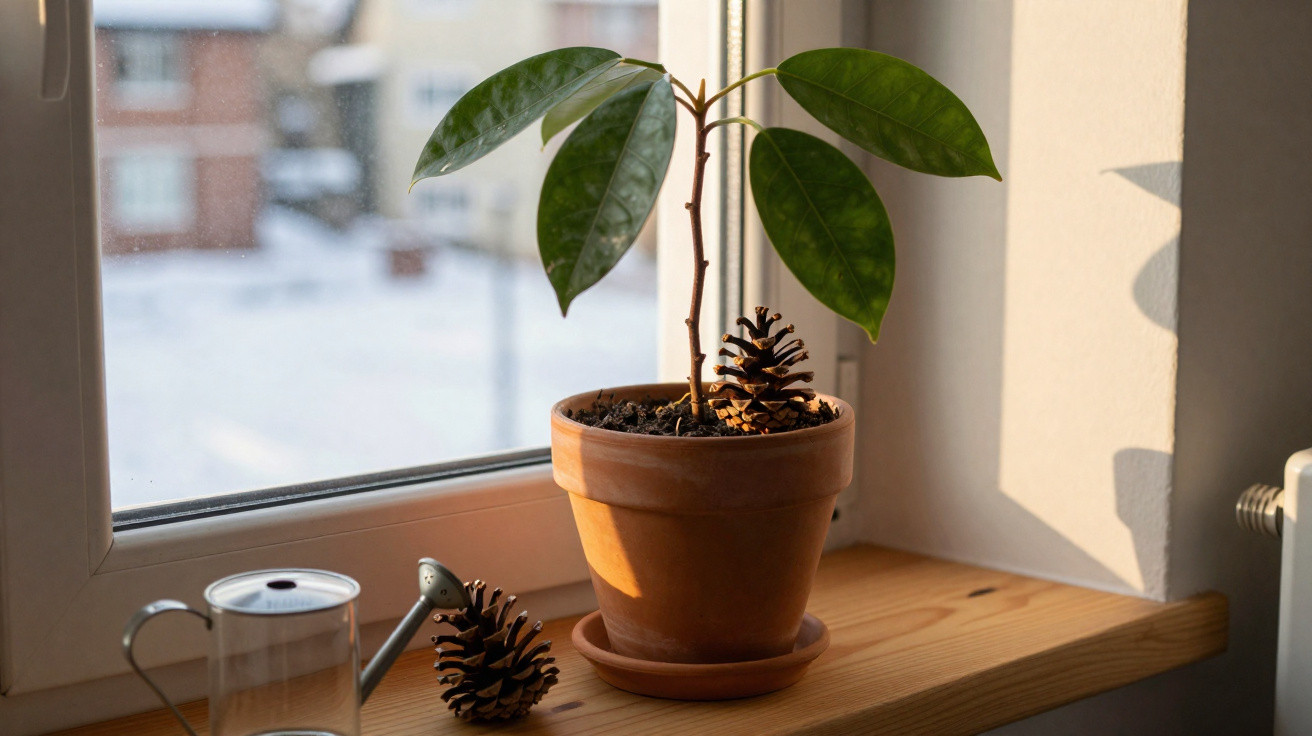
Yellowing leaves, soft stems, soggy compost: once the heating season starts, the living-room climate can quickly swing in a direction that Monstera, Ficus & co. struggle to cope with. Many people then reach for the watering can on autopilot - and that is exactly where the real trouble begins. Yet a modest find from the woods can become a quiet ally during this tricky period: a dry pine cone, with no gadgets and no pricey specialist fertiliser.
Central heating and winter dormancy: why your plants suddenly seem so fussy
In winter, radiators run flat out in many homes. The air dries out, leaves lose moisture, tips turn crisp, and foliage curls in on itself. It looks like thirst - but very often it is not.
At the same time, most houseplants are in a resting phase. Their metabolism slows down, growth is reduced, and the roots take up far less water. Even if the top layer of compost seems to dry quickly, lower down in the pot it can stay damp for a long time.
If you judge only by the surface and keep topping up with water, you can create a risky situation without noticing: waterlogged compost at the bottom, hardly any oxygen - ideal conditions for root rot.
"Too much water during winter dormancy damages plants more reliably than a brief spell of dryness."
What happens next is predictable: the roots gradually die back, the plant can no longer absorb water, it droops even more - and many people respond by watering even more. It is a classic vicious circle that costs countless houseplants every year.
The simple pine cone method: a woodland find as a moisture manager
This is where a dry pine cone comes into its own. It looks attractive, costs nothing, and acts like a small moisture regulator sitting right on top of the compost.
Using it is straightforward: place a larger, thoroughly dried pine cone on the surface of the compost. Don’t bury it, don’t crumble it up - just set it on top. Its woody structure soaks up excess moisture from the upper layer and then releases it slowly over time.
"A pine cone works like a natural buffer: less waterlogging, less mould, more stable conditions."
In effect, it forms a protective layer between dry indoor air and sensitive potting compost. The surface stays more open and loose, and the familiar white or greenish crust from limescale, algae, or mould appears less often.
How the pine cone shows when your plant really needs water
Pine cones are nature’s little precision tools. Their scales respond to humidity: they open when it is dry and close when moisture levels are high. You can use that behaviour in your living room.
- Scales tightly closed: the surrounding air and the compost are still clearly moist. Postpone watering.
- Scales wide open: the air and the top layer of compost are fairly dry. Now it is worth checking deeper in the substrate.
A pine cone is not a replacement for a moisture meter, but it can provide a surprisingly dependable visual cue. If you are unsure, combine methods: look at the cone first, then use your finger or a wooden stick to check how damp the compost still is deeper in the pot.
How to prepare pine cones properly before they go in the pot
If you put just anything from the woods into a plant pot, in the worst case you can bring insects, fungal spores, or tiny larvae into your home. A quick preparation step helps prevent that.
Step-by-step guide
- On a walk, collect only well-opened, dry pine cones that look undamaged.
- Gently brush off loose dirt, soil, and needles with a brush or an old towel.
- Heat-treat the cones at around 90°C in the oven for 20–30 minutes, or leave them for several days on a warm radiator.
- Let them cool completely afterwards.
- Place one cone in the centre of the pot; for large containers, spread two or three across the surface.
The effort takes less than five minutes, but the benefit can support your plants throughout the entire winter season. As a bonus, it creates a natural decorative effect reminiscent of the forest floor.
Watering in winter: less is more - with clear rules
The pine cone helps to stabilise moisture, but it does not replace adjusting how you water. During the heating period in particular, many houseplants need noticeably less water than they do in summer.
A few simple guidelines are often enough:
- Extend watering intervals significantly compared with summer.
- Water only when the compost feels dry several centimetres down.
- Always pour away any standing water in an outer pot straight away.
- With sensitive species, it is better to water slightly too little than once too much.
"If you’re unsure in winter, you’re usually better off skipping a watering."
It also helps to move pots a little further away from radiators. Direct radiant heat dries leaves out rapidly, without the roots being able to process more water.
More light, less stress: further tips for healthy winter houseplants
Alongside moisture, lack of light is the main challenge for many houseplants. Short days, a low sun angle, and often shaded windows mean the energy supply drops dramatically.
Helpful steps include:
- Move plants closer to the window, without exposing them to a cold draught.
- Dust leaves regularly so the little available light can be used fully.
- Avoid cold spots: in winter, leaves should not touch the glass directly.
If you keep lots of light-hungry species, simple LED grow lights can help during the darkest months. Even a few extra hours of brightness each day noticeably reduces stress.
When a pine cone is unsuitable - and what to do instead
As smart as the method is, it does not fit every situation. In a few cases, other solutions are the better choice.
- For plants that must be kept extremely dry (such as some succulents), a top dressing of mineral sand or grit is often sufficient.
- For pots heavily affected by mould or fungus gnats, you usually need to change the substrate first or allow a thorough drying period.
- If plants are kept consistently very cool, it is best not to cover the compost further, so it can dry out faster.
In most normally heated living rooms with classic green houseplants, however, the pine cone works remarkably well as a small helper.
Why the woodland trick often beats expensive gadgets
The market is full of moisture sensors, smart pots, and high-tech watering aids. Many cost a fair bit of money, and some end up in a drawer after a single season.
A pine cone, by contrast, delivers several benefits at once:
| Function | Effect |
|---|---|
| Surface moisture absorption | Less waterlogging, lower risk of rot in the upper root zone |
| Visual moisture indicator | The scale position hints at dryness versus remaining moisture |
| Decorative cover | A natural look instead of bare compost, helps suppress mould and algae |
This brings old nature know-how into modern homes: central heating, closed windows, little air movement - conditions plants would never experience like this in the wild.
Practical examples: which plants benefit most from the trick
The biggest winners are species that get “drowned” in winter because they have large leaves and quickly look limp. Typical candidates include:
- Monstera
- Rubber plant and other Ficus species
- Dragon tree
- Some palm species kept in the living room
- Small indoor trees in decorative outer pots where drainage is not monitored
For smaller pots, a single, more delicate cone is often enough. In tubs or large plant bowls, a small group works well - almost like a miniature landscape.
If you pay close attention for a few weeks to both the scales and the compost moisture, you will quickly get a feel for how reliably the method supports your watering routine. That way, your houseplants can stay healthy right through the middle of winter - without specialist fertiliser, but with an unassuming helper from the woodland floor.
Comments
No comments yet. Be the first to comment!
Leave a Comment