
The gardener looked drained. Not from digging or pruning, but from thumb-scrolling through endless plant catalogues on her phone, balanced on the edge of a plastic chair in a garden packed with pots. Tall grasses slumped over cracked terracotta. Roses jostled with hydrangeas, and somewhere beneath a snarl of ivy a birdbath listed like a sinking boat. She let out a long sigh and voiced what many of us quietly admit: “I keep adding more and it still looks… messy.”
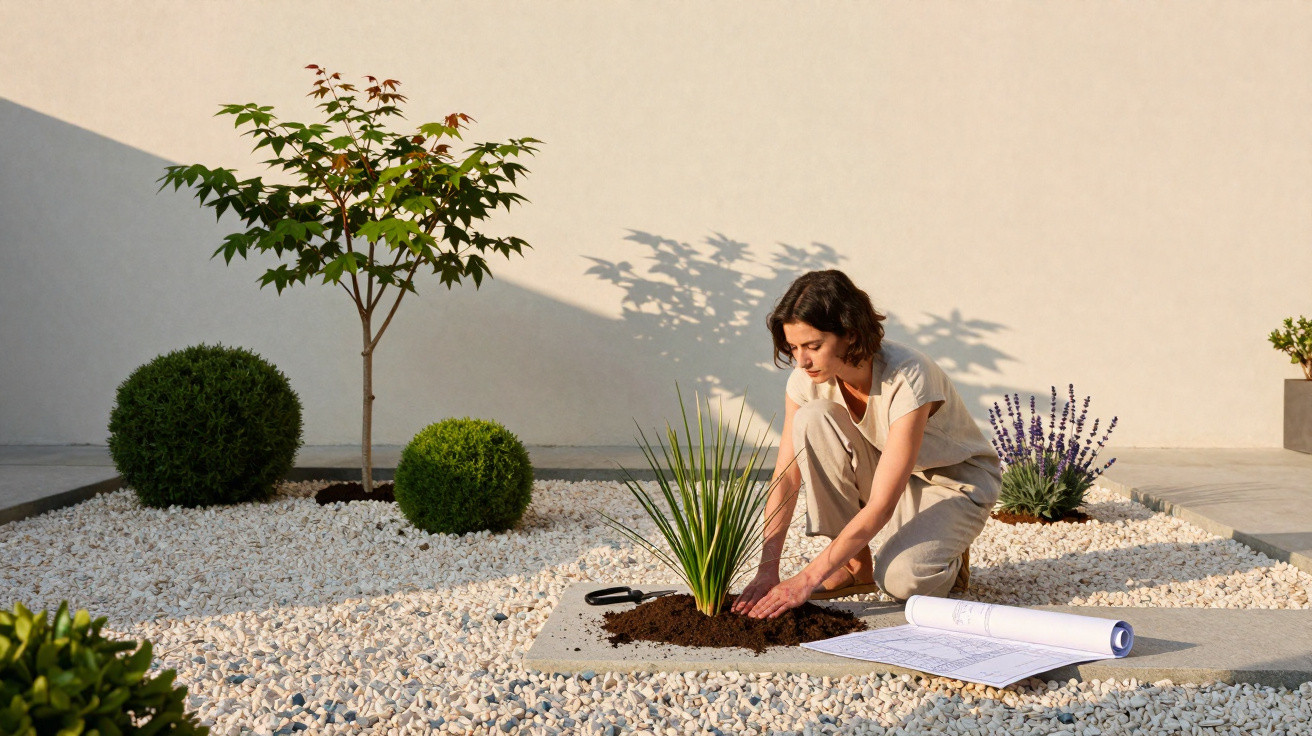
Over the road, her neighbour’s garden contained only a small edit of planting. One sculptural tree, a low hedge, a clean strip of gravel, and a single bench. Nothing else. And yet drivers slowed to stare. It had that hushed, costly calm you associate with boutique hotels.
Same climate, same street, completely different atmosphere.
Why fewer plants often look more luxurious
Visit any high-end garden open day and you’ll spot something that surprises people. There’s visible soil. There’s breathing room. You can read the silhouettes. You’re not pushing through a jumble of bargain buys. Instead, you move through something composed-more like a carefully framed photograph than a riot of “good deals”.
A luxury garden doesn’t yell for attention; it settles you. One colour plays off another. Forms repeat. There’s a rhythm you register without having to explain it. Your gaze can travel from a clipped shrub to a pale stone pot, then to a single Japanese maple that appears to glow. Even when planting is loose and naturalistic, it never feels accidental.
I once visited a compact London townhouse garden that looked as though it had stepped out of a design magazine. The owner insisted she had “hardly any plants.” In reality, she had twelve species-no more. Three grasses repeated in blocks, two types of evergreen, one statement tree, a low hedge, plus a few seasonal pots by the front door.
Even so, photos of her garden regularly went viral on Pinterest. People assumed it must have cost a fortune. But the trick wasn’t rare specimens. It was repetition, restraint, and the confidence to leave space unfilled. She’d removed nearly 40 mismatched plants that the previous owner had crammed in, and the garden immediately felt roughly twice the size.
Plant overload is easy to understand: buying plants delivers an instant hit of joy; designing with plants takes slow, deliberate thinking. Our brains are primed to grab the pretty thing at the garden centre, not to imagine what five of the same shrub will look like in three years. So borders become a “one of everything” collection-and the result is visual noise.
Design professionals work the other way round. They limit choices and ask practical questions: How large will this become? What form does it contribute? Does it echo something that’s already here? They’re not trying to maximise variety; they’re building a visual sentence where every plant functions like a word that earns its place.
The minimalist strategies garden pros quietly rely on
One of the easiest professional moves is ruthless simplicity: halve your plant list, then use the remaining plants in generous drifts rather than isolated singles. Three, five, or seven of the same grass planted together reads as intentional. A row of identical pots holding the same evergreen can turn a haphazard patio into a properly “designed” terrace.
Designers also begin with structure rather than flowers. They map out where height and shape will come from first: perhaps a small tree, a hedge, and one taller grass. Only then do they plug the gaps with low, dependable plants that behave. And the flowers people crave? Those are treated as contained, seasonal accents-not scattered everywhere like confetti.
The most frequent misstep I see is emotional planting. A friend gifts a rose, a neighbour shares a divided hosta, a child picks a sunflower, and before you know it the garden becomes a scrapbook of guilt plants you don’t even like. Because you can’t quite bring yourself to remove them, you plant around them-and the whole scheme starts to wobble.
Attachment is normal. Plants hold memories. Still, a calm, premium-looking garden nearly always requires a little kind editing. You can respect the sentiment while relocating-or even releasing-what doesn’t belong. And let’s be frank: nobody maintains perfect order every day. Gardens change in untidy bursts, and that’s fine. What counts is the direction you keep guiding it towards.
“A luxury garden isn’t about how much you plant. It’s about how much you’re willing to remove,” a landscape architect in Paris told me, standing in front of a courtyard with only seven plants and an absurd amount of mood.
- Repeat, don’t collect: Choose 5–10 core species and use them throughout the garden, rather than buying one of every plant that catches your eye.
- Prioritise structure over flowers: Start with trees, hedges, and shrubs that look good year-round, then add seasonal colour as a light layer rather than the main event.
- Leave visible ground: Use mulch, gravel, or low groundcovers so the soil line feels intentional, not like an empty space where “more plants” ought to go.
- Aim for easy-care plants: Favour tough perennials and evergreens. The garden will still look composed when life gets busy and you miss a weekend.
- Edit once a year: Set aside a single day to move, divide, or remove anything that disrupts the calm, clear look you’re working towards.
Living with less: a garden that breathes and lasts
The best minimalist gardens I’ve visited share a quality you won’t find on any plant label: they feel liveable. You can sit without dodging spiky leaves. You can see from one end to the other. There’s somewhere for the eye to pause-and somewhere for your body to relax as well. You sense that the space is there for humans first, plants second.
That’s the understated strength of planting less. You stop battling constant overgrowth or trying to cram in the latest novelty from the shop. Instead of hoarding, you curate. You make room for your future self-tired, busy, older, or suddenly passionate about something else entirely. The garden continues to work, even when you don’t.
Most of us recognise that moment: you stand in the middle of your own garden and feel more overwhelmed than pleased. If that’s where you are right now, the next step might not be another plant at all, but a black bag, a notebook, and a better question: What could I remove so that what I love can finally shine? That shift is what professionals practise-and once you notice it, you can’t unsee it.
| Key point | Detail | Value for the reader |
|---|---|---|
| Focus on fewer species | Limit your core palette to 5–10 plants and repeat them in groups | Creates a calm, high-end look and simplifies shopping and care |
| Design for structure first | Start with trees, hedges, and evergreen shapes before adding flowers | Garden looks “finished” all year, not just during peak bloom weeks |
| Edit regularly | Remove or move plants that break the rhythm or add clutter | Reduces maintenance and keeps the garden from sliding back into chaos |
FAQ:
- Question 1 Does a minimalist garden mean I have to give up colorful flowers?
- Question 2 How many different plant species is “too many” for a small garden?
- Question 3 Can I create a premium look on a tiny balcony with just pots?
- Question 4 What should I do with plants I already own that don’t fit the new style?
- Question 5 How long does it take to see the effect of simplifying my planting?


Comments
No comments yet. Be the first to comment!
Leave a Comment