
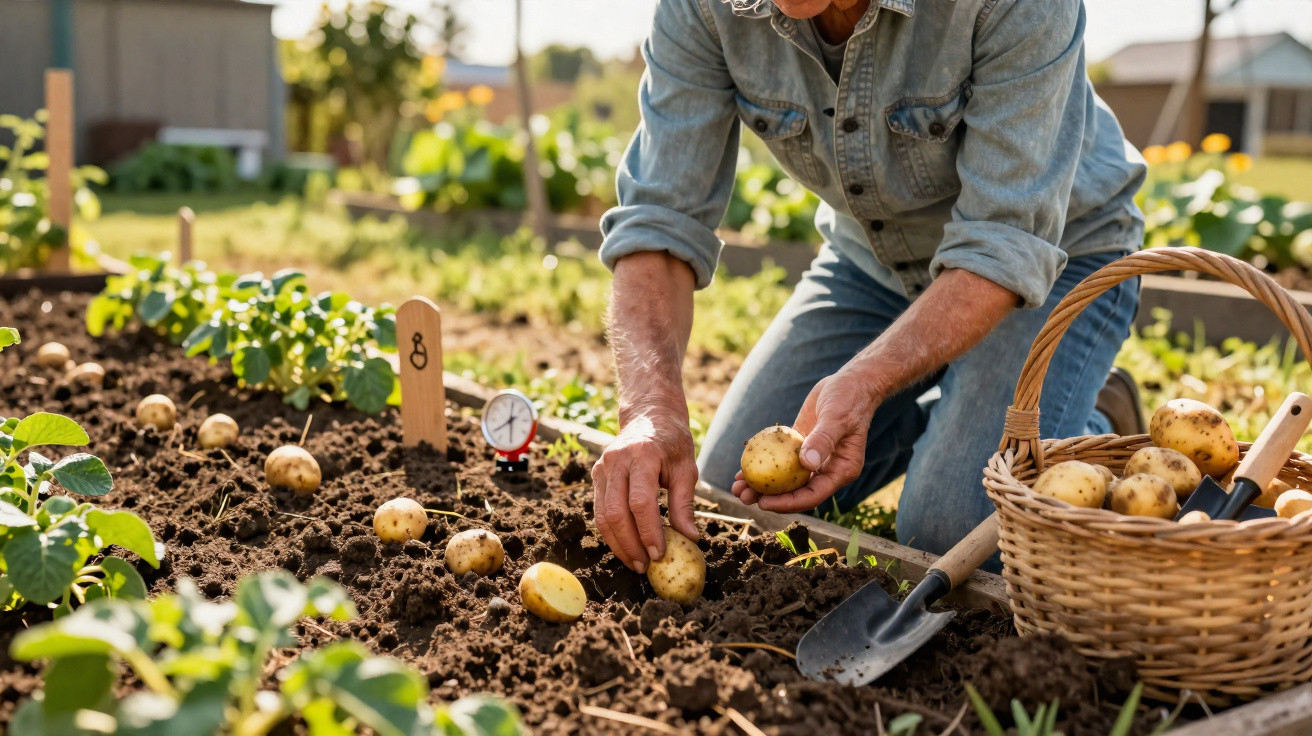
The first time I heard the answer, it came from a bloke in mud-caked boots at a farmers’ market. I barely got the words out before he cut in: “Potatoes? You plant them when the soil stops biting back,” he said, rubbing his fingertips as though the chill was still there.
The following day, on a city allotment, an older woman gave me almost the identical reply-only hers arrived via a tale about her grandad and a jam-jar thermometer pushed into the earth. That’s when I began to notice it. Different places, different voices, different sorts of plots. Yet the same message, repeated. With potatoes, the planting time isn’t really found in a seed catalogue. It’s recorded in the ground itself, in your hands, and in that brief moment when winter finally eases off.
Something odd happens once you put the same simple question to enough people.
So, when do gardeners actually plant potatoes?
If you ask a diary, it will cheerfully reply: “early spring”. Ask a gardener and you’ll usually get a beat of silence first-a quick look upwards-then an answer that’s more about conditions than dates. “When the soil is workable,” they’ll say. “When it falls apart, not into lumps.”
Across more than a dozen chats-everyone from back-garden growers to old-school farmers-people kept pointing to the same window: late winter into early spring, when the ground has thawed but hasn’t turned into a saturated mess.
Most of them offered a straightforward set of signs: soil that’s cool rather than icy, damp but no longer sticky, and a forecast that isn’t hinting at savage frosts. That’s the point at which seed potatoes finally come out of their cardboard box in the shed.
On a line of urban allotments outside Leeds, a retired nurse called Janet showed me her own “potato calendar”, pencilled on the back of an old electricity bill. “I’ve written dates on here for 14 years,” she said, tapping the paper. “The funny thing? The actual planting day moves, but the conditions feel exactly the same every time.” In some years she got going in mid-March; in one mild year she began in the last week of February; in others she stuck it out until the first week of April.
She wasn’t quoting gardening manuals. Instead, she talked about the squelch under her boots, how the soil dropped from the spade, and whether the washing would dry on the line in less than an hour. That was her evidence. That was her science.
Underneath all those anecdotes sits a simple bit of logic. Potatoes can cope with plenty, but the first few weeks set the tone for the entire crop. Get in too early and cold, wet soil slows everything down and raises the risk of rot. Leave it too late and plants run into summer heat or dry spells before they’ve properly bulked up underground.
So most gardeners aim for that narrow, forgiving early-spring zone: soil temperatures around 7–10°C (45–50°F), winter wetness starting to ease, and longer daylight during the day.
They aren’t hunting a magic day on the calendar; they’re lining up plant biology with local weather. That’s why someone in Cornwall might start three weeks ahead of someone in Scotland, and both will still insist they planted at the “right time”. In their own conditions, they did.
The method behind the answer everyone seems to share
Strip away the folklore and you find that gardeners are often using a couple of practical checks. Many told me they press a bare hand into the soil for a few seconds. If it’s cold but not painful, and it breaks up readily in the palm, then planting becomes an option.
Others go further and slide a cheap kitchen thermometer 5–10 cm into the bed, taking morning readings for a week. When the temperature reliably stays above roughly 7°C, the seed potatoes come out.
Some people rely on nature’s timetable instead: blackthorn in blossom, daffodils fading, birds kicking off the dawn chorus earlier. “When the blackbird sings while I’m making breakfast, I know we’re close,” one gardener told me, with a shrug as if it couldn’t be plainer.
For most beginners, the sticking point isn’t information-it’s confidence. Plant too soon and you imagine your potatoes turning into miserable, slimy lumps after a freeze. Wait too long and you picture everyone else lifting crops while you’re still looking at bare ground. It’s a familiar scene: staring at the weather app as though it can promise a flawless summer.
Seasoned gardeners accept the uncertainty. They often divide seed potatoes into two or three batches, putting some in on the first day that feels “good enough”, then planting the rest a week or two later. If a late frost threatens, they’ll chuck over fleece, old sheets, or even cardboard boxes overnight. Realistically, nobody manages this perfectly every day-but the scruffy, adaptable routine gives you far more breathing room than any fixed date.
The same line kept resurfacing in different conversations-slightly altered each time, but always carrying the same heart of advice.
“Plant your potatoes when the soil has warmed a little and no longer clings to your boots. Trust that more than any date in a book.”
To pin that down into something you can use, here’s the general pattern most gardeners described, turned into a quick mental checklist:
- Read the soil – Aim for crumbly rather than sticky; cool rather than icy; boots lifting without being plastered in mud.
- Look at the nights – Avoid hard frosts in the forecast, or be prepared to cover young shoots.
- Use windows, not dates – Late February to early April in many temperate regions, and later in colder areas.
- Stagger your planting – Two or three smaller plantings are safer than one big punt.
- Match it to your plot – Raised beds warm sooner; heavy clay can lag behind.
Where gardeners agree-and where they don’t
By the time I’d filled a notebook and collected voice memos on my phone, one pattern was impossible to miss. Gardeners will argue about varieties, spacing, whether chitting is worth the bother, and even watering. But on timing, their answers overlapped almost perfectly: an early-spring window, judged by the feel of the soil rather than a printed date.
Even so, there’s plenty of room for your own circumstances. A balcony grower using bags can begin earlier because containers warm up more quickly. A north-facing plot with heavy clay might be two or three weeks behind the sunny bed next door. The shared wisdom isn’t about copying somebody else’s calendar-it’s about copying how they observe and adjust.
| Key point | Detail | Value for the reader |
|---|---|---|
| Timing is a window | Early spring, once the soil has thawed, turns crumbly, and sits above ~7°C | Lowers the chance of rot and frost damage, while avoiding a late, underpowered crop |
| Trust the soil, not the date | Use touch, simple spring indicators, or an inexpensive thermometer | Helps you plant for your real conditions, not a generic chart |
| Spread the risk | Plant in two or three small waves and be ready to cover if frost is due | Boosts the likelihood of a decent harvest in changeable weather |
FAQ:
- Question 1 Is it OK to plant potatoes before my last frost date?
- Answer 1 Yes-lots of gardeners do, provided the soil has warmed and you can protect emerging shoots with fleece, mulch, or covers if a sharp frost is forecast.
- Question 2 What if I put potatoes in the ground too early?
- Answer 2 In cold, wet soil they can sit doing very little, rot, or sprout poorly, often resulting in smaller plants and an underwhelming harvest.
- Question 3 What if I leave potato planting too late?
- Answer 3 The plants may meet summer heat or drought before the tubers have properly bulked up, meaning fewer, smaller potatoes and a shorter harvest window.
- Question 4 Do I need to wait for a particular moon phase?
- Answer 4 Some gardeners follow lunar calendars, but the consistent drivers of a good crop are soil temperature, moisture, and frost risk-not the moon.
- Question 5 Is there an easy test for beginners?
- Answer 5 Grab a handful of soil from 10 cm down: if it crumbles in your hand, doesn’t feel painfully cold, and your boots aren’t caked in mud, you’re close to the sweet spot.


Comments
No comments yet. Be the first to comment!
Leave a Comment