
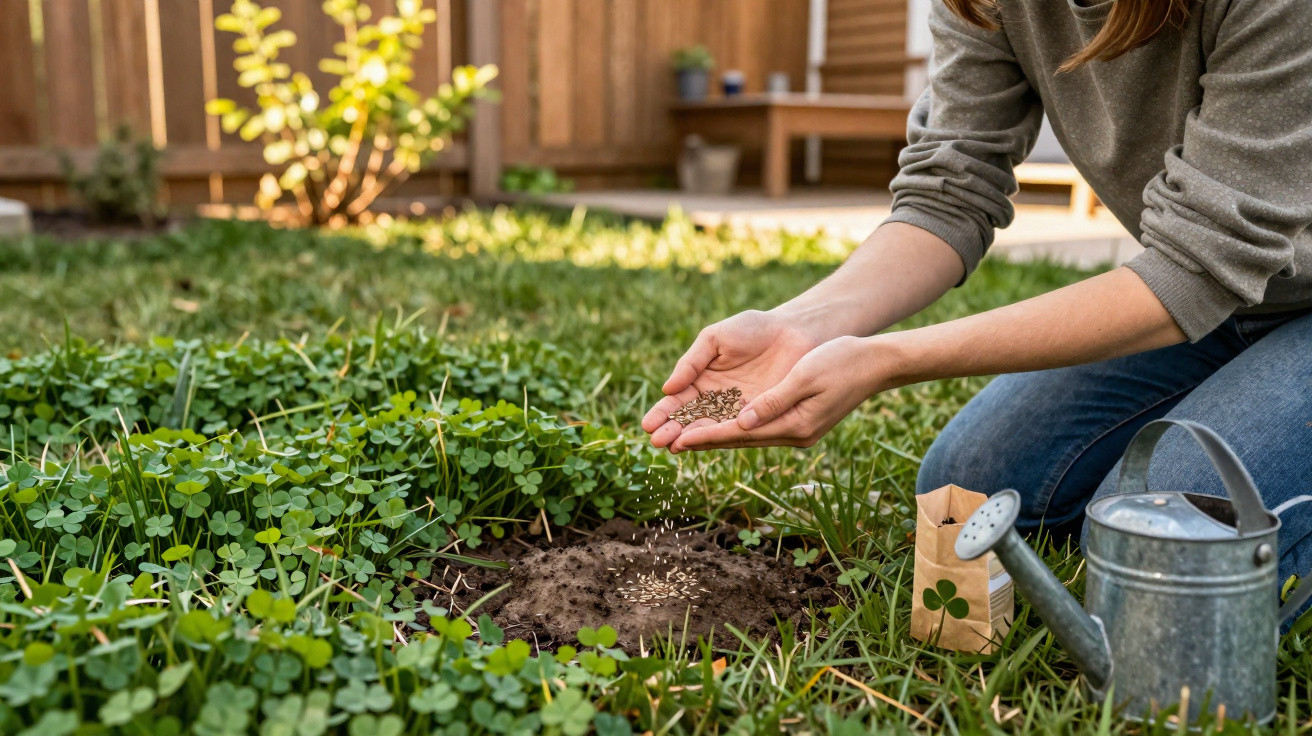
After winter, your lawn mercilessly reveals every weak spot: bare patches, yellowing areas and worn tracks. Rather than reaching (yet again) for ordinary grass seed and ending up disappointed, more and more home gardeners are turning to a different, surprisingly tough plant: microclover. Used properly, it quickly knits gaps together, helps the lawn cope better with dry spells and can even reduce how much fertiliser you need over time.
Why the lawn is full of holes after winter
Frost, waterlogged ground, dog urine, snow mould, children playing, or even last summer’s paddling pool - all of it takes a toll on the turf. Individual grass plants die back, roots rot, and unattractive dry patches are left behind.
If you simply work fresh lawn seed in every year, you’ll know the pattern: the thin areas fill in for a while, but the next bout of heat or drought stress opens up gaps again. That’s exactly where microclover comes into its own.
"Microclover works like a natural carpet patcher: it fills holes, strengthens the lawn and supplies the soil with nutrients."
Microclover – the secret weapon against bare patches
Microclover is a specially low-growing form of the familiar white clover. It usually stays only 3–8 cm tall and blends into the lawn so smoothly that it barely stands out. Unlike a typical clover takeover in a meadow, you don’t end up with a “pasture” look - instead you get a dense, rich green carpet.
The most important characteristics of microclover
- Low growth habit: Small leaves, a carpet-like finish, and far less noticeable than regular clover.
- Hard-wearing under foot traffic: Well suited to areas where children play or dogs run.
- Good drought tolerance: Handles heatwaves far better than grass alone.
- Nutrient provider: Captures nitrogen from the air and releases it to the soil.
- Fast to establish: Typically closes open areas quicker than grasses.
In years with extended dry periods, clover acts as a safety buffer: grass may thin out, but microclover stays green and visually disguises gaps.
How to do it: sowing microclover correctly
The best time to sow is early spring, as soon as night frosts are no longer likely. That gives the plant several months to build a strong root network before high summer and drought stress arrive.
Step by step to a thicker lawn
- Check the area: Identify and mark any bare, yellowed or heavily thinned spots.
- Remove old material: Thoroughly lift out dry grass, moss and weeds with a rake or scarifier.
- Loosen the soil: Scratch up the top layer to 2–3 cm depth and break up larger clods.
- Level the surface: Smooth with a rake so no hollows remain.
- Mix the seed: Combine microclover seed with a little fine soil or lawn seed to distribute it more evenly.
- Sow: Scatter the mix lightly over the prepared patches - not too thickly, so seedlings still get enough light.
- Press in gently: Use a board, kneeling planks or flat shoes to press down so the seed makes contact with the soil.
- Water in: Irrigate carefully without washing the seed away.
"In the first few weeks after sowing, microclover needs an evenly moist surface - not wet, but never completely dried out."
Watering properly: avoiding common mistakes
A lot of lawn damage has less to do with “bad seed” and more to do with watering the wrong way. Especially while plants are establishing, a few habits can decide whether the clover stays - or disappears again.
Common watering mistakes for lawns
- Too often, but too little: Daily light watering encourages shallow roots, which dry out faster.
- Watering at the wrong time of day: At midday most water evaporates, and watering warm soil can contribute to scorching.
- Waterlogging: Constantly wet ground encourages fungal diseases and can literally “suffocate” fresh seedlings.
Ideally, water less often but thoroughly, early in the morning. With new sowing, a light daily misting can be worthwhile for the first two to three weeks, then you can switch to less frequent, deeper watering.
Less fertiliser, more green: how microclover improves the soil
Microclover belongs to the legumes. These plants form a symbiosis with soil bacteria. In small nodules on the roots, these microorganisms bind nitrogen from the air and make it available to plants.
| Effect | Benefit for the lawn |
|---|---|
| Nitrogen fixation | A natural nutrient source directly in the root zone |
| Dense root mat | Better soil stability, less erosion and fewer holes |
| Green leaf growth | A fresher colour, even when grasses are slightly weakened |
If your lawn contains a proportion of microclover, you can often cut back mineral nitrogen fertiliser significantly. That’s kinder to your budget and the environment, and it helps prevent the soil being “overfed” in the long run.
Where microclover makes particular sense – and where it doesn’t
A lawn with some clover is especially suitable for practical, family gardens - areas where people play, lounge, barbecue and generally live. The grass-and-clover mix tends to be more forgiving and still looks fairly presentable even under drought stress.
A bit of restraint may be sensible in the following cases:
- Show lawns: If you want a flawless, uniform grass-only surface, visible clover may not be what you’re after.
- Severe allergies: Anyone with strong reactions to clover or insect stings should speak to their GP before sowing.
- Bees in children’s areas: Flowering clover attracts pollinators. If you have lots of children playing barefoot, keep the clover proportion lower or mow before it flowers.
Practical care tips for a clover-rich lawn
A lawn with microclover doesn’t need special treatment, but a few details are worth following:
- Don’t set the mowing height too low; 4–5 cm encourages dense, healthy green growth.
- Sharpen mower blades regularly so leaves aren’t torn and ragged.
- In summer, mow less often and higher rather than short and harsh.
- Largely avoid heavy, blanket applications of high-nitrogen fertiliser.
If you’re unsure how much clover you want, start by treating only the problem areas. Often it’s enough to “inoculate” typical weak zones - such as worn paths, play areas or sunny south-facing spots - with microclover to noticeably improve the overall look.
What’s really behind bare patches – and how clover helps long term
Bare patches are usually just the visible sign of a deeper issue: compacted soil, nutrient imbalance, too little root mass or constant wear. Microclover tackles several of these points at once. It roots deeply, helps loosen the topsoil, supplies nutrients and shields the surface with its leaf growth.
In practical terms, that means fewer brown patches, less watering stress in summer and a lawn that doesn’t slump the moment a hot weekend arrives. If you put in a few timely steps in spring and sow microclover, you can save yourself many frustrating hours in midsummer with a watering can and repeated reseeding.




Comments
No comments yet. Be the first to comment!
Leave a Comment