
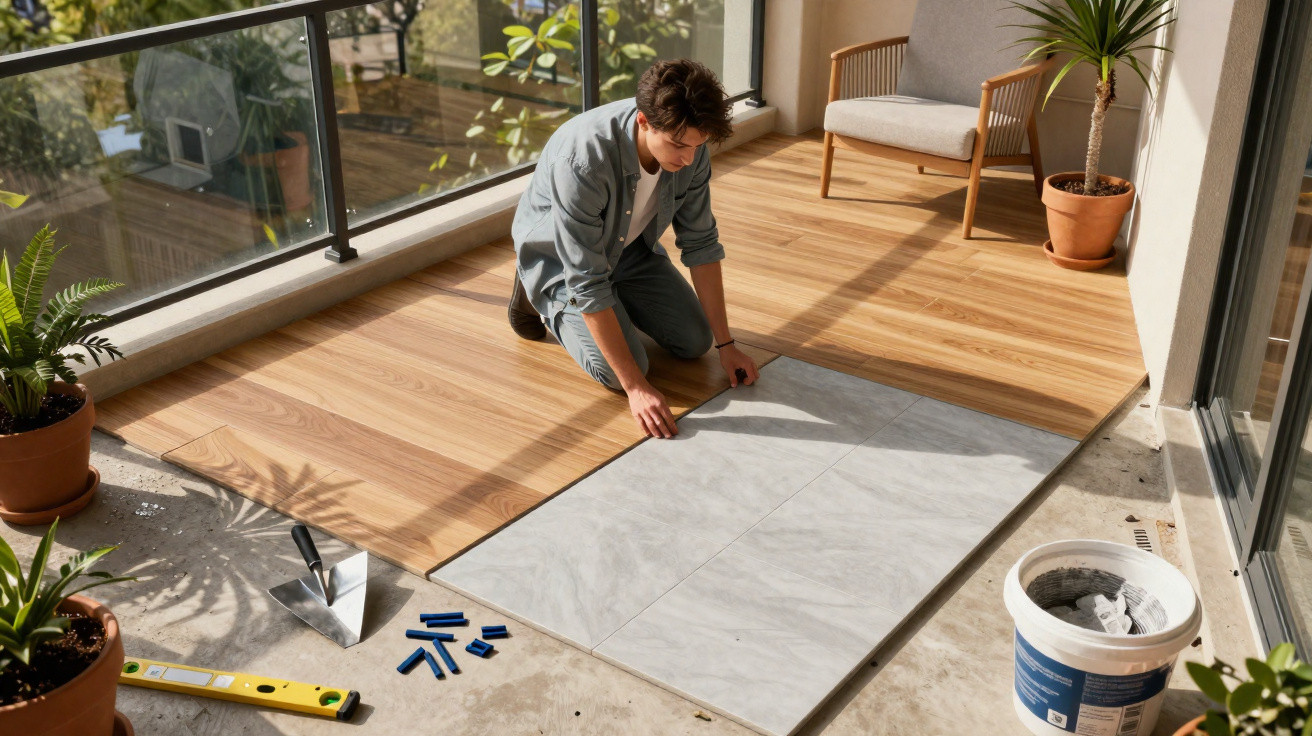
On a compact city balcony, one big decision keeps coming up: WPC boards or porcelain stoneware? If you want a fast, tidy, long-lasting finish without screed, you end up weighing up feel underfoot, overall weight and ongoing upkeep.
The city hums in the background: crockery clinks somewhere, a bicycle rattles past. Most of us know that moment when you pull your bare feet back and think, this could be much nicer.
In the DIY store I run my hand over warm-feeling WPC boards, then over cool porcelain stoneware slabs. Two materials, two completely different moods. The assistant mentions slip resistance and UV stability, but all I really hear is: “Sunny in July, slippery in November.”
On the way home, my balcony suddenly looks like a tiny extra room rather than a dumping ground. A spot for parsley, a glass of fizzy water and a small radio. And the question that sticks is surprisingly straightforward.
What carries the summer better?
WPC boards or porcelain stoneware: which surface wins on under 5 m²?
WPC feels pleasantly warm to bare feet and instantly makes the space seem more homely. There’s a slight spring to it, and the grain softens the hard look of concrete. Porcelain stoneware is the opposite: dense, weighty and solid - like a little patch of piazza up above the rooftops.
Both are designed for outdoor use, yet they react differently to sun, rain and frost. In strong sunshine WPC can heat up more, while porcelain stoneware stays more neutral; in wet conditions, though, grip depends heavily on the surface finish. The choice starts as a practical one, but it’s decided by what you feel when you step out.
A real fourth-floor example: Lea covered 4.2 m² with WPC click tiles in two hours - no drilling and no mortar. After an evening downpour, the water beaded away and the joints allowed drainage. Next door, Martin laid 20 mm porcelain stoneware slabs on low pedestal supports; it took him four hours, and he needed an angle grinder for two cut-outs.
WPC typically comes in at around 10–18 kg/m², while porcelain stoneware is about 40–50 kg/m² - a meaningful difference for older buildings with lighter balcony structures. Costs? Decent WPC click tiles often start at €35–60/m²; 20 mm porcelain stoneware usually sits around €30–70/m², plus pedestal supports.
The sober comparison: WPC has more give, copes better with minor unevenness, and adds visual warmth. Porcelain stoneware is dimensionally stable, colourfast and exceptionally scratch-resistant. WPC expands in sun, so it needs expansion gaps and clean perimeter detailing. Porcelain stoneware is hard, but if it’s poorly supported or takes point loads, edges can crack.
For maintenance, porcelain stoneware has the edge: a quick mop and you’re done. WPC benefits from the occasional clean with a soft brush so you don’t end up with a grey film. Porcelain stoneware is the champion for durability and ease of care.
DIY installation without screed: how to do it on a mini balcony
Begin by checking what you’ve already got: confirm the fall (1–2% towards the outlet), respect the waterproofing, and don’t drill through anything. For both options, the build-up follows the same principle: a separation/drainage mat, then small rubber-granulate pads for decoupling, and on top either WPC click tiles or 20 mm porcelain stoneware slabs on low pedestal supports.
With a plan in mind and a tape measure in hand, mark out the support points first, then start parallel to the balcony edge. WPC click tiles lock together with a noticeable snap; lay them in a staggered pattern so the surface looks calm and intentional. With porcelain stoneware, set each slab on three to four support points, keep joints at 3–5 mm, and finish edges neatly with edge strips or L-profiles.
Mistakes people often miss: blocked outlets, missing expansion gaps, and a build-up that ends up too high at the door threshold. Let’s be honest: nobody does this every day. Put down a short “test strip” by the doorway first so you can see the final height in advance. When cutting porcelain stoneware, a wet cut is preferable - otherwise the dust is relentless.
WPC is easy to trim with a fine-tooth wood/plastic saw; place cut edges where they’ll be least noticeable. For porcelain, dress the edge cleanly with a diamond blade and add a slight chamfer. WPC feels instantly homely under bare feet.
A professional once told me: plan the drainage, not just the finish. That’s half the job done. One afternoon, two tools, done.
“The balcony needs to breathe: no silicone, no glue that seals everything up. Lay it, decouple it, let it drain - then the waterproofing stays intact.”
- Quick weight check: respect the balcony’s structure (WPC lighter, porcelain stoneware heavier).
- Drainage: keep the outlet clear; don’t clog the joints.
- Build-up height: allow for the door threshold, drip edge and balustrade posts.
- Slip resistance: at least R10 is sensible for wet areas.
- Warmth/barefoot feel: choose carefully for a south-facing balcony.
- Cut edges: where will they be visible?
- Removal: renting? Click systems are your best friend.
Small balcony, big impact: what matters in the end
On less than 5 m², it isn’t perfect theory that decides - it’s the moment you step outside in the morning. If it feels right and it lasts, you’ll use it. Sometimes all it takes is a handful of components, a quiet hour and a clear drainage route for the balcony to open up like a small room.
Porcelain stoneware brings a sense of architecture and calm. WPC delivers the quick warmth of a timber look, without the maintenance real wood demands. On a mini balcony, the winner is usually the option you can lay faster and remove more easily.
Perhaps that’s exactly the compromise that makes the space work: a lightweight system, a tidy edge detail, and free-flowing drainage. Then the plants arrive on their own. And so do those evenings when the city seems quieter - even though it isn’t.
| Key point | Detail | Why it matters to you |
|---|---|---|
| Weight & build-up height | WPC approx. 10–18 kg/m², porcelain stoneware approx. 40–50 kg/m²; build-up from around 18–35 mm | Will it suit the structure and the door threshold? |
| Feel & use | WPC warm underfoot, slightly forgiving; porcelain stoneware cool, extremely robust | Barefoot comfort or maximum durability? |
| DIY & removal | Click tiles are quick; pedestal supports are precise; both without drilling | Weekend-friendly fitting, rental-friendly |
FAQ:
- Can I mix WPC and porcelain stoneware? Yes - as a zoned approach: a seating area in WPC, with a planting/work area in porcelain stoneware. Make sure the build-up height matches and use clean transition profiles.
- What if my balcony has no fall? Height-adjustable pedestal supports can create a minimal fall. Water must be able to reach the outlet, otherwise it will pool.
- Is WPC slippery in rain? WPC with a textured surface offers good grip. Check the profiling and avoid smooth, lacquer-like top layers.
- How do I cut 20 mm porcelain stoneware neatly? Use a wet cutter or an angle grinder with a diamond cutting disc. Chamfer the edge and place the cut side at the perimeter.
- Do I need an underlay beneath click tiles? A thin drainage/decoupling mat plus small rubber pads reduce footfall noise, protect the waterproofing and let water drain away.


Comments
No comments yet. Be the first to comment!
Leave a Comment