
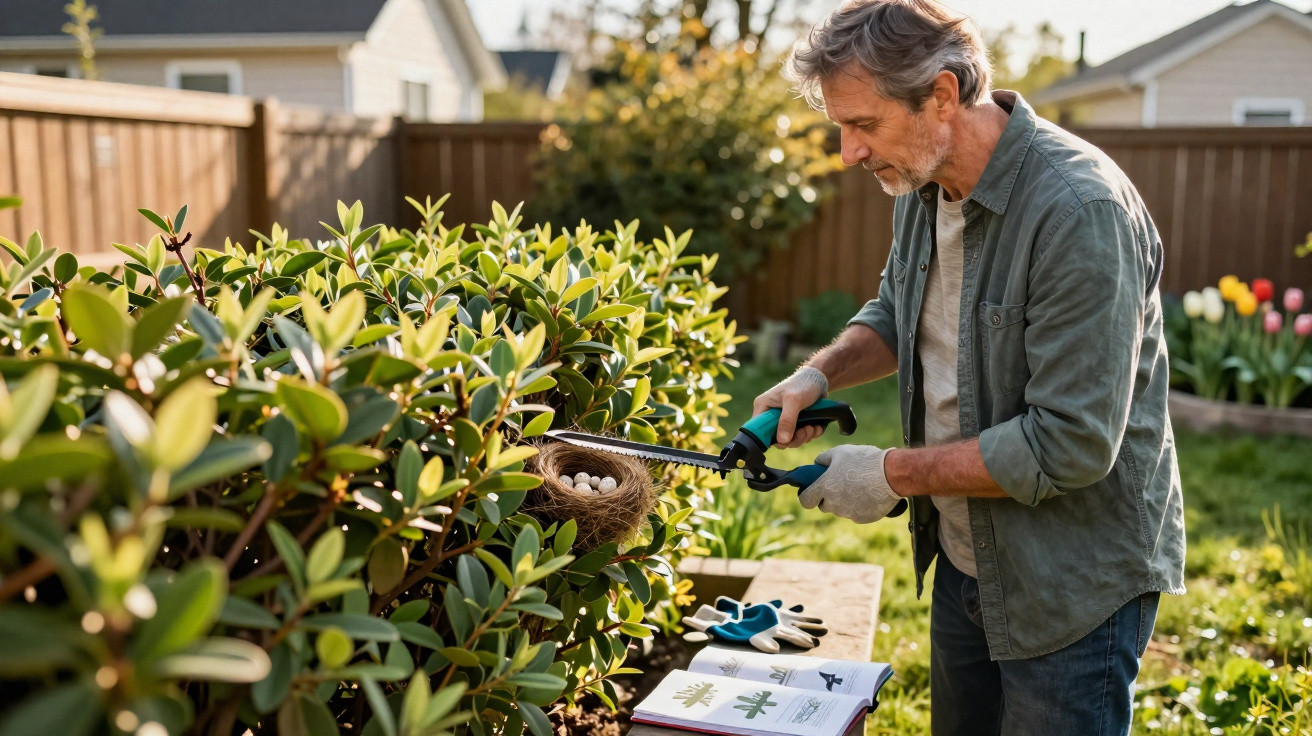
Many amateur gardeners face the same question in March: can you still cut back a hedge now - or will it harm wildlife and even land you in trouble?
Every year, the urge to keep the garden looking tidy clashes with the need to protect birds and other wild animals. If you reach for the hedge trimmer at the wrong moment, you can drive nesting birds away and disrupt a whole mini‑ecosystem. At the same time, a mix of dates, restrictions and advice circulates and can be hard to untangle. Knowing the rules, the recommendations and the best timing makes it much easier to plan calmly - and in a wildlife‑friendly way.
Why spring is such a sensitive time for hedges
As soon as the days begin to warm up, hedges quickly become sought‑after nurseries. Many songbirds build nests right inside the dense foliage, while others shelter close to the ground near the roots. Unfortunately, this is exactly when plenty of garden owners start doing a full “spring clean”.
A hard cut at this point doesn’t just damage nests. Adult birds can lose their young; many won’t attempt a second brood or will move to poorer, less suitable locations. Experts have been warning for years that bird numbers in Europe have fallen sharply - in some cases by a quarter in only a few decades. Species in heavily farmed landscapes have been hit particularly hard, with losses close to 60 percent.
Hedges are also far more than simple boundary lines. They act like lifelines across the landscape:
- Birds nest, rest and forage there.
- Grasshoppers, beetles and butterflies use them as shelter.
- Hedgehogs, amphibians and small mammals find cover.
- Bats navigate along hedge lines while hunting.
If a hedge is cut right back to the base during the main nesting season, this whole network is torn apart. By contrast, gentle care at the right time can keep the garden looking neat while still preserving habitat.
"In spring, a hedge isn’t just greenery - it’s a densely populated block of flats for birds and many other animals."
Legal position: who can cut when - and who should wait
In the underlying case, the detailed requirements come from agricultural policy: farms receiving state support often have clearly defined closed periods. Applied more broadly, it helps to separate two layers: what the law forbids and what ecology strongly advises.
The difference between agriculture and the private garden
Agricultural businesses that are tied into specific subsidy schemes frequently have strict conditions to meet. The key point is that hedges may not be cut - or only very limited work is allowed - during a fixed period in spring and summer. Breaking those rules can lead to payments being reduced or reclaimed and, in some cases, fines or even criminal proceedings.
Private individuals and many local authorities, by contrast, are usually covered by more general nature‑protection provisions. The typical approach is: major вмешательства to shrubs and trees during nesting season are prohibited; light maintenance can be permitted within limits, provided no nests are destroyed. The exact wording differs depending on the country or region.
Alongside the legal baseline, nature‑conservation bodies often publish clear guidance that goes further than the law. The message is commonly along these lines: it’s better to pause hedge maintenance from the second half of March until the end of July so birds and other wildlife are not disturbed.
| Group | Typical period with strong restrictions | Consequence for breaches |
|---|---|---|
| Agriculture with subsidy schemes | Spring to late summer (e.g. mid‑March to mid‑August) | Reduction of payments, fines, sometimes criminal proceedings |
| Private garden | Nesting season, usually spring to summer | Fines are possible if nests are destroyed or strictly protected species are disturbed |
| Local authorities, companies | Similar to private gardens, sometimes with extra requirements | Fines, and contractual consequences on commissioned work |
The practical takeaway is simple: even if there is no explicit criminal ban in a particular situation, that does not mean every cut is automatically harmless. If you disturb animals or destroy their breeding sites, you may still be breaching general nature‑protection rules.
"Legally, cutting from mid‑March may still be possible in some gardens - ecologically, in most cases it’s a poor time to do it."
Good practice: when it really is best to cut a hedge
If you want a garden that looks cared for but stays wildlife‑friendly, timing is the main factor. There are two periods when hedge cutting is usually much less problematic.
Ideal time windows for hedge cutting
- Late winter: January to February, on frost‑free days. Most birds have not started nesting yet, so more substantial trimming is often possible.
- Late summer: once the nesting season has finished, roughly from mid‑ or late August onwards. By then, young birds have fledged and many animals move to other cover.
During these windows, you can also tackle bigger corrections: narrowing hedges that have become too wide, thinning out overgrown sections, or removing dead branches.
How to check a hedge before you cut
If, for practical reasons, you must cut close to the sensitive period, you need to be exceptionally careful. This quick checklist helps:
- Stand back and look over the hedge from both sides and from above.
- Watch for repeated flight paths: are birds returning to the same spot?
- Gently part dense areas by hand and look for nests.
- Check the ground zone too - some species nest very low down or even in grass.
If you find a nest or chicks, the basic rule applies: stop cutting and leave that section untouched until the young have fledged.
Gentle trimming instead of drastic cutting
Beyond the date on the calendar, the way you cut matters just as much. A “shaved” hedge may look tidy, but for animals it can resemble a bare concrete wall.
What wildlife‑friendly hedge care looks like
- Work in smaller steps: regular light trims are better than a drastic cut every few years.
- Leave sections untouched: on long hedges, keep some stretches uncut so refuges remain.
- Maintain enough height: avoid cutting too low so birds still have cover and protection from cats.
- Leave some cuttings: keep part of the trimmings as a small deadwood pile at the edge - helpful for hedgehogs and insects.
It also pays to check your tools. Sharp blades give clean cuts and are kinder to the plant. Blunt equipment crushes shoots, which can encourage fungal disease and rot.
"A slightly ‘imperfect’ hedge usually supports far more life than a tightly clipped green wall."
Which plants make a hedge especially valuable
Not every hedge offers the same ecological benefits. Thuja or cherry laurel may be evergreen, but they provide relatively little for wildlife. Native shrubs with flowers and berries are very different.
If you’re reshaping a hedge over time or planting a new one, you can deliberately choose a mixed hedge. Typical choices include:
- Hornbeam - dense, hardy and easy to trim.
- Hawthorn and blackthorn (sloe) - flowers and thorns, excellent for birds.
- Lesser celandine, elder and wild rose - provide berries and rose hips.
- Privet (choose non‑toxic varieties) - popular with insects and birds.
Hedges like these provide blossoms, nectar, insect food and fruit throughout the year. Choosing species that are native to your area supports the animals that already live locally.
What to do if a nest appears while you’re cutting
It happens all the time: you’ve started trimming, and suddenly a nest is exposed right in front of you. That’s the moment to switch approach immediately.
- Stop cutting at once.
- Keep a safe distance - ideally leave a “protective ring” of uncut branches around the nest.
- Mark the spot (for example with a tie or a stick) so nobody accidentally carries on there.
- Watch quietly to see whether the adult birds keep returning; they often adapt quickly to the changed surroundings.
If you are unsure, contact your local council, a nature‑conservation authority or a bird‑protection group. Many organisations will advise informally on whether the area should remain off‑limits for longer, or whether small corrections might be possible later.
Why it’s worth seeing your hedge differently
Hedge cutting is no longer just about appearance. With the climate changing, gardens are becoming increasingly important refuges for species that can barely find space in intensively farmed areas. A single hedge won’t stop a species going extinct, but it can be a valuable link in a wider chain of habitats.
If you trim your hedge consciously and only at suitable times, you don’t just protect birds and hedgehogs - you also gain practical benefits. More insects means more pollinators for fruit trees; a dense hedge line slows the wind, holds moisture and can make the garden feel noticeably cooler on hot days.
A simple idea helps in day‑to‑day decisions: a hedge isn’t merely a green fence, but a living strip between home and the wider landscape. If you give it time to develop and intervene at the right moments, it will usually stay attractive for longer - while also helping, in a small but real way, to counter gradual biodiversity loss on your own doorstep.

Comments
No comments yet. Be the first to comment!
Leave a Comment