
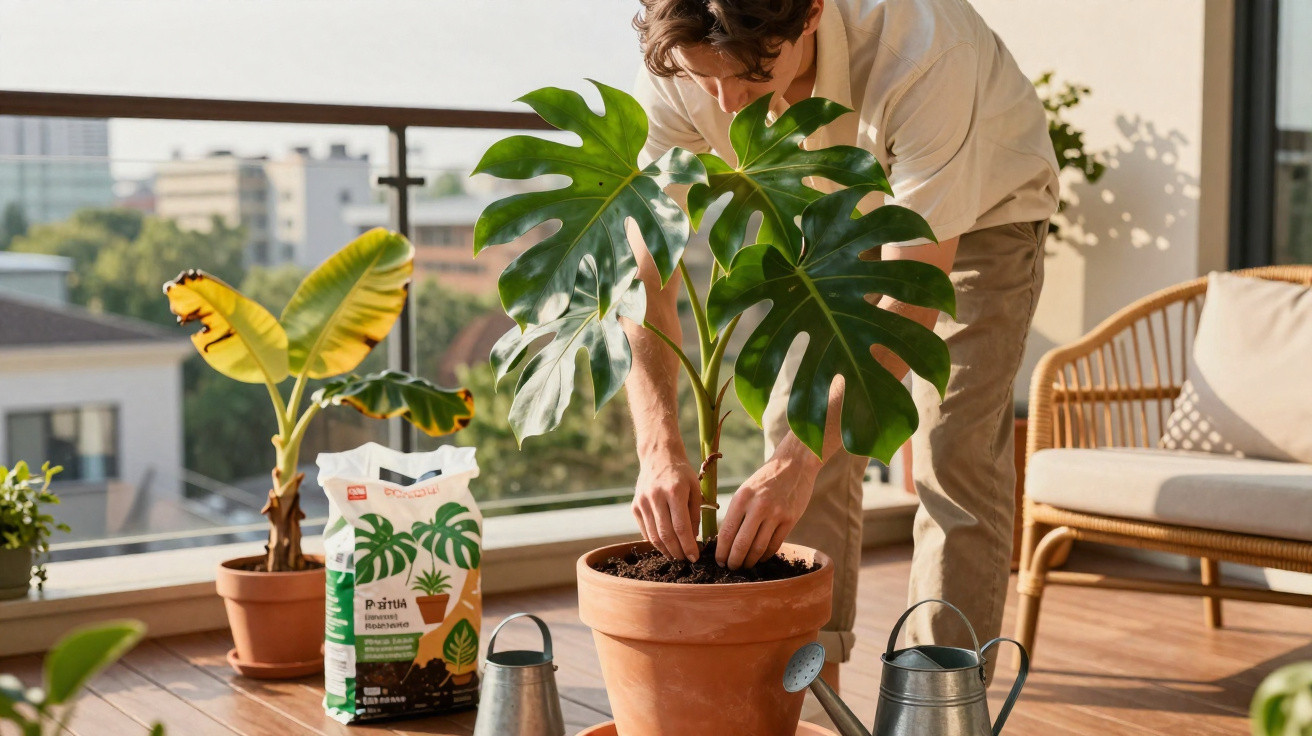
Many balcony owners dream of a jungle vibe – and regularly come unstuck with the delicate banana tree.
A different exotic offers the answer.
Big, glossy leaves, a dense green backdrop and that holiday-at-home feeling – that’s exactly what many city dwellers want on a balcony or roof terrace. Yet after winter, the reality is often a sad sight: battered banana clumps with brown leaves and soft, mushy stems. The good news is there’s a little-known shrub that delivers a tropical atmosphere all year round and copes surprisingly well with cold, wind and tight spaces.
Why the banana tree fails on many terraces
Visually, a banana tree is a guaranteed hit: enormous leaves, instant holiday mood, a hint of the Caribbean above the rooftops. But on many terraces, the day-to-day experience looks very different.
- Strong gusts rip the thin leaves like paper
- Cold snaps and late frosts turn the foliage black
- Persistent winter damp makes the waterlogged “trunk” rot
- In spring the plant restarts weakened and takes ages to look good again
The reason is down to botany. The classic banana tree isn’t a tough woody plant; it’s a herbaceous perennial with a water-rich pseudo-stem. That structure is extremely sensitive to frost. Damage can start around 0°C, especially in exposed positions on higher floors.
“If you plant a banana tree on a windy city terrace, you’re often buying yourself the same hassle every year: shredded leaves, brown stems, weak new growth.”
For that reason, garden professionals often recommend exotic-looking but far more frost-hardy alternatives for balconies and terraces. And that’s where a shrub comes in that many hobby gardeners still haven’t considered.
The quiet star: Fatsia japonica brings a jungle look without the drama
The shrub is called Fatsia japonica, commonly sold as the Japanese aralia. At first glance it can look like an extra-large houseplant, but in reality it’s a surprisingly resilient outdoor exotic.
Tough as a shrub, exotic like a tropical glasshouse
Fatsia develops true woody shoots, so it handles wind and cold far better than a banana plant. It tolerates temperatures down to about -15°C, as long as the compost isn’t left constantly waterlogged. That’s more than enough for many parts of Central Europe, particularly on sheltered city terraces.
Typical features of Fatsia japonica:
- In a container, usually 1.5 to 2 metres tall, ideally up to 3 metres
- Large, hand-shaped lobed leaves, 30 to 40 centimetres across
- Thick, leathery foliage with a glossy surface
- Stands well even with frequent wind and draughts
- Prefers partial shade and manages with little direct sun
The effect is instant “jungle feeling” without having to create truly tropical conditions. Placed near a wall or balcony parapet, a single specimen in a large pot quickly becomes a lush green backdrop that frames furniture, lanterns and décor beautifully.
An ideal match for a city roof terrace
Many urban terraces share the same challenges: it’s windy, often shaded, space is limited, and surfaces can heat up strongly in summer. That’s precisely where Fatsia shows its strengths. It likes partial shade, copes with reflected heat from concrete and walls, and doesn’t need constant staking or tying-in.
“Where banana leaves hang in tatters, the Japanese aralia often stays remarkably unmarked – a clear plus for anyone looking for low-effort terrace planting.”
How to plant Fatsia japonica correctly in spring
The best time to plant is late spring, once night frosts are no longer a risk. In Central Europe, many gardeners use the mid-May frost dates as a guide. After that, Fatsia settles into pot life most comfortably.
Choosing the right pot and compost
- Pick a large, heavy container: The diameter should be around 20 to 30% bigger than the nursery pot. A sturdy, heavier pot helps prevent the plant from toppling in the wind.
- Add a drainage layer: Put 3 to 4 centimetres of expanded clay or coarse gravel in the base so excess water can drain quickly.
- Mix the growing medium: Two thirds quality green-plant compost, one third garden soil or well-rotted compost. This blend holds nutrients without staying too wet.
- Position the plant: Loosen the root ball slightly, set it in the centre, backfill, and water well so no air pockets remain.
The container should never sit permanently in water. A saucer is useful, but in winter any excess water must be tipped away regularly to prevent root rot.
The best position on a balcony or terrace
Fatsia likes light but not harsh sun. A spot with morning or evening sun, protected from strong midday sunshine, suits it perfectly. Side protection from a wall or glass balustrade also helps keep the large leaves looking good for longer.
- Partially shaded position, ideally close to a house wall
- No constant funnelled draughts, though normal air movement is fine
- Raise the pot slightly so water can drain freely from the bottom
“On very windy roof terraces, the advantage of woody growth becomes obvious: the Fatsia moves, but it keeps its leaves – unlike many tropical perennials.”
Everyday care: little effort, big impact
Compared with many exotic container plants, the ongoing care is manageable. Stick to a few basics and you can enjoy your “terrace aralia” for years.
Watering, feeding, pruning
In summer the plant needs regular watering; in winter, much less. The simplest check is to feel the top centimetre of compost with a finger. If it’s dry, water; if it’s still moist, wait.
- Summer: water every few days, depending on the weather
- Winter: water very sparingly, just enough to stop the root ball drying out completely
- Feeding: two applications of slow-release or liquid feed in spring are usually enough for container plants
- Pruning: remove only brown or damaged leaves; shorten lightly if needed to keep shape
For winter, it’s best to pull the pot close to a sheltered wall. During cold spells, a simple fleece wrap around the container helps; in extreme sub-zero conditions the plant can be moved temporarily into a cool stairwell or a bright, frost-free room.
Glossy leaves with simple household helpers
Fatsia’s appeal largely comes from its large, shiny leaves. Dust from city air and pollen can dull that surface over time. A small monthly routine keeps the characteristic gloss.
A soft cloth, lightly dampened with a mixture of still mineral water and flat, pale beer, is enough. The thin film helps condition the leaf surface, removes grime, and many hobby gardeners regard it as mild protection against some pests. The key point: don’t soak the leaves – simply wipe them gently.
“Clean, glossy leaves massively boost the jungle effect – especially on small terraces, where every plant counts visually.”
Who benefits most from Fatsia
Japanese aralia is especially well suited to people with limited space but high expectations of how their outdoor area should look. One or two large pots can turn an entire terrace into a green lounge, without constant moving, staking or complicated overwintering.
For families with children, the shrub often feels more appealing than spiky plants. The foliage looks exotic, yet it’s robust enough to cope if a ball knocks into it during play. For busy professionals, it’s an attractive option because it fits into short care windows: a few minutes at the weekend for watering and a quick check is usually sufficient.
If you already grow container plants such as hydrangeas, olive trees or ornamental grasses on the terrace, Fatsia slots in easily. It creates a rich green background that makes flower colours and pale materials stand out more strongly. It looks particularly cohesive alongside:
- Grasses in pots that add movement to the scene
- Light-coloured terrace furniture or lounge sets
- Lanterns, fairy lights and warm-white lighting
If you’re thinking long-term, there’s another advantage as well: unlike many annuals or frost-tender exotics, Fatsia doesn’t need replacing every year. With each season it becomes denser and fuller, so the “rainforest effect” actually increases. For urban gardeners who want a green retreat without having to start over again and again, that’s a compelling point.
Comments
No comments yet. Be the first to comment!
Leave a Comment