
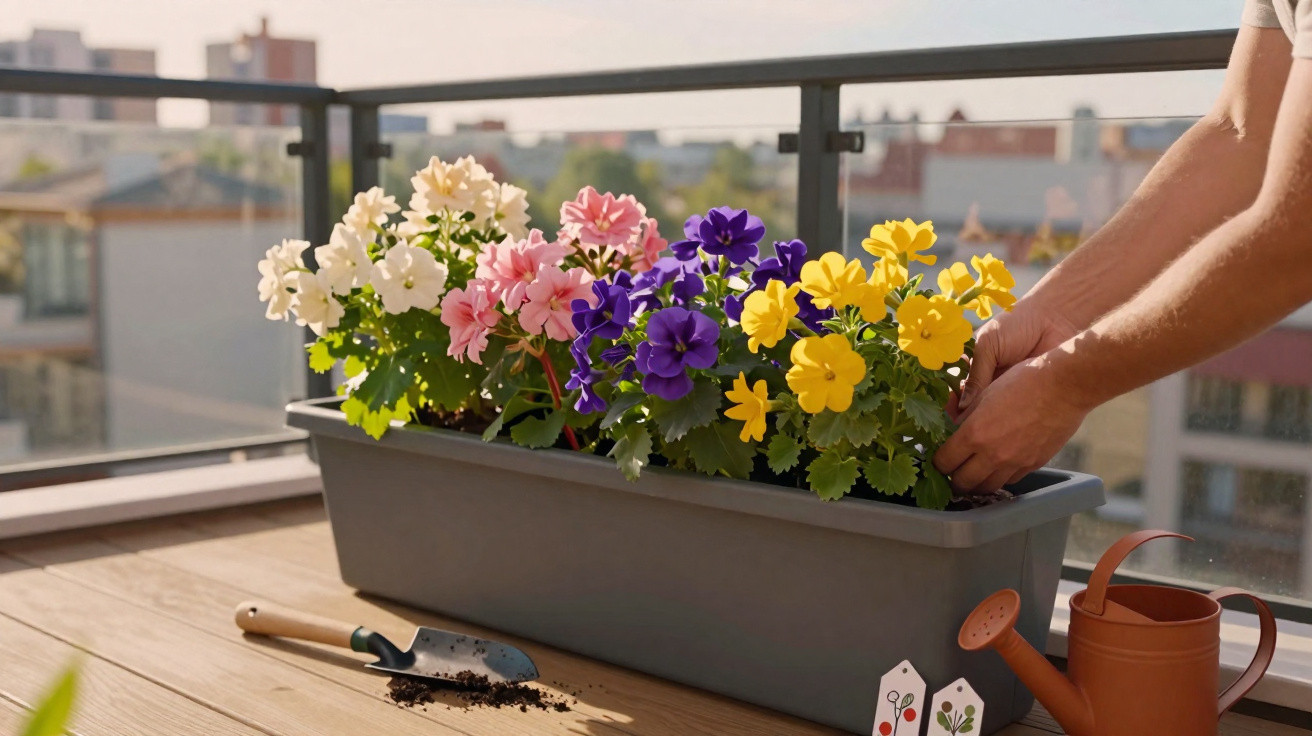
Buying new balcony plants again and again, only for them to die miserably after the first frost?
It doesn’t have to be that way.
Plenty of hobby gardeners know the routine: plant geraniums in May, everything turns brown by October, and in November the entire planter ends up in the bin. Professionals in nurseries and garden centres do it differently - their balconies and terraces still look colourful in January. The secret isn’t pricey specialist feed; it’s a smart choice of a few exceptionally tough perennials and the way the planter is built.
The professionals’ secret: one planter box for all four seasons
Gardeners don’t think season by season - they work in a relay. Their approach is a “four-season jardinière”: one planter box with just four hardy perennials, each taking the lead in a different season, and all of them coping down to around -15 °C.
“The goal: plant once in autumn, then colour 365 days a year - without constantly buying new plants or replanting.”
In winter, the plants may die back to some extent, but they don’t disappear. The foliage of certain varieties stays visible as the structure, while others pause and then surge back when the next light window arrives. If you plant in September or October, the roots get enough time to anchor before the first hard frosts. From then on, the system more or less runs itself.
The winning quartet: four perennials that replace any geranium
In the professional planter, four rugged, long-lived bloomers share the space. They take turns so you don’t end up with ugly gaps.
- Winter - Christmas rose (Helleborus): Flowers from December to March, often even beneath snow. Its dark, tough foliage keeps the planter looking full when everything else feels empty.
- Spring - Aubrieta or cushion bellflower: From April, thousands of small flowers cover the planter edge like a carpet.
- Summer - Gaura (Gaura lindheimeri): Delicate, floating clouds of flowers right up to the first frosts, and highly heat-tolerant.
- Autumn - Autumn aster: From September to November it delivers strong violet, pink or blue tones when other plants have already given up.
The thinking is simple: while one plant is having its moment, the others sit back - but they remain present and keep the overall picture alive.
Why this method works: light, soil and rhythm
The technical term is photoperiod - the length of the day. Each of the four plants responds to a different light window and starts flowering when the daylight hours match “its” season. That creates a natural handover: spring follows winter, summer takes over from spring, and asters provide the final sprint in autumn.
Soil in the planter is just as important as light. Many balcony plants don’t fail because of cold, but because of waterlogging. A wet, compacted box makes roots rot long before temperatures truly drop.
Without good drainage, even the toughest perennial becomes disposable - the right planter mix is what decides between success and frustration.
Professionals rely on a loose substrate with excellent drainage:
- good-quality compost
- plus around 20% coarse sand or perlite
- and a depth of at least 40 cm
That depth provides enough root room and a buffer against drought and heat. The coarse components ensure excess water drains quickly instead of sitting in the planter.
How to create an all-year balcony, step by step
1. Choose the right planter
Many balcony boxes are simply too shallow. If you want a box that flowers year-round, check for the following:
- at least 40 cm depth
- several drainage holes in the base
- a layer of expanded clay pellets or gravel as drainage at the bottom
- sturdy brackets, because a deep box filled with compost and water becomes properly heavy
2. Plant in autumn - not spring
For this idea, early autumn is ideal - preferably September or early October. The compost is still warm, the sun is no longer relentless, and the plants can root in without stress.
Method:
- Add the drainage layer, then fill with substrate to just below the rim.
- Place the Christmas rose slightly off-centre, as it will form the winter focal point.
- Plant aubrieta or cushion bellflower along the front edge so it can trail nicely later.
- Put the gaura on one side and the aster on the other so the height is balanced.
- Water thoroughly to settle everything and avoid air pockets in the compost.
3. Water, cut back, done - it needs very little more
After planting, water well once so the substrate settles. After that, the rule is: water less often, but deeply. The water should reach the roots rather than merely dampening the surface.
Another professional tip: don’t keep feeding. These perennials aren’t high-speed, high-output bloomers like classic seasonal balcony favourites. They do need nutrients, but only in moderation. A slow-release feed in spring is usually more than enough.
After each major flowering phase, a quick tidy-up is worthwhile:
- remove spent stems from the Christmas rose and the asters
- trim the gaura lightly if it gets too long and straggly
- only lightly clip cushion plants so they stay compact
Balcony aspect: north, south, windy - how to adapt the planting
Not every balcony is the same. A draughty, full-sun south-facing balcony needs different care from a sheltered north-facing loggia.
| Balcony type | What it’s like | Adjustment |
|---|---|---|
| South-facing balcony, full sun | Hot; the box dries out quickly | Mulch well, water deeply on a regular basis, and use lighter-coloured planters so they don’t heat up as much. |
| North-facing balcony | Little direct sun; often cool | Swap light-loving gaura varieties for more shade-tolerant perennials; the Christmas rose is especially happy here. |
| Very windy position | High evaporation; plants dry out | Fix the planter against the wall, add some wind protection (e.g. a bamboo screen), and choose robust varieties. |
The core principle - four perennials working in a relay - stays the same. Only the varieties need small tweaks depending on light and wind. If your spot is very shady, for example, you can replace gaura with a shade-tolerant, summer-flowering perennial.
Why it’s genuinely worth saying goodbye to geraniums
Geraniums can look lush in summer, but they’re a classic single-use model: buy once, flower once, then throw away. A four-season planter saves money and hassle over time - and produces far less plant waste.
Once it’s planned properly, a single planter replaces several rounds of buying from the garden centre - and still looks photo-ready in January.
There’s also an emotional benefit: seeing a balcony with a flowering Christmas rose in February, or being greeted by glowing asters in October, changes how you experience the space. The terrace shifts from a summer-only spot to a genuine year-round zone.
Practical extra tips: colours, combinations and mistakes to avoid
When it comes to colour, it pays to sketch out a rough idea in advance. If you view the planter as a focal point from the living room, for example, you might opt for a calmer palette:
- Tone on tone: white, cream, soft pink for an elegant, understated look.
- Strong contrasts: violet, deep pink, rich blue for more impact on a city balcony.
- Natural look: pastel shades and plenty of single, open flowers to attract insects.
Most common mistakes come from well-meant overenthusiasm: cramming too many plants into a small box, repotting constantly, or mixing plants with very different watering needs. The four-perennial formula works precisely because it stays manageable. A small number of well-matched perennials grow together into a stable system.
If you enjoy experimenting, you can add subtle extras through the year: tuck small bulbs between the perennials in spring, or set a few ornamental grasses in pots beside the box in late summer. The base stays unchanged, yet the balcony still feels different again and again.




Comments
No comments yet. Be the first to comment!
Leave a Comment