
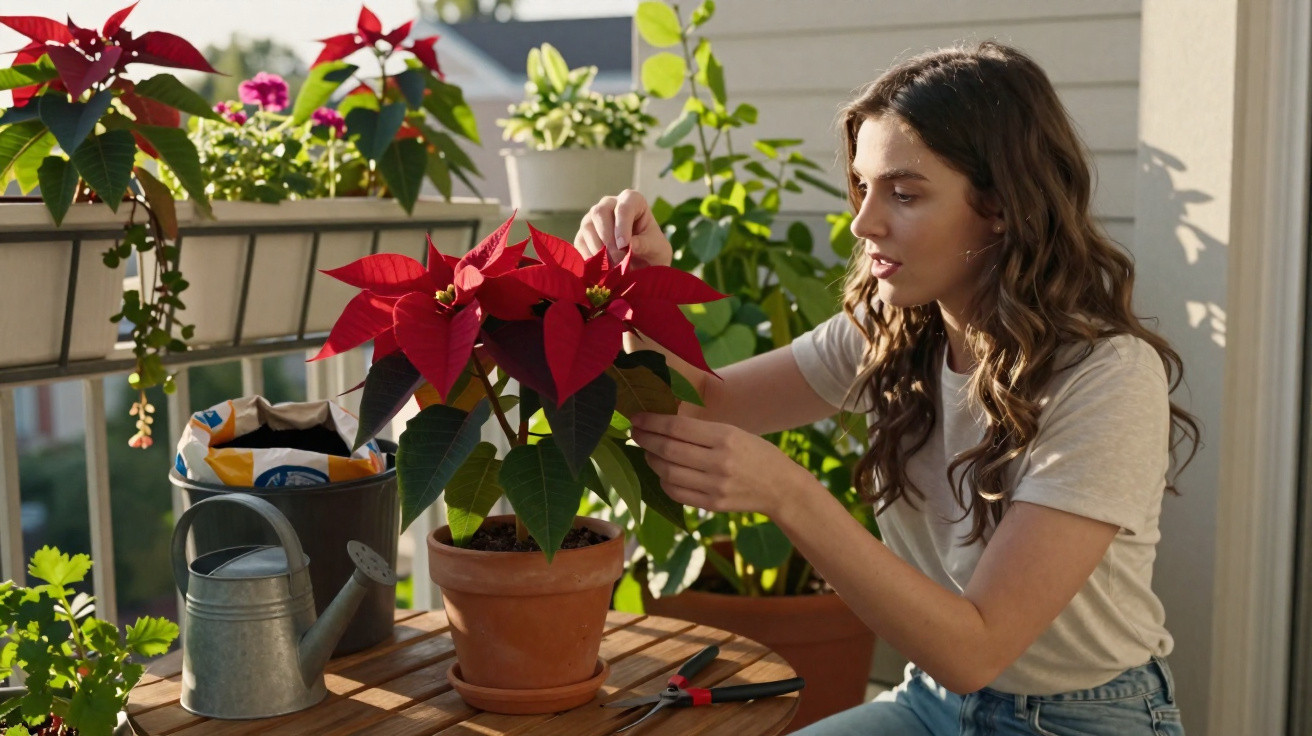
After the festivities, a poinsettia often looks rather miserable: the red bracts fade, a few leaves drop, and the pot ends up on the balcony-or straight in the bin. That is exactly where things go wrong. Between March and April, you effectively decide whether your poinsettia becomes a one-season decoration, or whether it carries on as a strong houseplant all summer and shows colour again in time for next Advent.
Why poinsettias look so limp after Christmas
The poinsettia (botanical name Euphorbia pulcherrima) is a classic seasonal star in our living rooms. In shops it is sold at its peak-lush foliage and vivid red, creamy white or pink bracts. Behind the scenes, though, this plant follows its own internal rhythm.
- Growth habit: 30–60 cm tall, 30–50 cm wide in a pot
- Position: Bright, but not in full sun
- Temperature: Happy above 13 °C, not frost-hardy
- Leaves: Evergreen indoors; drops leaves when stressed (draughts, waterlogging, heat from radiators)
In late winter, what many people interpret as “dying” is actually a rest period. The plant uses less energy, growth slows to a standstill, and the showy bracts lose their intensity. If you keep watering as you did in December, you can damage the roots-and later you end up with bare stems and brown leaves.
"A poinsettia usually doesn’t die of old age-it dies from well-meaning but incorrect care between March and April."
In March: respect the winter rest instead of ‘loving it to death’
March is when the most important shift happens: you accept that your poinsettia is resting. During this stage it needs less of everything-less warmth, less water, and less fuss.
The best spot during the resting phase
Move the pot to a bright place that is on the cooler side. Ideally aim for 13 to 16 °C-such as a light stairwell, a cool bedroom, or a lightly heated hallway. Key points:
- Don’t place it directly above a radiator
- Avoid icy draughts from a tilt-and-turn window left ajar
- Don’t sit it in harsh midday sun on the windowsill
This reduces stress and helps stop the remaining leaves from dropping even faster.
Avoid watering mistakes in March
At this time of year, many poinsettias simply rot in their pots. The roots stay constantly wet because people keep watering “by the calendar”. A far better approach is a simple, strict rule:
- Water only when the compost is almost completely dry
- It can easily be two to three weeks between waterings
- Always empty any water in the saucer straight away
Check the compost with your finger: if it still feels slightly damp, wait. When the surface turns pale and crumbly, give a modest drink. One thorough watering and then leave it alone-your poinsettia will prefer that now to frequent little top-ups.
Tidy gently-don’t cut it back hard
This is when many people reach for the shears and chop the whole plant down to a few centimetres. That is rarely necessary. Instead:
- Remove only clearly dried-out, brown leaves with care
- Cut dead shoots back to healthy green growth
- Wear gloves when handling it-the milky sap can irritate skin
With this low-key routine, a poinsettia typically gets through March without drama. It is building reserves for its restart-usually in April.
In April: a gentle restart with a new pot and fresh compost
When you spot small, fresh green shoots on the stems-often in April-the plant is waking up. This is the moment to set it up for strong summer growth.
Repotting-sensibly, not excessively
Repotting in spring is worthwhile, especially if your poinsettia has been sitting in the same compost since you bought it. Choose:
- A pot only one size larger than the current one
- A base with drainage holes so water cannot sit
- A good-quality houseplant compost, ideally lightened with expanded clay or perlite
Lift the plant out carefully, loosen the rootball a little, and remove any matted or dead roots. Then place it into the fresh compost and water in lightly. Don’t drown it-the roots need time to re-establish.
Adjust light, temperature and watering frequency
In April, poinsettias want more light again, but they still burn in strong sun. A bright windowsill with filtered light is ideal-such as a north- or east-facing window. Room temperature can comfortably be around 18 to 20 °C.
Watering should increase compared with March, but it still needs control.
- Do a finger test: if the top layer is dry, you can water
- Use water at room temperature, preferably low in limescale
- Avoid constantly wet compost and any “standing puddle” in the outer pot
"If you stay patient in April instead of overwhelming the plant with water and fertiliser, you’ll be rewarded in early summer with fresh, dense greenery."
Late April to summer: turning a decoration into a real green houseplant
From late April, the poinsettia enters its active growing period. Shoots extend, and the foliage fills out. Now it pays to keep a steady routine.
Regular watering and feeding
During this phase the plant needs more nutrients to produce strong leaves. A liquid feed for flowering plants or green houseplants works well. A straightforward plan:
- Add a little fertiliser to the watering can every two to three weeks
- Never feed onto bone-dry compost-moisten it lightly first
- Poinsettias often respond particularly well to very soft tap water or rainwater
For watering, you can now follow a more even schedule-roughly once or twice a week-depending on pot size, room temperature and position.
Summering outdoors on a balcony or patio
Once night frosts are no longer a risk-usually from mid-May-your poinsettia can go outside. Make the change gradually:
- For the first week, put it outside only for a few hours at a time
- Pick a semi-shaded spot, for example under a table or beside taller plants
- Avoid direct midday sun at first, otherwise leaf scorch is likely
Outdoors, a poinsettia often becomes surprisingly bushy. With one or two light shaping trims in early summer, you can train it into a compact plant that hardly anyone would recognise as last year’s “Christmas decoration”.
Getting ready for next Advent: using light and darkness
To bring back the familiar red bracts, the poinsettia needs a strict day–night rhythm in autumn. In its native habitat, plants grow where day length is consistent and clearly defined-and they react strongly to that.
To encourage the bracts to colour up, the following approach helps from around the beginning of October:
- Provide about 14 hours of complete darkness every day (for example in a cupboard or under a light-proof cover)
- Keep it up consistently for 8–10 weeks
- During the light phase, keep it bright but out of direct sun
The stronger your poinsettia has grown through spring and summer, the more impressive the later colouring is likely to be. Once you try this rhythm, it quickly becomes clear: this plant isn’t disposable-it can be a dependable companion from year to year.
Practical tips, risks and smart pairings
One detail that is often overlooked is the poinsettia’s milky sap. It belongs to the spurge family. Many people tolerate the sap without issues, but some develop skin irritation. Pets should not chew the leaves-cats in particular can develop stomach problems if they ingest larger amounts.
Poinsettias also work well alongside other houseplants with similar needs:
- With spider plants or peace lilies in semi-shade
- With smaller ficus varieties in brighter positions
- With ferns, if humidity is a little higher
If you’re unsure whether your poinsettia is still alive, gently scratch the bark on a stem. If you see fresh green underneath, the effort in March and April is almost always worthwhile. Even half-bare plants can push out vigorous new growth in spring-provided you don’t waterlog them beforehand.
Ultimately, success with this plant comes down to following its yearly rhythm: a short, colour-packed display in winter; a quiet retreat in March; a careful restart in April; and then months as a robust, tropical-looking green houseplant. Once you internalise that pattern, you’re far less likely to throw a poinsettia away-and more likely to treat it like a reliable housemate that returns to its best form each year.



Comments
No comments yet. Be the first to comment!
Leave a Comment