
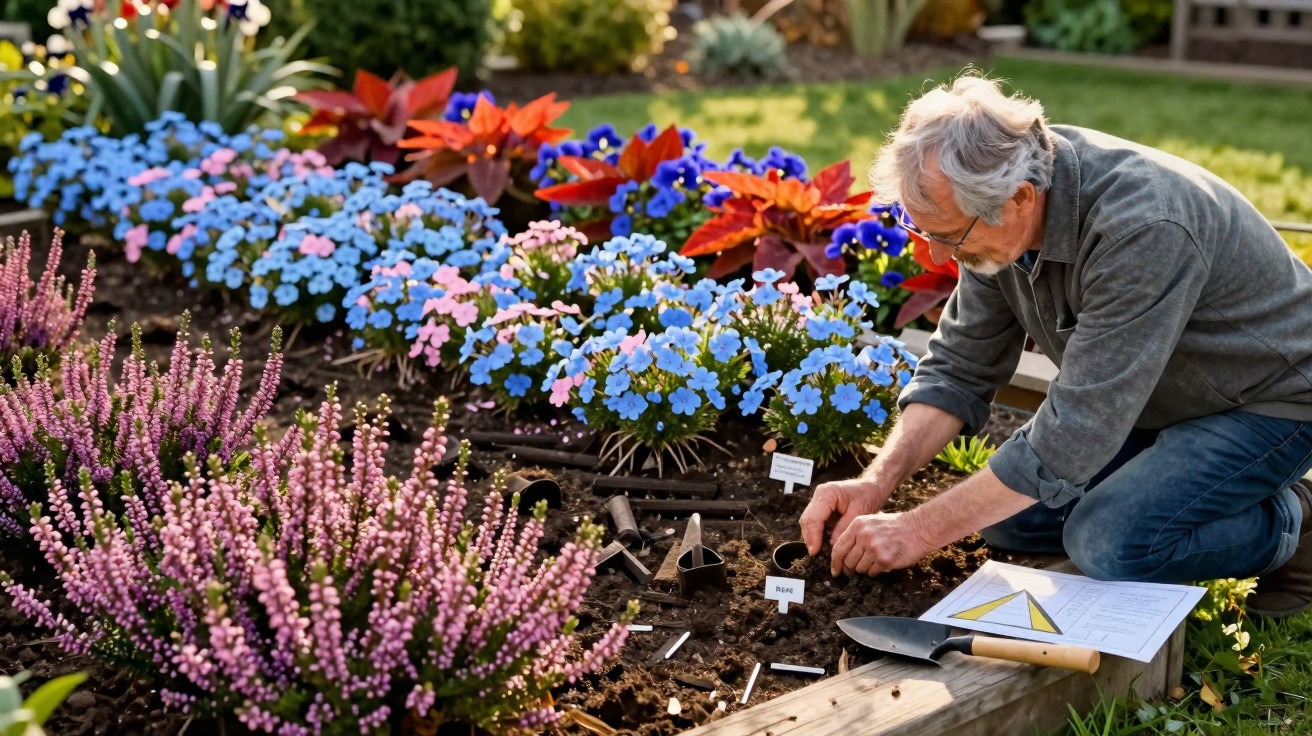
With the right planting mix, a border can stay colourful 365 days a year.
A border that never looks bare, leaves weeds little chance, and keeps flowering year after year with minimal effort is a common ambition for many keen gardeners. The trick isn’t hunting down exotic rarities, but choosing three well-matched ground cover plants that take turns through the seasons. Understand how they work together, follow a few straightforward planting rules, and you can create a surprisingly low-maintenance, ever-blooming carpet.
Why ground cover plants are the secret ace in an ornamental garden
Ground cover plants often get dismissed as dull, or criticised as “bullies” that push out other plants. In practice, they can be the very thing that keeps a border looking good when everything else is flagging. Many are hardy, perennial plants that tolerate frost well below 0°C and return reliably every year.
Perennial, creeping plants tackle several jobs at once:
- They cover exposed soil and help prevent it drying out.
- They suppress weeds because very little light reaches the soil surface.
- They protect soil from erosion on slopes and banks.
- They add structure and colour when other plants are taking a break.
"Combined properly, three different ground cover plants form a living ribbon of colour all year long - without constant replanting."
The key point is that this is not about planting any random mix. It’s a deliberate trio whose flowering times and growth habits support one another rather than compete.
The 3-part formula: a trio for 365 flowering days
The idea can be boiled down to a simple formula: three creeping perennials, five young plants per square metre, planted within the right time window. That’s enough to build a long-lasting flowering band that provides colour from January right through to December.
The proven trio is:
1. Winter heather (Erica carnea) – colour in the depths of winter
While the garden is still dormant, winter heather gets going. Depending on the weather, it flowers from January to April, producing countless small bell-shaped blooms in white, pink, or purple.
- Position: sunny to partially shaded
- Soil: slightly acidic, loose, well-drained
- Stand-out feature: stays green through winter, so it keeps the border looking structured
During this period, it visually takes centre stage, while the other two partners are still building strength “below the surface”.
2. Cushion phlox (Phlox subulata) – a flowering carpet in spring and summer
From around May, cushion phlox moves to the foreground. It forms dense, low mounds that read as a continuous carpet of flowers, bridging the transition from spring into summer.
- Flowering period: roughly May to August
- Colours: white, pink, lilac, blue - depending on the cultivar
- Height: usually just 10–15 cm, making it ideal at the front
As winter heather finishes and slips back into the role of a green backdrop, phlox takes over the colour. Its tight growth closes gaps that would otherwise be quickly colonised by weeds.
3. Leadwort (Ceratostigma plumbaginoides) – autumn flowers with fiery foliage
As autumn arrives, the third partner comes into its own: creeping leadwort. It produces vivid blue flowers while its leaves turn a strong red at the same time - a high-contrast display that carries from September into December.
- Flowering period: broadly September to December
- Effect: blue flowers plus reddish autumn foliage
- Position: sunny to partially shaded, preferably on the warmer side
"Winter heather, cushion phlox and leadwort take turns through the year - each plant shines in its own window."
When leadwort is at full strength in autumn, heather and phlox use the period to build reserves without demanding attention. That handover prevents any “gap” in the seasonal display.
How three ground cover plants grow together without smothering each other
Many gardeners avoid mixed ground cover planting because they worry one plant will overrun the others. The solution is “layering” - both below ground and above it.
These three perennials differ in:
- root depth and how they spread
- nutrient demand
- flowering time and growth rhythm
In effect, they occupy different levels within the border. One roots more shallowly, another a little deeper. One pushes on in spring, while another only really surges in late summer. That separation reduces competition significantly.
When one species is in a resting phase, the other two can make use of the space at the surface. The border stays visually full without the plants forcing each other out. This kind of “stratification” mirrors natural plant communities, where it’s rare for just one species to dominate.
Planting plan: triangles instead of rows create a calmer look
Planting ground cover in straight lines can look artificial and rigid - and it often leaves channels where weeds can shoot up. A triangular layout is both more attractive and more effective.
"Allow five young plants per square metre - arranged in small triangles in which the three species alternate."
A practical approach:
- Roughly mark out the area and mentally split it into triangles.
- Plant a different one of the three perennials at each “corner” of a triangle.
- Make sure you don’t create large islands made up of only one species.
This produces a natural, mosaic-like surface. Transitions between winter, summer, and autumn flowering plants appear softer. Where one plant grows a little less strongly, neighbouring plants fill the space. Beginners can simply stagger plants rather than lining them up perfectly straight - the effect largely takes care of itself.
The right timing and the ideal quantity
For this method to work, it’s less about expensive cultivars and more about two straightforward essentials: when you plant and how densely you plant.
| Criterion | Recommendation |
|---|---|
| Planting time | Mid-October or early spring |
| Density | 5 young plants (pots) per square metre |
| Number of species | Stick consistently to three species |
Plant more densely and you will cover the ground faster, but you’ll lose airflow and definition. Space them too far apart and you’ll be battling weeds for longer, only getting a closed carpet after several years.
Day-to-day care: fewer weeds, hardly any replanting
Once the area has knitted together, the workload drops noticeably. Because the soil is shaded almost continuously, only a few weeds manage to force their way through the carpet. Still, it’s worth doing an occasional check and removing any more vigorous intruders.
Typical places to use this planting style:
- slopes and banks that are awkward to mow
- edging along paths or driveways
- small front gardens that need to look presentable year-round
- gaps between shrubs or beneath light, open-canopy trees
A light trim after flowering can encourage denser growth. Feeding should be modest; many ground cover plants cope well with poorer soils and often form tighter, healthier cushions there.
What to watch for with site conditions and combinations
For the trio to work smoothly, all three plants should suit broadly similar conditions. A sunny to partially shaded spot with free-draining soil is ideal. Waterlogging is especially damaging for winter heather and leadwort.
If you’re unsure whether your soil is suitable, work in a thin layer of sand or fine grit before planting. This improves drainage and helps prevent root rot. In very heavy, clay-rich ground, a slightly raised bed can even be worthwhile.
Useful to know: this three-plant combination can be expanded with a few specimen perennials or ornamental grasses. Taller plants can rise like “islands” out of the ground cover carpet, as long as they don’t cast dense shade across the whole area.
Practical examples and common mistakes to avoid
For a narrow border along a footpath, you can place more cushion phlox at the front, then plant winter heather and leadwort mixed behind it. That keeps the low edge attractive while different colours flare up behind it over the seasons.
Common mistakes include:
- using too many different species in the same border
- irregular spacing that leaves large bare holes
- choosing a site that stays too wet
- feeding too heavily, which makes plants soft and more prone to disease
If you stick to the simple three-part formula and consistently plant five plants per square metre, you’ll usually have a closed, stable system after one to two years. After that, the border largely looks after itself - and delivers what many neighbours notice with surprise: a planting that practically never appears empty.




Comments
No comments yet. Be the first to comment!
Leave a Comment