
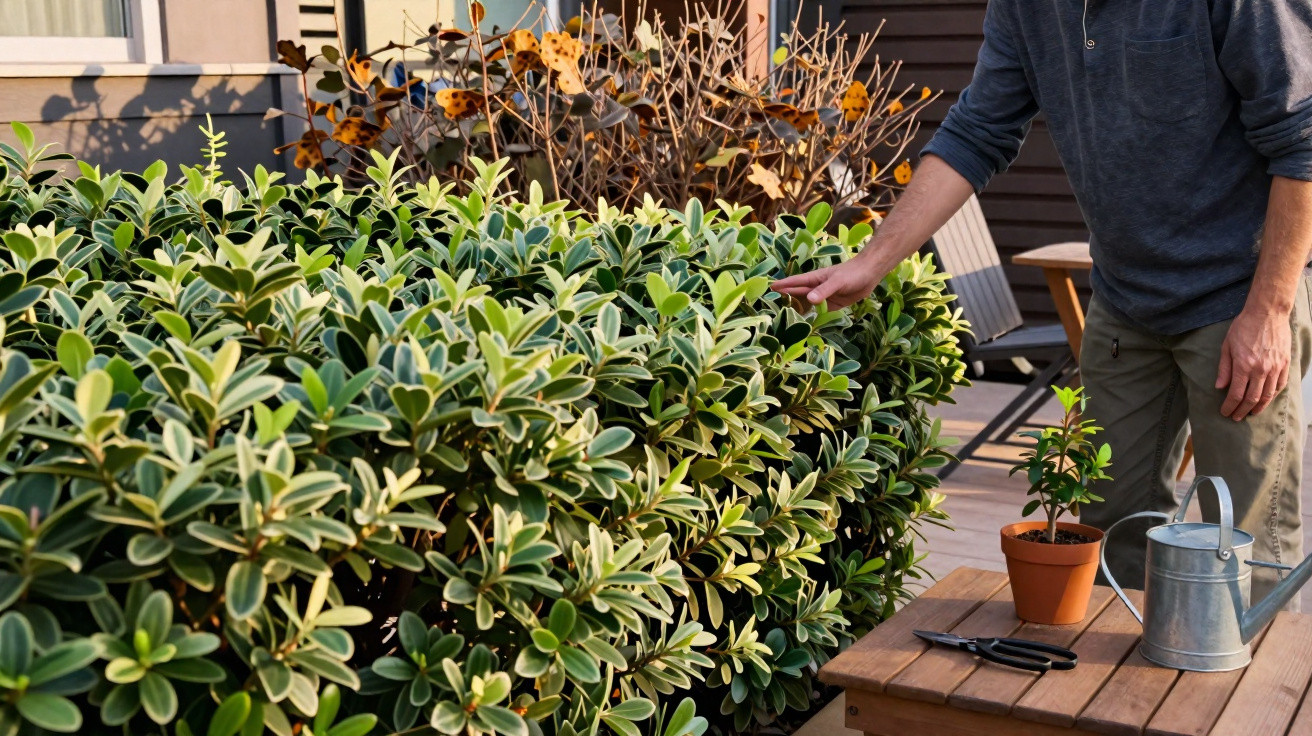
Many garden owners are at their wits’ end with holey, failing Photinia hedges - and another surprisingly low-fuss shrub is now quietly stepping into the spotlight.
Anyone who has backed the fashionable Photinia ‘Red Robin’ in recent years often ends up facing a dispiriting sight: bare branches, brown blotches and an endless cycle of sprays. While entire neighbourhoods complain about their hedges’ rapid decline, a previously underestimated alternative is moving to the front: Pittosporum. What makes it so resilient - and is switching worth considering in the German-speaking region?
Why Photinia fails in so many gardens
Spotted leaves, thinning hedges: the fungal issue
The former star of front-garden hedging has a serious health weakness. A specific leaf fungus can hit Photinia hard. It typically begins with small brown spots on the foliage. These quickly spread; the leaves stop functioning properly, dry out and then drop.
"What started as a dense privacy screen often ends up as a gappy thicket of sticks - with privacy completely lost."
Mild winters and damp springs are especially problematic. In these conditions the fungus thrives, multiplies rapidly and can move through entire lines of plants. In many new-build areas, you can now see hedges stretching for long distances all collapsing at the same time.
High effort, little reward
Many homeowners try to fight back by doing the following:
- spraying fungicides several times a year
- frequent pruning to remove infected shoots
- constantly collecting and disposing of diseased leaves
Even with all that work, results are often disappointing. Costs rise, patience wears thin, and the fungus usually returns the following year - frequently worse than before. For keen but time-limited gardeners, that’s often the point where they start looking for a more sustainable solution.
The limits of a fashionable hedge have been reached
This decline strongly echoes what happened to Thuja hedges some years ago. Back then, too, a single species was planted on a massive scale. Once diseases and pests take hold, such monocultures have very little resilience.
Garden professionals have been noticing a clear shift in mood for some time. Photinia is being requested less often, and many nurseries are reducing their stock. In its place, tougher species are gaining ground - and that is exactly where Pittosporum’s quiet rise begins.
Pittosporum: the new favourite for dense, modern privacy hedges
Evergreen, colourful and shape-holding
Pittosporum originates from warmer regions, yet in many Central European locations it proves surprisingly adaptable. As a hedge shrub, it brings several qualities that really matter:
- Evergreen foliage: year-round screening, including in winter
- Dense branching: becomes private after only a few years
- Moderate growth: usually 20–30 cm of growth per year, easy to keep under control
- Attractive leaves: depending on the variety, green, grey-green or strikingly variegated
Many varieties have slightly glossy, almost leathery leaves. This not only looks refined, it also creates a calm, graphic backdrop in borders for perennials or ornamental grasses. For modern front gardens, that look is a clear advantage.
Significantly lower disease pressure
Pittosporum’s biggest strength is its sturdiness against the typical leaf fungi that trouble Photinia. In practical terms, that means:
- a much lower risk of major leaf loss
- little need for chemical plant protection
- hedges staying evenly dense over many years
"Pittosporum isn’t considered indestructible, but it is widely seen as a far more dependable partner for anyone who wants a hedge without constant stress."
For many garden owners, the environmental angle now matters too. If you want to avoid spraying, you need plants that are naturally more robust - and here Photinia is clearly at a disadvantage.
Low-maintenance rather than labour-intensive
Planting Pittosporum doesn’t mean doing nothing, but the workload is usually manageable:
- Pruning: one light shaping cut per year is often enough
- Watering: water regularly during the first years after planting, later only in extended dry spells
- Feeding: a little organic fertiliser or compost in spring is sufficient
Many varieties cope with both sun and bright partial shade. On very heavy, waterlogged soils growth can stall; a drainage layer can help, or plant on slightly raised strips.
How to use Pittosporum as a privacy screen in your own garden
The right planting density for a fully private hedge
How close you should plant depends on the variety and the height you want. As a rough guide:
| Planned hedge height | Recommended spacing |
|---|---|
| up to 1.20 m | 50–60 cm |
| 1.50–1.80 m | 60–80 cm |
| over 2.00 m | 70–90 cm |
If you want fast coverage, plant slightly closer together. If you can wait and want very robust individual shrubs long term, wider spacing can work well.
Suitable varieties for Central European gardens
Different species and cultivars appear in the trade. Common examples include:
- Pittosporum tenuifolium: a more slender habit and very popular as a hedging plant
- variegated varieties: with creamy white or yellowish leaf margins, ideal for brighter accents
- compact dwarf forms: for low edging or container planting
In harsher locations, winter protection is an important consideration. Many varieties tolerate light sub-zero temperatures, but during severe frost a horticultural fleece, a layer of leaves around the root area, or choosing a more sheltered position can make a real difference.
Why mixed hedges are the better long-term choice
More species, less risk
Many specialists now generally advise against hedges made from only one plant species. That applies to Pittosporum too, however robust it may be. Mixed hedges reduce the risk that a single pest or fungus will ruin the entire screening project.
Combinations that have proved their worth include:
- Elaeagnus (oleaster) for silvery, shimmering foliage
- hazel shrubs for more naturalistic garden areas
- Cornus (dogwood) for colourful winter stems
"A mixed hedge doesn’t just block prying eyes - it also creates habitat for birds, insects and small mammals."
Shrubs that flower at different times provide nectar for many months. Berrying species support birds in autumn and winter. That way, a simple privacy screen becomes a small, stable ecosystem.
More design flexibility for the front garden and patio
Pairing Pittosporum with other species also pays off visually. Light, variegated leaves can lift darker conifers, making them look fresher. Combined with grasses, the result is modern with an almost Mediterranean feel - without turning the garden into a holiday-brochure cliché.
A practical bonus: many Pittosporum varieties also work well in large containers on a balcony or terrace. That makes it easier to carry a consistent style around the home, from the front garden right through to a roof terrace.
What garden owners should consider before switching
Before removing a weakened Photinia hedge completely, it’s worth taking a closer look. If only a few plants are badly affected, partial replacement may be sensible. But if you have been battling for years and seeing the same damage repeatedly, a clean restart is often the better route.
Pittosporum’s advantages include stronger disease resistance, lower maintenance demands and appealing foliage. The key question is winter hardiness in your particular microclimate. In exposed, windy locations or at higher elevations, it’s wise to trial a few plants first before redesigning an entire boundary.
If you choose a mixed hedge from the outset, you spread the risk and increase your garden’s ecological value. Pittosporum can serve as the central evergreen element within that mix - without the weaknesses many people now associate with Photinia.

Comments
No comments yet. Be the first to comment!
Leave a Comment