
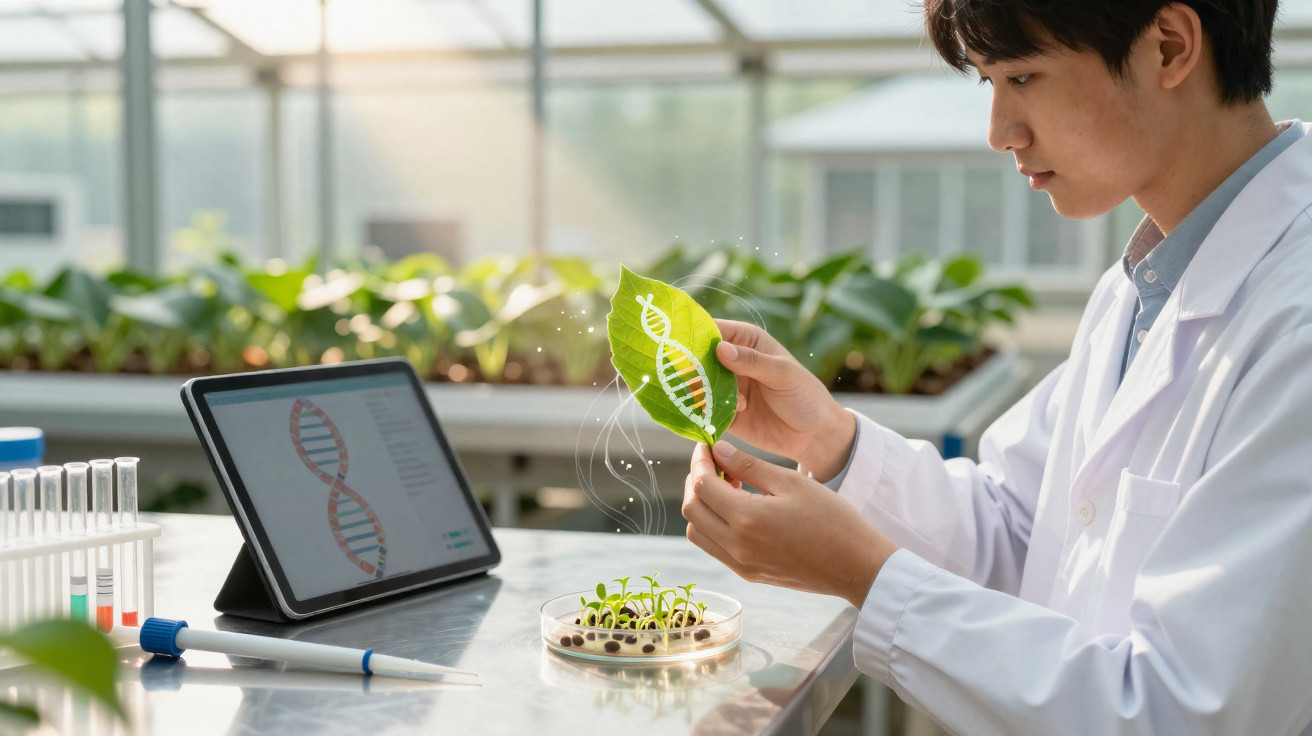
Sunlight powers plant life, but it can also set off damaging reactions. The very rays that fuel growth repeatedly fracture the DNA within plant cells.
Animals can move away from danger; plants cannot. Instead, they must put things right in place, wherever they are rooted.
Researchers at the Salk Institute have now reported that plants possess a dedicated repair protein suited to this challenge.
Sunlight: Essential but damaging
Plants exist under ongoing pressure. Sunlight, radiation, drought and nutrient-poor soils can all disrupt the genetic instructions their cells depend upon.
To remain viable, plants operate DNA repair pathways around the clock. Yet the way these fixes are organised-particularly in the tissues that generate new growth-has been difficult to define.
“Plants are unique because the same thing that gives them the ability to grow – sunlight – is constantly damaging their DNA,” said Julie Law, a professor at the Salk Institute.
“The question is, how do they cope with that level of DNA damage?”
Damage hides inside tight packing
Repairing DNA is complicated by how it is packaged.
Within each cell, DNA is wound tightly around proteins known as histones, and these units are further compacted into a dense substance called chromatin.
This arrangement keeps the genome orderly, but it can also conceal a damaged site-meaning repair machinery cannot mend a break it cannot access.
“In order to repair damaged DNA, you first need to detect the damage and then recruit the proteins required to unwind the chromatin and repair the DNA,” Law said.
A protein that evolved for DNA repair
To relax this compact structure, plants depend on helper proteins that function like first responders. They loosen chromatin, steer repair factors to the break and help the process proceed correctly.
A key group among these helpers is the YAF9 family. It is ancient and appears in many organisms, but plants have adapted it in a distinctive way.
“The YAF9 family of proteins is found in yeast, animals, and plants,” said Neeraja Vegesna, a former graduate student researcher in Law’s lab.
“But plants evolved a second version, YAF9B, that is specifically activated after DNA damage occurs.”
As a result, plants use two forms. YAF9A operates broadly as a general-purpose repair helper, whereas YAF9B is a specialist that is primarily triggered when damage happens.
When the repair system switches on
To probe the two genes, the team exposed seedlings to radiation that induces DNA breaks. YAF9A remained active regardless of treatment.
YAF9B, however, behaved in a stimulus-dependent way: it was largely silent under normal conditions and then rapidly switched on once DNA started breaking.
That activation is controlled by a regulatory switch called SOG1. SOG1 binds a short sequence within the YAF9B gene to turn it on after damage; when the researchers disrupted that sequence, the activation response collapsed.
YAF9B was also selective about what it responded to. Agents that cut both DNA strands triggered it, while cold, salt, heat and other stresses generally had little effect.
Stem cells get extra protection
YAF9B activity was not uniform throughout the plant. The strongest signal appeared at the shoot tip and in root tips-regions rich in stem cells.
These stem cells give rise to new roots, shoots and leaves. An error in those cells can be propagated into everything the plant produces afterwards.
“These stem cells are what generate the rest of the plant,” said Law.
“The hypothesis is that the plant produces this factor to help protect those cells and give them a better chance of carrying out highly accurate DNA repair.”
Fast repair versus accurate repair
Plants can restore broken DNA in multiple ways. One rapid option, non-homologous end joining, effectively sticks the loose ends back together.
That speed comes with a trade-off: the repair often holds, but it can introduce mistakes or small mutations.
A slower alternative, homology-directed repair, reconstructs the damaged segment using an intact copy as a template. It takes longer, but it preserves the original sequence.
The study found that both YAF9A and YAF9B contribute to this more precise pathway.
Mutant plants struggle to recover
To test the importance of these proteins, the researchers created plants lacking one or both YAF9 genes. In a broad assessment of plant health, only the double mutants showed clear difficulties, suggesting the two proteins can compensate for one another in general.
A more targeted assay revealed added nuance. When the team specifically measured the high-accuracy repair route, removing either gene on its own substantially reduced repair, indicating the proteins are not simply interchangeable.
The two proteins also associate with different partners inside the cell. YAF9A works with two established repair complexes, whereas YAF9B associates with only one-creating a specialised, damage-focused version.
This is the first time that complex has been connected to DNA break repair in plants.
“Accurate DNA repair is essential for maintaining genome stability, but it depends on many proteins working together within chromatin,” said Law.
“What’s exciting about this study is that we identified YAF9B as a DNA damage-responsive chromatin reader that helps cells carry out high-fidelity DNA repair, revealing a novel innovation used by plants to protect their genomes.”
Better crops could follow
The findings also have practical implications. In plants, gene-editing approaches such as CRISPR often end up using the faster, error-prone pathway, which can limit how precisely new genetic material can be inserted.
By clarifying how plants promote the more accurate route, the work may point to strategies for improving editing outcomes. The team’s next step is to determine how these proteins divide tasks during repair.
“Our next goal is to understand how these chromatin effectors coordinate different stages of DNA repair and how exactly YAF9B promotes accurate and effective DNA repair,” said Law.
“If we can understand how plants promote high-fidelity repair, we may eventually be able to improve genome editing technologies in plants,” Law added.




Comments
No comments yet. Be the first to comment!
Leave a Comment