
Taiwanese orchids have produced 63 samples of disease-causing fungi, and a single fungal group was found turning up across seven different orchid groups.
This finding makes clear that root mould is not only the result of incorrect watering. Conditions matter: persistently damp pots can harbour pathogens that drive rot.
Tracing the source of rot
In commercial orchid nurseries and flower markets throughout Taiwan, affected plants showed rot in roots, stems, storage stems and leaves.
After analysing diseased orchid material, Wen-Hsin Chung, a plant pathologist at National Chung Hsing University (NCHU), linked the damage to one fungal group.
Working at NCHU’s Taichung campus, Chung’s team observed symptoms develop within 7 to 14 days after introducing the fungus to wounds on otherwise healthy orchids.
That helps explain how an over-wet pot can shift from a minor nuisance to a major problem for orchid owners.
Hidden fungal identity
The organism responsible sits within the Fusarium oxysporum species complex: a set of closely related, soil-borne fungi known for attacking plants.
Once established, these fungi push thread-like cells through compromised tissue, restricting water transport and turning normally firm root or stem tissue soft.
DNA work split the 63 samples into six separate species, rather than lumping everything into one loosely defined “mould”.
That distinction is important because each species may disperse in its own way, prefer different hosts, or respond differently to control approaches.
How different orchids responded
Terrestrial orchids were hit hardest, accounting for 41 of the 63 confirmed fungal samples.
Cymbidium-a widely grown cultivated orchid group-frequently showed rotting pseudobulbs, the swollen storage stems that store water and nutrients.
Vanilla planifolia, the orchid used to produce commercial vanilla beans, developed stem and root rot that often went unnoticed until the plant had declined beyond recovery.
Because infections can stay subtle, early attention to care matters: visible mould may not appear until the damage is already severe.
Six distinct pathogens identified
Among the six species, Fusarium curvatum-the most frequently detected-was present in 34 survey samples.
A second species, Fusarium nirenbergiae-noted for a wide host range-made up 22 samples and included all vanilla samples.
Less common members still contributed, with two species appearing in only one or two samples.
Assigning names to the species gives growers a more precise target for treatment. Previously, root mould was often tackled with the same general methods regardless of the actual pathogen.
Wet pots trigger disease
Root mould often gets started when ageing bark breaks down: the smaller fragments retain water and reduce the air spaces inside the pot.
By contrast, fresh potting medium allows water to pass through while still retaining enough moisture to sustain living roots between waterings.
When what’s in the pot remains cold, dark and wet, oxygen availability falls, and injured roots become easier for fungi to invade.
That helps clarify why a plant can seem fine for weeks and then abruptly collapse after heavy watering.
Perfect environment for fungi
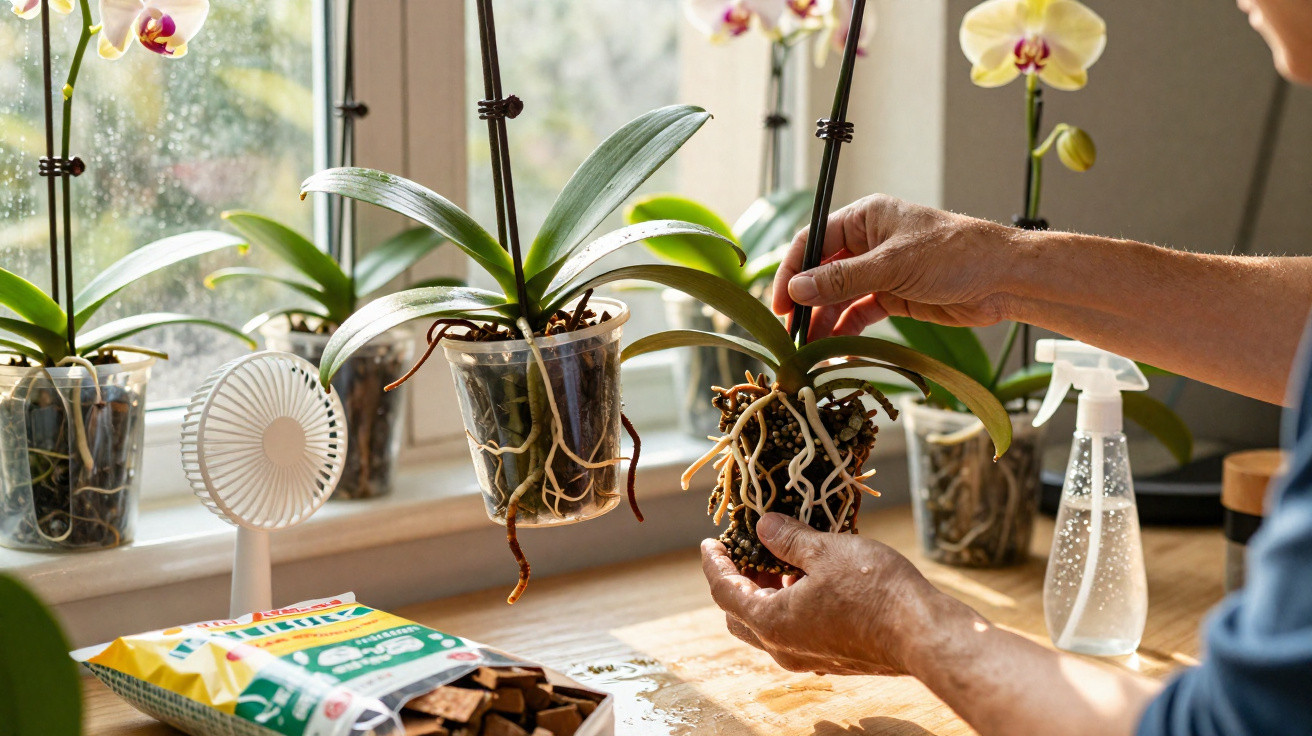
If mould is only on the surface, gentle cleaning can help-particularly once the plant is out of its pot.
Using lukewarm water can wash away loose spores and decomposed bark, and cutting away soft roots removes tissue that the fungus would otherwise continue to consume.
In an experiment using cinnamon oil against a related Fusarium pathogen, spore germination was blocked, which helps explain the cautious practice of using cinnamon on cut areas.
Even so, cinnamon, chamomile tea, or diluted apple cider vinegar are not cures for deep Fusarium disease.
Fresh media matters
Removal and recovery work best when the orchid is repotted into a clean container with good drainage and fresh bark.
Water should drain freely from the holes, because standing water keeps roots saturated and concentrates salts around already damaged tissue.
Clear pots can help owners spot green, firm roots before problems spread into the main stem.
Rescue has limits, however: mushy tissue, a foul smell, or expanding black patches often indicate the plant is too far gone to save.
Why orchids need airflow
Orchid roots need air as much as they need water, which makes them unlike many typical houseplants.
In the wild, many orchids grow on tree bark, so their exposed roots are adapted to wet–dry cycles rather than enclosed, soggy compost.
Steady airflow helps dry the pot surface, reduces fungal growth, and keeps root cells supplied with oxygen.
However, harsh draughts can stress foliage, so gentle, consistent room air movement is preferable to aiming a fan directly at the plant.
From guesswork to diagnosis
The survey is useful for commercial growers because rapid identification can distinguish a care issue from a genuine disease outbreak.
DNA-based testing of samples gives plant health specialists a clearer explanation for fungal problems than appearance alone can provide.
Chung and colleagues also cautioned that Fusarium curvatum has been associated with human infection in Taiwan.
“The potential threats to field managers cannot be ignored,” they wrote.
Healthy orchid roots rely on biology and horticulture working together: open media, careful watering, clean cuts, consistent airflow and accurate disease identification.
For home growers, the safest next step is not a stronger home remedy, but quicker repotting, improved airflow and more frequent root checks.



Comments
No comments yet. Be the first to comment!
Leave a Comment