
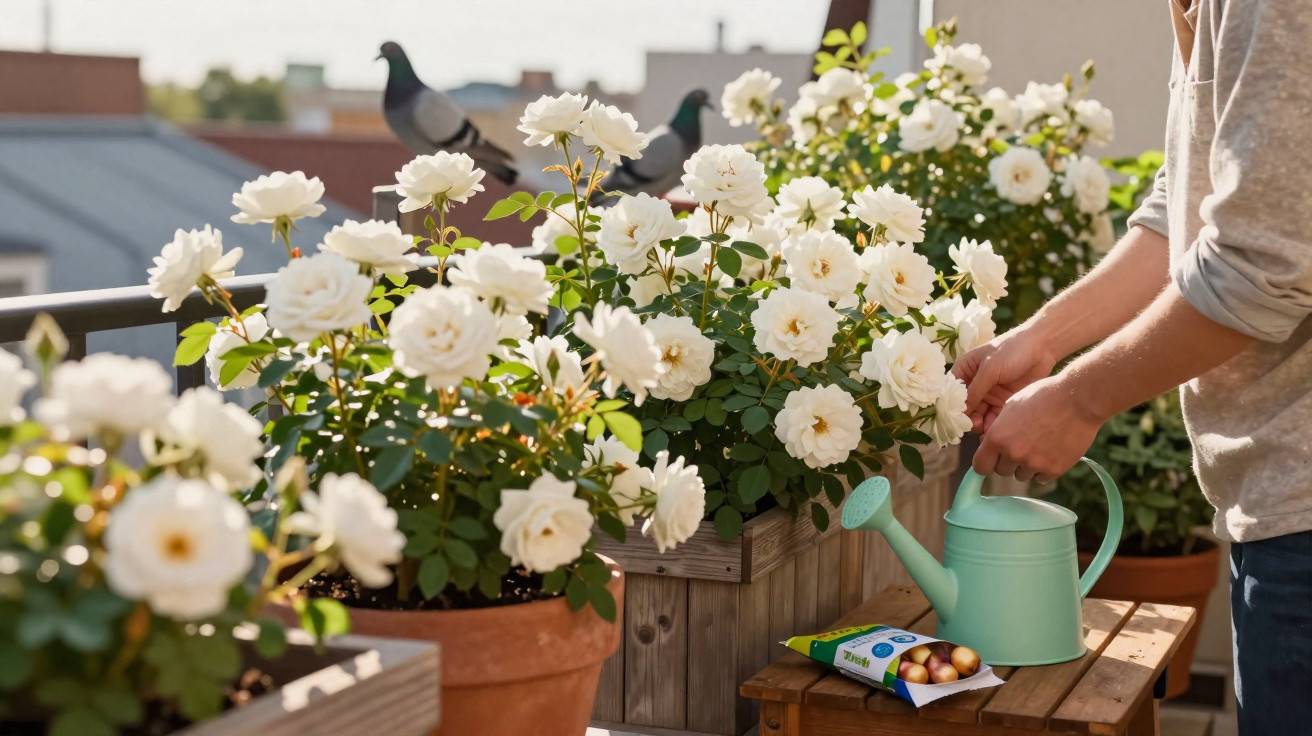
Pigeons on a balcony or in the vegetable patch can become a real test of patience in no time. Young plants get nibbled, lettuces are trampled, and furniture and railings end up filthy. Many people then turn to nets, spikes or chemical sprays - often with only limited success and, quite often, a guilty conscience. Garden experts are now pointing to a surprisingly straightforward alternative: a white-flowering plant that works as a natural, purely visual barrier.
Why pigeons love gardens and balconies so much
Pigeons are classed as seed-eaters. They actively look for:
- newly sown seeds
- tender young plants and seedlings
- soft leaves on cabbage, broccoli and peas
- calm, sheltered spots for resting and nesting
To them, a typical city balcony with window boxes - or a neatly kept vegetable garden - looks like an all-inclusive buffet with a hotel terrace thrown in. The trouble starts when the birds decide the spot is their regular haunt: they return day after day, learn exactly where the food is and gradually lose their fear.
That is why many owners and tenants fall back on the standard deterrents: netting over the bed, spikes on the railing, shiny ribbons or loud noises. Some birds are put off, while others simply get used to it or find a way around. So the hunt for a gentler method that still works has been going on for years.
The role of the colour white in bird behaviour
One approach avoids deterrence through pain or noise and instead relies on a simple visual cue: the colour white. Horticultural specialists describe white as a kind of warning colour for many bird species. While people traditionally treat red as a danger signal, birds are strongly influenced by bright, high-contrast markings.
In the natural world, many birds have white patches on their wings or tail. These markings function as signals to one another - for example, to warn of danger or to indicate territory. When a flock encounters an area that is strongly broken up by bright surfaces, it can disrupt their usual “reading” of the space.
“A dense block of white flowers looks to pigeons like a visual interference field that they would rather avoid than fly through.”
Gardeners take advantage of exactly this effect by positioning particular plants around beds, terraces and railings. What matters is not one bloom on its own, but the uninterrupted area the flowers create together.
The star among pigeon-deterrent flowers: the ‘Iceberg’ rose bush
Among the plants most often recommended, one familiar favourite stands out time and again: the white rose bush ‘Iceberg’. It is one of the free-flowering varieties that keeps producing fresh blooms right through the summer. Several of its traits make it well suited to pigeon deterrence:
- Colour: clean, bright white to creamy white blooms
- Height: typically around 1.2 to 1.5 metres, clearly visible even from above
- Width: can grow into a bush almost 1 metre across
- Flowering period: a long season from early summer into autumn
When several of these roses are planted along a fence or in front of a balcony, they form an obvious pale band. From the perspective of a pigeon flying past, it reads as a conspicuous, continuous strip - not just the odd blossom dotted somewhere in the bed.
Gardeners report that pigeons land in these areas noticeably less often. Instead of settling on the railing, they tend to choose another roof or wall nearby that feels less visually unsettling.
Other white blooms that reinforce the effect
To intensify the result, many people do not rely on a single rose variety alone. A mix of different white-flowering plants is often the most practical option.
Low flowering cushions at ground level
Low-growing species that spread like a carpet are particularly useful. This includes small perennials with white, bowl-shaped flowers that form dense cushions about 20 to 30 centimetres high. They work well along the front edge of a bed or in balcony planters.
Eye-catching trumpet-shaped flowers
In addition, ornamental plants with large, trumpet-like flowers are worth considering. They draw the eye from several metres away. However, anyone with children or pets should check potential toxicity before buying and avoid placing them where children can reach them.
For a clearly visible “line of light”, the following also work well:
- white hydrangeas planted along fences
- white petunias in pots and balcony boxes
- pale summer flowers planted in an unbroken row
How to create an effective flowering barrier against pigeons
A single pale rose in the middle of a bed will not do the job. For this method to work, the planting layout is what counts. In practice, this basic structure has proven effective:
- Create a clear line: either as a ring around the vegetable bed or as a continuously planted edge on the balcony.
- Layer the heights: a back row of taller shrubs such as roses, with lower summer flowers in front.
- Close the gaps: fill empty spaces between larger plants with small white-flowering species.
- Make the area large enough: the bright zone should be obviously wider than a single pot.
“The more continuous and brighter the band of flowers appears, the more strongly pigeons’ instincts react to this visual obstacle.”
On a balcony, you can place long planters along the full length of the railing. If there is enough room, add a taller pot at the corners with a standard rose or a bushy shrub. The result is a white frame that makes the pigeons’ approach line less appealing.
Smart combinations with other gentle deterrents
Many hobby gardeners do not stop at the flowering barrier and instead pair it with other subtle measures. Strongly scented plants are popular, such as certain geraniums or tagetes (marigolds). They do not directly repel pigeons, but they add extra stimuli in an area the birds are already inclined to avoid.
Some people place small bird-of-prey figures on the roof edge or on cupboards in the loggia. These should be moved now and then, otherwise pigeons get used to them. Alongside the white belt of flowers, this becomes a kind of signal “puzzle” that simply feels unattractive to the birds.
Risks, limits and practical tips
The method is not completely without constraints. If you have a very persistent pigeon population right outside your home, you will not always see the birds disappear entirely. Individual flocks also vary in how sensitive they are to visual cues.
There are also gardening considerations to keep in mind:
- Roses and many perennials need a sunny to partially shaded position.
- Regular watering and feeding supports a long flowering period - without blooms, the effect fades.
- Some decorative species can be toxic to pets or small children, so check before planting.
If you live in rented accommodation, make sure pots and planters are securely fixed. Run-off water from watering or falling leaves can annoy neighbours below, which can quickly cause problems in the building.
Why natural methods score in the long term
Compared with rigid plastic spikes and harsh products, using white blooms to deter pigeons offers a key advantage: it improves the look of your outdoor space. Instead of defensive hardware, you get a flowering band that attracts bees and other insects while also bringing relief from pigeons.
In densely built-up towns and cities in particular, this creates a small counterbalance. Balconies and back courtyards feel more alive, without hurting the animals or sending them into panic. With a planned approach, a few roses, hydrangeas and summer flowers can form a kind of “light fence” - attractive to people, but visually disruptive for pigeons.
Anyone who sticks to the basic rule - bright, continuous areas rather than scattered blooms - has a good chance of making their balcony or vegetable patch far less appealing to these persistent feathered visitors. And, in the best case, you gain a new favourite green corner at the same time.
Comments
No comments yet. Be the first to comment!
Leave a Comment