
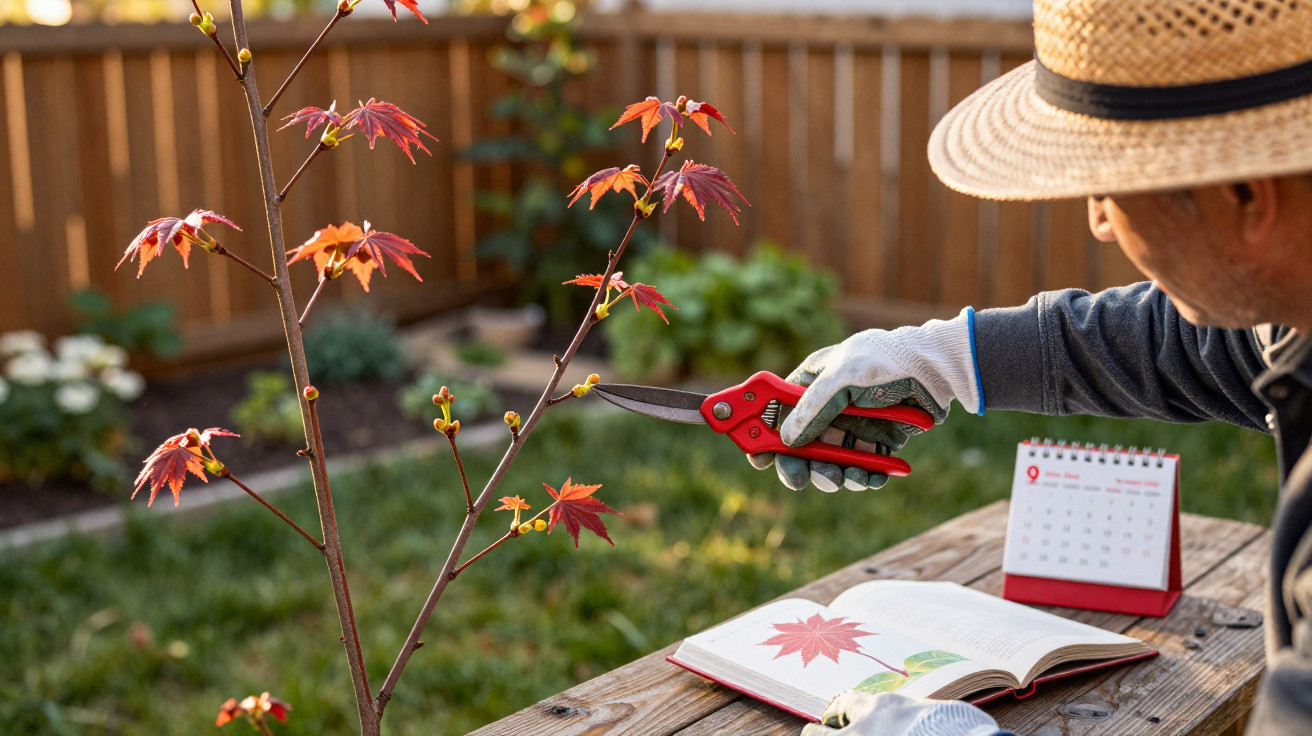
Many garden owners treat their Japanese maple as a real prize. That is easy to understand: a delicate, finely branched crown, elegant bark and-often-a hefty purchase price can turn the tree into a genuine status feature in the border. Precisely for that reason, it pays to get the timing and technique right when pruning, because a single cut made at the wrong moment can trigger heavy sap flow and cause lasting harm.
Why Japanese maple reacts so sensitively to pruning
The classic Japanese maple (Acer palmatum) is a slow grower with comparatively thin bark, and it does not seal larger wounds particularly well. That makes it far more delicate than many native woody plants. As late winter approaches and the so‑called sap pressure rises, the tree is effectively under internal pressure: water and nutrients surge from the roots up into the crown.
If you make a heavier cut during this period, the tree often responds by “bleeding” strongly. The liquid running from the wound may look harmless, but it drains the maple’s reserves and extends the time the cut surface remains open. While the wound is exposed, fungi and bacteria can invade very easily.
"The later in winter the cut is made, the greater the risk that the Japanese maple will bleed heavily from the wound and be weakened over the long term."
For that reason, garden specialists generally recommend pruning during the deep dormant phase: late autumn through to mid‑winter is considered the safest window, provided there is no hard frost. At that time, the tree’s metabolism is running at a low level, sap pressure stays modest, and it copes better with minor interventions.
February as a tricky line: last chance-or already too late?
Across German‑speaking regions, February is widely seen as the month when many hobby gardeners feel the urge to pick up the secateurs. The aim is to “get everything tidy” before the season begins. With Japanese maple, that habit can backfire.
Tree-care professionals such as British arborist Ned Cromack warn against pushing pruning too far into late spring. Once work is done when buds are clearly swelling, sap pressure increases sharply. Any larger branch removal can then lead to plant sap running freely-sometimes for hours.
That is why late-winter work needs a restrained approach. In February, professionals advise:
- removing only dead, brownish twigs or clearly lifeless shoot tips,
- postponing any more substantial work until the following winter,
- watching the buds closely: as soon as they noticeably round up, it is better to put the secateurs away,
- choosing frost-free days, and not cutting when temperatures are below 0°C.
As soon as buds are plainly swollen or the first leaves begin to appear, pruning on an otherwise healthy tree should be kept to an absolute minimum. Any bigger corrections are consistently moved by professionals to the next winter.
Basic rules for safer winter pruning
If you want to look after your Japanese maple gently, treat pruning like a surgical procedure. Careful preparation-and a measure of restraint-make the difference.
Tools and technique: less really is more
A sharp, clean pair of hand secateurs is essential. Blunt blades crush the wood and enlarge the wound area. Make the cut just above the branch collar-the slight swelling where the side shoot joins-rather than slicing flush into the trunk, which creates a large wound that closes poorly.
Using electric hedge trimmers is a no‑go. They leave countless small, ragged cut surfaces that the tree cannot seal neatly. It is far better to remove individual shoots with intention than to “shear” the crown.
"A good rule of thumb: remove no more than a quarter of the living crown in a single season-anything beyond that puts the tree under clear stress."
What you can genuinely remove in winter
During dormancy, the main targets are:
- dead, grey or hollow branches,
- visibly diseased shoots with discolouration or fungal attack,
- branches that cross or rub against one another,
- very steep, inward-growing shoots that disrupt a balanced crown.
Rather than trying to “neaten up” the whole tree, pruning should lightly support its natural shape. Japanese maples are valued for their airy, flowing silhouette. If you thin too hard, you lose that charm-and, at the same time, place the tree under unnecessary strain.
What if you missed the ideal timing?
Many hobby gardeners only notice in March or April that a few branches are poorly placed. In that case, the best approach is to stay calm. A drastic cut during the flush of new growth does far more damage than it solves.
In this situation, specialists usually suggest two approaches:
- Remove only genuine hazards: brittle, dead branches that might fall onto paths or seating areas can be shortened carefully.
- Strengthen the tree instead of cutting: clear weeds from the root zone, apply a thin mulch layer, and water regularly in dry spells-steady, but not excessive.
Larger reshaping should be planned for the following winter, once the tree is fully dormant again. Heavy spring pruning risks not only sap loss, but also frost damage to fresh wound edges if late cold snaps arrive.
Common mistakes that ruin Japanese maples
A few straightforward habits prevent most problems. The most critical are:
- Removing large branches in late winter: the thicker the branch, the heavier the sap flow and the slower the wound closes.
- Pruning in frost: cold can split tissues weakened by cutting, leading to cracking.
- Taking off too much at once: the tree must rebuild and supply an entire crown, often producing weak emergency shoots.
- Regular “shaping with shears”: natural structure is lost, the interior ages and dies back, and fungi gain easy entry points.
Avoiding these errors lays the groundwork for a long‑lived, stable maple that keeps its distinctive, refined character for many years.
How to support the tree after pruning
A gentle cut is only the first part of care; what happens around the roots matters afterwards. Loose, weed‑free soil helps the tree seal wounds more quickly and push strong new growth.
Avoid letting lawn grow right up to the base of the trunk. A better option is an open tree ring with a thin layer of bark mulch or fine wood chips. This layer conserves moisture, buffers the roots against temperature swings and suppresses unwanted growth.
| Care step | Recommended period |
|---|---|
| Light pruning / removing dead wood | Late autumn to mid‑winter, on frost‑free days |
| Checking the crown for break points | Late winter and after storms |
| Mulching the tree ring | Late autumn or early spring |
| Checking water supply | Especially during hot spells in summer |
How to recognise a weakened maple
Not every mistake shows up straight away. Some damage only becomes obvious one or two years later. If you watch your tree closely, you can react in time.
Warning signs include:
- increasing amounts of dead twigs in the inner crown,
- stunted leaves or clearly smaller leaf size than normal,
- bark splits, resin seepage or dark staining around older cut sites,
- bare patches developing on one side of the crown.
If these symptoms appear after a heavy prune, it is worth getting an assessment from a tree-care professional. Often, a careful corrective cut in the next dormant period can help the tree regain stability.
Why minimal intervention is often the best protection
Japanese maples are naturally attractive, well‑shaped trees. Many specimens manage for years without significant pruning when the site and general care are right. A sheltered, semi‑shaded position, humus‑rich slightly acidic soil, and even moisture are frequently more important than any pair of secateurs.
A useful principle for hobby gardeners is: observe first, decide second. If you restrict yourself to removing dead wood, resolving crossings and otherwise trusting the natural growth habit, you are usually taking the safest route. That way, your favourite garden tree remains not only visually striking, but also healthy for the long term.


Comments
No comments yet. Be the first to comment!
Leave a Comment