
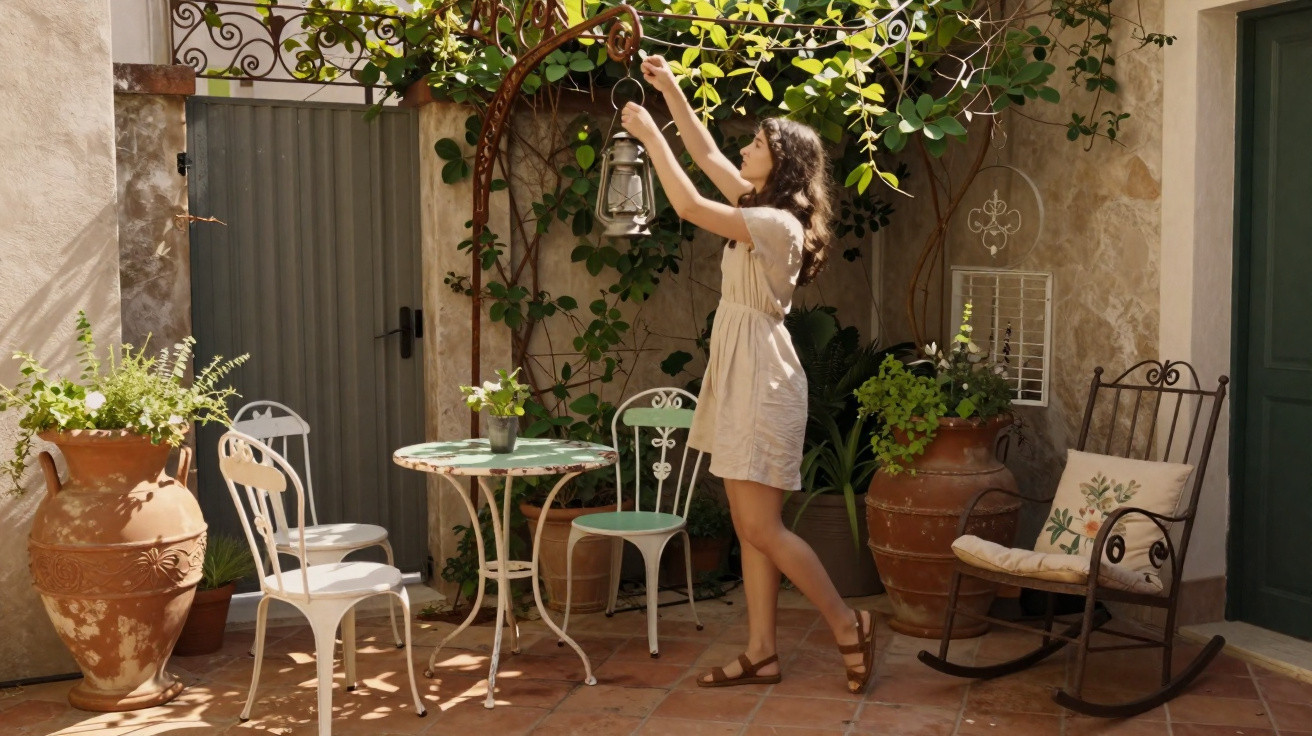
Anyone redesigning a balcony, courtyard or garden today is increasingly turning away from sterile-looking, all-in-one sets from the local DIY superstore. The clear movement is towards the Brocante look: pre-owned one-off pieces, visible signs of use, and sturdy materials that have already lasted for decades - and work all the better for it. Outdoor spaces are no longer meant to resemble furniture catalogues; they’re becoming extensions of the living room, complete with a story of their own.
Why Brocante in the garden is so popular right now
For a long time, styling effort went mainly into interiors. Now, many people treat a terrace as an extra room, which raises expectations around style, build quality and individuality. Mass-produced ranges can feel interchangeable very quickly, whereas flea-market treasures and finds from local listings are distinctive by nature.
“In the garden, patina becomes an ornament: marks left by weather, time and use give objects exactly the charm that new furniture often lacks.”
At the same time, awareness of sustainability continues to grow. Saving well-made furniture and accessories from the 1950s, 60s or 70s protects resources and preserves craftsmanship that’s often hard to find in today’s high-volume production.
1. Old outdoor lights: from unsold stock to centrepiece
Atmospheric lighting often decides whether you’ll happily stay outside in the evening or head indoors quickly. In that sense, the trend is moving away from uniform fairy lights and towards individual fittings with real character.
Particularly sought-after are:
- Brass or copper lanterns from the 1960s
- Pendant lamps with frosted glass and visible patina
- Wall lights with paint that’s already slightly flaked
You’ll see these lights regularly at flea markets, in Brocante shops, or on platforms such as eBay Kleinanzeigen. When you’re searching, focus on two essentials: the electrics and overall sturdiness. A bit of rust on the metal is fine, but the lampholder must be replaceable safely.
Practical tip: older housings can often be paired with new outdoor-rated wiring. That way, the historic appearance remains, while the electrical components meet current safety standards.
2. Terracotta pots and urns with a past
Terracotta never feels artificial outdoors, especially when its surface shows moss, limescale marks and fine hairline cracks. Pieces like these do more than hold plants: they help define areas and guide the eye.
“The older and more ‘used’ a terracotta pot looks, the more naturally it seems to belong in the garden.”
Interior designers and garden stylists often choose oversized pots and urns, placing them almost like sculptures - for example, at the end of a path or beside a bench. The principle is simple: fewer large pieces tend to look more intentional than lots of small ones scattered around.
When buying, it’s worth checking carefully:
- When you tap it, does it sound solid and dense rather than dull and fragile?
- Are any cracks only on the surface, or do they run through the body?
- Can the vessel still be lifted and moved without risk?
If you’re unsure, very old or cracked pieces can still work purely as decoration - left empty, half-buried, or used as the base for a small dry bed with succulents.
3. Wrought iron: arches, pergolas and old garden gates
Wrought-iron features are making a strong comeback outdoors. This isn’t only about seating, but also architectural elements such as arches, pergolas and garden gates.
The main advantage is that older pieces are often made from thicker stock with carefully executed joints. They cope with years outside, can be repainted when needed, and often become more attractive over time rather than less.
“A single iron arch with climbing roses is enough to add depth and romance to an otherwise flat garden scene.”
If you come across a used gate or an old pergola, look for rust pockets in load-bearing areas. Light surface rust is usually harmless; deep corrosion at joints and connections is more problematic. Minor damage is often manageable with a wire brush, an anti-rust primer and a suitable topcoat.
How to care for Brocante ironwork in the garden
- Remove loose rust layers with a metal brush.
- Wipe away dust thoroughly or blow it off with compressed air.
- Apply an anti-rust primer, especially on cut edges and welded seams.
- Paint with a matt or satin finish - black, dark green or grey-blue look particularly timeless.
If you want to keep the aged character, paint only selected areas and leave some rust marks as deliberate patina.
4. Vintage wrought-iron garden furniture
Nostalgic iron dining sets tend to appear wherever old houses, inns or villas are being cleared out. Typical details include ornate backrests, lattice or vine patterns, and solid - often surprisingly heavy - construction.
Many designers favour these sets because they combine several benefits:
- Extremely sturdy frames, usually far more durable than modern aluminium sets
- A delicate look that doesn’t feel bulky and suits small balconies well
- Individual patina rather than a perfect paint finish that scratches quickly
Brand names such as John Salterini push prices up, but unbranded pieces can still be excellent. With patience, you can often find complete ensembles for far less than new furniture in the shops.
Refurbishing is often achievable in an afternoon:
- Tighten bolts and check seating surfaces
- Sand or brush back any loose paint
- Add new seat cushions or pads - ideally in bold stripes or muted natural tones
Important: on terraces with delicate tiles, use felt pads or coasters so rust doesn’t transfer onto the floor.
5. Vintage armchairs, rocking chairs and loungers
The most personal part of any terrace is the seating: it’s where you read, take calls and doze. That’s exactly why vintage pieces have such impact - their scuffs, fabrics and shapes hint at summers gone by.
These are especially popular:
- Wooden rocking chairs with curved runners
- Rattan armchairs from the 1960s and 1970s
- Deckchairs with wooden frames and retro striped fabric slings
“A single old rocking chair on the balcony can feel cosier than a completely new lounge set.”
At flea markets, you’ll often spot these chairs pushed to the side, with faded covers or a slight wobble. That can put people off - unfairly. Fabrics can be re-upholstered, screws tightened, and rattan reinforced. If DIY isn’t your strength, there are upholsterers who specialise in vintage furniture.
What to check when buying second-hand seating
| Criterion | What to look for |
|---|---|
| Stability | It shouldn’t creak or wobble heavily when you sit down. |
| Material | No soft, rotten wood; no broken rattan canes in load-bearing areas. |
| Screws | Rusty but still grippable screws are fine; avoid ones that are completely rounded off. |
| Upholstery | Stains aren’t a big issue, but odours and mould are - in that case, re-upholster. |
How to create a coherent overall concept from Brocante finds
The real skill isn’t buying - it’s combining. If you collect every bargain at random, it’s easy to end up with chaotic bric-a-brac. It helps to set a broad style framework: Mediterranean-rustic, an urban courtyard feel, country house, or mid-century.
One workable approach:
- Keep metal finishes to one or two colours (for example, black and dark green).
- Choose woods in similar tones - very dark wood with dark metal, lighter wood with lighter shades.
- Link textiles through patterns and colours, such as stripes that repeat the same colour combinations.
A clear zoning plan also helps: one area for eating, a quiet reading chair in partial shade, and a decorative corner with pots and urns.
Opportunities, risks and low-effort strategies
Brocante in the garden brings tangible upsides: strong material quality, a more individual look, a smaller environmental footprint, and often better value for money. At the same time, there are pitfalls to watch out for.
Possible risks:
- metal furniture that rusts onto sensitive flooring
- unsafe electrics in old outdoor lights
- wood that fails too quickly outdoors without protection
If you keep these points in mind, you can enjoy your finds for a long time. A useful rule of thumb: anything you sit on or touch should be stable and smooth. Patina yes - splinters and sharp edges, no.
In practice, it’s often easiest to mix Brocante pieces with simple new basics: a plain weatherproof table with old chairs, new cushions on a historic frame, or modern LED bulbs inside older housings. The result is a garden that’s made to be used rather than just admired - and one that becomes more interesting with every flea-market discovery.

Comments
No comments yet. Be the first to comment!
Leave a Comment