
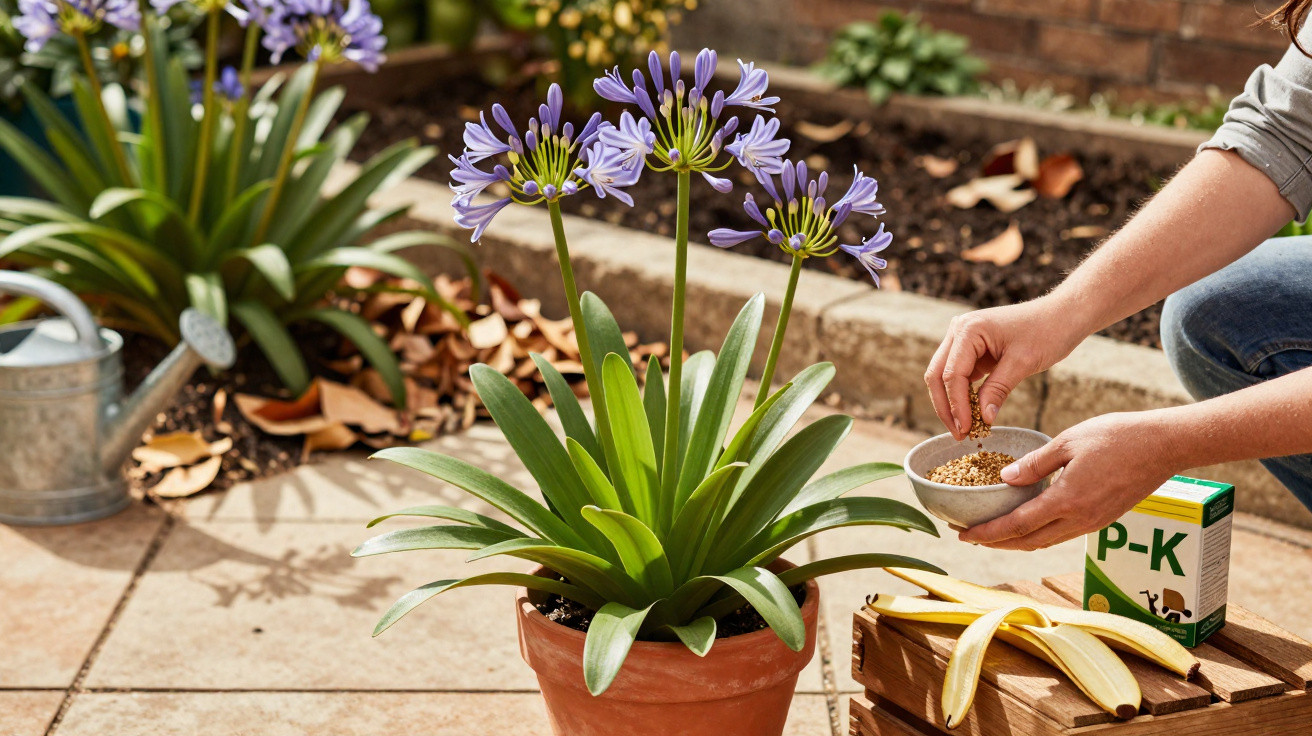
Many keen gardeners ask themselves every year why so-called ornamental allium looks perfectly healthy yet produces hardly any flowers. The cause is rarely the variety and almost always comes down to timing. If you supply the right nutrients and work the root zone with intent by the end of March, you can dramatically increase both the height and the number of flower stems.
Why March decides the height of the flowers
Agapanthus, often sold in shops as “ornamental allium”, comes out of winter rest with a brief but crucial burst of growth. During this window the plant “wakes up” its buds, the roots become active again and-put simply-sets how much energy goes into leaves and how much is reserved for flower stems.
Depending on the type, the flower heads later sit at roughly 30 to 120 centimetres tall. Genetics explains part of that range, but not all of it. The best moment to encourage strong, long stems is precisely when the root area begins to warm and growth starts-typically in March.
“Wer den Agapanthus vor Ende März gezielt stärkt, lenkt seine Kraft weg vom Blattwerk und hin zu stabilen, hohen Blütenstielen.”
Professionals refer to this as the “phase after winter dormancy”. In this short period the plant responds especially well to targeted care. A practical routine pairs gentle soil loosening with a clearly chosen nutrient mix.
The P–K trick: phosphorus and potassium instead of leaf fertiliser
If you want ornamental allium to focus on flowers rather than endless foliage, it mainly needs two nutrients in spring: phosphorus (P) and potassium (K). It will happily take nitrogen (N) too, but that mostly drives leafy growth rather than blooms.
Spring clean at the root zone
The basic order of jobs-whether in a border or a pot-is easy to remember:
- Remove all dried leaves and old plant debris completely
- Cut last year’s spent stems back to the base
- Lightly loosen the soil around the crown (3–5 cm deep)
- Work in nutrients with precision, taking care not to damage roots
Using a small cultivator or hand rake helps break up the hard crust that forms over winter. Air and water can get in again, worms and soil life become active, and nutrients reach the exact area where young fibrous roots start growing.
The ideal nutrient mix for strong flower stems
After loosening, it is time to feed:
- 1–2 handfuls of mature compost or worm castings per plant
- a thin layer of sieved wood ash as a natural potassium source
- no, or only very little, nitrogen-heavy fertiliser
Compost or worm castings provide a broad spectrum of nutrients and also improve soil activity. Wood ash (only from untreated wood) contributes mainly potassium, which helps stems stay sturdy and encourages flowering.
“Merksatz: Phosphor fördert Knospen und Wurzeln, Kalium macht Stiel und Gewebe robust – ideal für riesige Blütenkugeln.”
To finish, many professionals lightly cover the loosened surface with compost again and then add an organic mulch layer about two centimetres thick-for example, flax or hemp fibres. A slow, thorough watering then carries the nutrients directly into the roots’ active zone.
A household tip using banana skins
If you cannot get wood ash, a simple kitchen alternative works: chop banana skins into pieces of around one centimetre and bury them very shallowly around the plant. As they break down, they also release potassium-just more gradually.
Ornamental allium in a pot: tight space, big impact
Agapanthus in containers tends to fill the compost with roots. After two to three years, the plant can sit in the pot like a solid block. Without annual loosening and fresh nutrients, watering often runs down the pot’s sides rather than soaking the root ball properly.
The results are clear:
- The plant goes short of food even when watered regularly
- Flower stems stay under 30 centimetres and topple easily
- Lots of leaves form, but hardly any flowering stems
As long as the root ball is not completely matted, the spring P–K routine-loosening, compost, potassium and mulch-is usually sufficient. Repotting only becomes necessary once the roots fully occupy the pot edge.
Repot correctly, then feed
When repotting, choose a container only slightly larger than the current one. With agapanthus, too much extra space often means it prioritises roots and leaves again and delays flowering.
Key points for the new pot:
- Large drainage holes to prevent waterlogging
- A drainage layer of expanded clay or coarse gravel
- A structurally stable compost with enough coarse material
After planting, follow the same approach as in a border: lightly scratch up the surface, incorporate nutrients with an emphasis on phosphorus and potassium, mulch, then water thoroughly.
Agapanthus in borders: divide when the clump gets too dense
Outdoors, start your spring work once the soil noticeably warms. At that point, a quick check is worthwhile: if clumps are extremely tight or thick roots are already showing at the surface, it is time to divide.
Gardeners lift the entire clump, split it with a spade or sharp knife, and make sure each piece has strong roots plus one or two growing buds. These divisions go back into the border-ideally with some spacing so they can rebuild.
“Das Teilen im März wirkt wie eine Verjüngungskur: Die Pflanzen danken es mit frischer Kraft und mehr Blütenschäften in den Folgejahren.”
Straight after replanting, a thin organic mulch helps the soil stay moist for longer and reduces competition from weeds. The P–K feeding step is best done immediately after the divisions are set in.
What if you miss the late-March window?
Many gardeners look at the calendar and realise in mid-April that March has gone. In mild areas, or after a very warm early spring, you can often still catch up-provided the plant has only just begun to grow.
The plant’s stage matters more than the date: as soon as fresh leaf tips are visible and the soil no longer feels icy, it is still worthwhile to loosen the surface and feed with phosphorus and potassium. The sooner after the first signs of growth, the better.
In pots, growth usually starts a little earlier than in borders because the compost warms up faster. If you keep an eye on your containers, you will spot the first green tips and can act in time.
In-season care: watering, cutting back and liquid feed
Between June and September, ornamental allium is at its best. To stop the long stems flagging in midsummer, it needs steady moisture-especially in containers.
During dry spells, water deeply rather than giving small, frequent splashes. In a pot, pour away any excess water left in saucers after a few minutes to avoid waterlogging. In borders, the spring mulch layer helps retain moisture for longer.
Removing spent stems is worthwhile for two reasons: the plant does not waste energy on seed production, and the display stays neat. If you want to collect seed, you can of course leave a few stems in place.
For container plants, a liquid feed for flowering plants works well during the main growth period, used according to the manufacturer’s instructions. The key point here too is to avoid an excess of nitrogen. Feeding that is heavily biased towards leaves risks lush greenery with few flowers.
Why some agapanthus produce only leaves
If your ornamental allium grows strongly year after year but scarcely flowers, run through this quick checklist:
- Did you use high-nitrogen fertilisers heavily in spring?
- Was there any targeted P–K application at the start of the year?
- Is the plant sitting very loosely in fresh compost in the pot, without the pressure of a tight root ball?
- Has the agapanthus been kept in deep shade long term?
Many reluctant bloomers suffer from a combination of too much nitrogen, poor timing and not enough sun. The site should be bright and preferably sunny, with at least a few hours of direct sunlight each day. Nutrient-wise, focus on phosphorus and potassium in late winter and early spring, and keep nitrogen use restrained.
Additional notes: frost, choosing varieties and planting companions
Agapanthus is considered only partially hardy. In very cold areas, it will only survive severe frosts in borders with thick winter protection; in pots it often will not make it at all. Many gardeners overwinter container plants frost-free but cool in a garage or shed, then move them back outside from March.
When planting anew, you can choose between deciduous and evergreen types. Deciduous forms usually cope better with harsh frost, though they start into growth a little later. Evergreen varieties look more attractive, but in cold winters they definitely need protection.
In a perennial border, ornamental allium pairs beautifully with grasses, daylilies, lavender or low roses. The tall, clean stems topped with round flower heads bring calm structure, while companion plants shade the soil and reduce evaporation. If you apply the March P–K trick properly, these combinations can look far more dramatic-with blooms that quite literally rise above everything else.
Comments
No comments yet. Be the first to comment!
Leave a Comment