
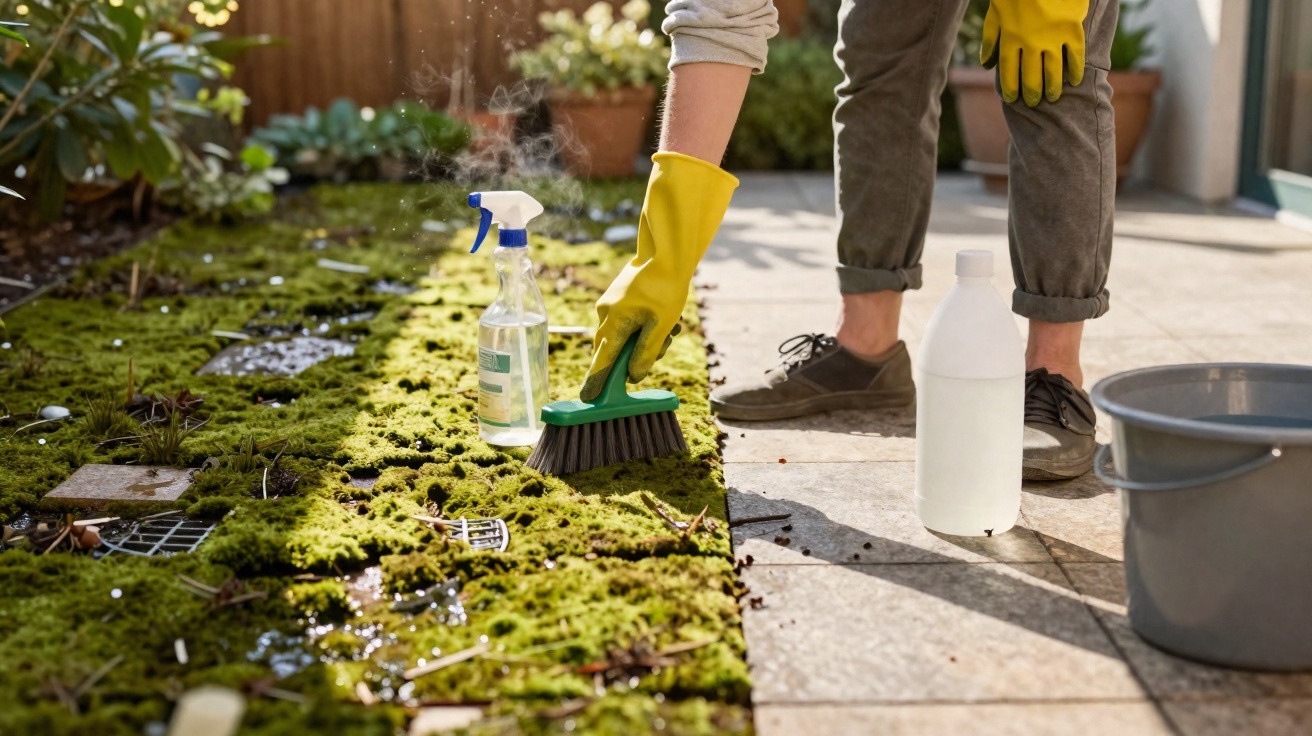
Most people see a mossy terrace and automatically reach for pricey chemical treatments or hire a pressure washer. Our writer tried something else: a basic household staple costing about €0.35 (roughly 35p), mixed with tap water, left to work for an hour - and the concrete slabs suddenly looked as though they’d just been laid. It sounds like an internet tall tale, but there’s a straightforward explanation behind it.
When the terrace looks more like a mini ecosystem after winter
Anyone with a terrace knows what happens after months of rain, frost and weak sunlight: a green film appears. Moss, algae, dark patches - and the moment you put a chair down, you can find yourself slipping. Add weeds pushing through the joints and it’s not only annoying to look at, it can be a genuine safety issue.
Walk into any DIY store and you’ll see stacks of containers: green deposit removers, sealants, specialist cleaners. They’re often expensive and frequently carry hazard symbols on the label. At the same time, everyday household cleaning products have become pricier, yet they still tend to struggle with stubborn outdoor build-up.
"The starting point: a slippery, green terrace, high shop prices - what we needed was a fast, affordable and reasonably eco-friendly solution."
The unexpected wonder product: simple household vinegar
The key tip came from a report by a British colleague. Instead of a specialist product, she used plain white household vinegar from the supermarket, priced at the equivalent of about €0.35 per bottle. No elaborate recipe, no premium cleaner, no pressure-washing equipment.
Most people know vinegar from cooking or as a limescale remover in the bathroom. What’s less widely known is that, when diluted appropriately, it can also loosen some of the deposits that cling to outdoor concrete and ceramic surfaces. That was exactly what made the trial worth doing.
Step by step: demoss a terrace in one hour
1. Sweep thoroughly - otherwise you just spread the mess
Before any vinegar solution goes down, the rough debris needs to come off: leaves, twigs, sand and soil. A stiff broom works best. The cleaner the surface, the better the water-and-vinegar mix can reach the actual green film and staining.
- Remove all loose leaves and soil
- Give the joints a quick sweep as well
- Pay extra attention to spots where water tends to sit
2. The mix: vinegar and water at a 1:1 ratio
The British journalist whose tip this test is based on uses a very simple rule: one part white household vinegar, one part water. Mix it in a bucket. The water shouldn’t be too hot, so the vinegar doesn’t evaporate too strongly.
For a medium-sized terrace, half a bottle of vinegar is usually enough - around 500 millilitres - plus the same amount of water. For larger areas, scale the quantities up accordingly.
3. Apply, then leave it alone for an hour
Pour the finished solution generously over the terrace. Give particularly stubborn green patches and dark marks an extra helping. An old cup, a watering can or simply the bucket itself makes it easier to spread evenly.
"The key to success is the contact time: the mixture works for around 60 minutes, without any need to brush or scrub."
During this time, the mildly acidic solution attacks the top layer of the deposits. Algae and moss begin to lose their grip, and the colour visibly fades.
4. A light brush - and the terrace looks noticeably brighter
After the hour is up, go back in with the stiff broom. Moderate pressure is usually enough to lift away what has loosened. Many marks come off immediately; in a few areas, a second pass with the broom can be worthwhile.
The change can be striking: the terrace doesn’t just look cleaner, it often appears a few shades lighter. Concrete slabs in particular, hidden for years under a grey-green cast, can regain much more of their original colour.
Where vinegar works - and where it should be avoided
Vinegar is acidic, even if it’s far milder than many specialist products. Even so, not every surface tolerates it equally well.
| Surface | Suitability | Note |
|---|---|---|
| Concrete slabs | well suited | Leave for 30–60 minutes, then brush |
| Outdoor ceramic / porcelain tiles | usually well suited | Test first on an inconspicuous area |
| Sensitive natural stone (e.g. marble) | not recommended | Risk of dulling and staining |
| Granite & other polished stones | use with caution | Only use following professional advice |
| Timber decking | limited | Wood can leach; better to use specialist cleaners |
A welcome side effect: weeds weakened between the slabs are often easier to pull from the joints afterwards. If you rinse the terrace with a hose once you’re finished, you’ll flush away the remaining loosened residue.
Price comparison: household staple versus DIY-store containers
Many ready-made green deposit products are not only more concentrated, they also contain biocides. They target algae and moss effectively, but come with a list of precautions:
- Protective gloves and eye protection are recommended
- Avoid contact with skin, plants and pets
- Apply only in dry, still conditions
- Prevent any run-off into a garden pond or flower beds
A typical 5-litre container costs about €3.99 and, according to the manufacturer, covers roughly 50 square metres. That may work out cheaply per litre, but the contents are considerably more aggressive than diluted household vinegar.
"The vinegar solution scores not only on price, but also on the feeling that you’re not pouring a chemical bomb over your terrace - even if it isn’t perfect."
The downside is that the effect is gentler than professional biocides. Heavily weathered or extremely dirty surfaces may need several rounds. And if you’re dealing with a huge terrace covered in a thick, years-old layer of moss, this milder method will eventually reach its limits.
How safe is vinegar in the garden, really?
In the home, vinegar is generally seen as relatively harmless. Outdoors, it still needs common sense. Pouring large amounts straight into flower beds or onto a lawn won’t do plants any favours. On a terrace - where most of the solution stays on the stone - the overall impact is more limited.
If you have pets, wait until the treated surface has soaked in or has been rinsed with water before letting them back onto it. Not because animals are instantly at risk, but because concentrated vinegar can irritate mucous membranes. During the contact time, children should also be kept off the wet surface.
Practical tips for everyday use
The best time to do it
- Choose a dry day with no rain expected for the next few hours
- Avoid blazing midday sun so the solution doesn’t evaporate immediately
- Temperatures above 5 °C, so the vinegar can work properly
If you give the terrace a thorough treatment once in spring and then sweep regularly, you can stop the green film building up too much. In that case, two to three applications per year are usually enough.
What to have ready
- Household vinegar (clear, with no additives)
- A bucket and, if needed, a measuring jug for the ratio
- A stiff broom or scrubbing brush
- Optional: rubber gloves for sensitive skin
If you have delicate metal garden furniture or metal decorative items on the terrace, move them out of the way briefly. Acids can encourage corrosion when they come into direct contact with unprotected metal.
Why so many people like this method
The appeal of the vinegar approach is the mix of low cost, simplicity and easy availability. Many people already have a bottle in the cupboard, or can pick one up at the nearest supermarket. There’s no complicated dosing, no heavy protective kit, and no machine rental.
At the same time, it’s important to stay realistic about the limitations: for sensitive natural stone, freshly pointed areas or timber decking, professional advice is sensible. If you’re unsure, test a small, hidden patch first. If you see discolouration or the surface turns dull, stop and switch to a specialist cleaner.
For typical concrete and ceramic terraces around a family home, though, the 1:1 mix of vinegar and water often delivers exactly what you want in spring: visibly brighter slabs, less slip risk, and the reassuring sense you haven’t sacrificed half the household budget for the result.
Comments
No comments yet. Be the first to comment!
Leave a Comment