
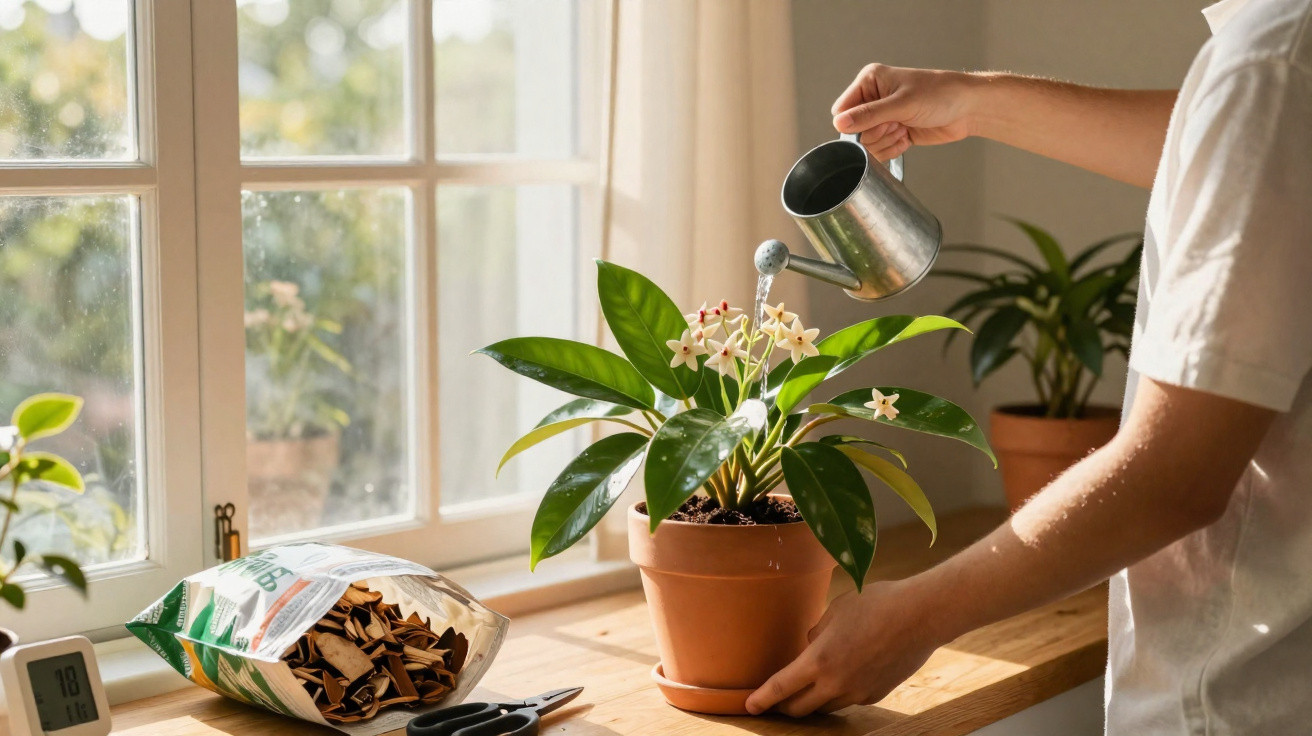
Many people only know the so-called Wachsblume from photos in plant forums. In real life, it is one of the most rewarding houseplants you can keep. If you understand what it likes in terms of light, watering and pot size, it will stay with you for years - and at some point it can surprise you with a real burst of small, fragrant star-shaped flowers.
What makes Hoya so special
The genus Hoya includes well over 300 species, mainly from South East Asia and Australia. In homes here, you most often see Hoya carnosa with long, slightly trailing shoots, as well as the more compact Hoya bella or the heart-leaved Hoya kerrii.
They all share one key trait: thick, leathery leaves that store water. That means they behave a bit like succulents, and they forgive missed waterings far better than tropical foliage plants with thin leaves.
"If you want a plant that’s tough but eventually flowers spectacularly, you end up with the wax plant surprisingly often."
Temperatures of 18–24 °C are ideal. For short periods, the plant will also cope with 15–30 °C, as long as it is not exposed to cold draughts. That’s exactly why it suits normal homes: winter heating, summer heat, and no special climate required.
The best spot: bright, but without harsh midday sun
With a healthy Hoya, the position matters more than almost anything else. It needs lots of light, but it does not appreciate intense midday sun through glass.
- Ideal: east- or west-facing windows
- Good: set back a little from a south-facing window (not pressed up against the pane)
- Tricky: a dark north-facing position or several metres from any window
Gentle morning or evening sun does the plant good, as it encourages growth and flower formation. Scorching midday sun in high summer, by contrast, can burn the leaves. Typical signs include pale patches, brown edges and a dull, lifeless look.
Hoya should not sit directly on a radiator. The air is extremely dry there and the root ball overheats, which stresses the plant and can attract pests.
Compost and pot: airy, free-draining, and preferably slightly snug
The Wachsblume does not want “wet feet”. Waterlogging is one of the most common reasons the plant declines slowly. A standard indoor plant compost can be improved easily:
- 1 part houseplant compost (for green plants)
- 1 part mineral component such as perlite, broken expanded clay, or orchid compost
- optional: a small portion of cactus compost for even better drainage
The pot must have drainage holes. Excess water needs to be able to run out at the bottom. A decorative cachepot is fine, but pour away any water collected from the inner pot after a few minutes.
"A slightly cramped root zone encourages flowering in many Hoyas - pots that are too large tend to hold them back instead."
Repotting is only necessary every two to three years. If roots are already appearing from the base, or if the compost looks heavily compacted, moving up to a slightly larger pot makes sense - but only one size up, not a huge new container.
Watering correctly: less often, but thoroughly
Because the leaves store water, Hoya tolerates dry spells much better than constant damp. A rough schedule works surprisingly well in many homes:
| Season | Watering rhythm | Note |
|---|---|---|
| Spring/Summer | every 10–15 days | when the top layer of compost is dry |
| Autumn/Winter | every 2–4 weeks | in cooler rooms, extend the intervals |
Even more reliable than any calendar is the “pot test”: lift the pot briefly. If it feels light, water it. If it still feels heavy and the compost seems cool and damp, it is better to wait.
Warning signals from the plant:
- Yellow leaves while the compost is wet: too much water; roots may start to rot.
- Soft, wrinkled leaves and a very light pot: it is thirsty; a thorough watering will help.
Hoya responds most gently to lukewarm, stale water. Cold tap water straight from the tap can shock the roots, especially in winter.
Nutrients, humidity and common care mistakes
During the growing season - roughly March to September - the plant appreciates a little feed. A standard liquid fertiliser for green or flowering plants is sufficient, ideally at half strength once a month. In winter, it does not need extra nutrients.
Typical household humidity suits most species. If you live in a very dry older property with a fireplace, or you have strong central heating, you can make things a bit easier for your Hoya:
- Use a saucer filled with expanded clay and water, with the pot standing on the clay, not in the water.
- Mist lightly from time to time - but never in strong sun.
Common mistakes in care:
- moving the plant to a new spot every few weeks
- using pots that are far too large and stay wet for ages
- constantly “checking” with little sips of water instead of watering thoroughly, then allowing it to dry a little
How the Wachsblume produces its starry flowers
At some point, many owners get frustrated: the plant grows and looks healthy, but it simply will not bloom. Usually, one of the following is to blame:
- too little light - especially during the darker winter months
- a pot that is clearly too large, so the plant invests energy into roots rather than flowers
- repeatedly changing its position or turning the pot
Once the Hoya has properly settled into a spot, it forms small knobbly structures called flower spurs (peduncles). New clusters then emerge from these year after year.
"Never cut off these short, woody stubs on the shoots - that’s exactly where the flowers return again and again."
If you accidentally remove them after flowering, you may wonder the next year why nothing happens. You can shorten long, bare shoots, but only cut back to just before these spurs.
Shape, pruning and propagation
Hoya works equally well as a trailing plant or as a climbing feature trained over a hoop or trellis. Depending on the species, you can present it in different ways:
- Trailing: let the stems fall naturally, ideal for high shelves or macramé hangers.
- Climbing: secure stems to a support cane or wire hoop to create a dense, green arch.
If individual stems get too long or start to look bare, cut them back above a leaf node. This encourages the plant to branch from the side and grow bushier.
Propagation is impressively straightforward: take a healthy stem with two to three nodes and remove the lower leaves. Then place it either in a glass of water or into a lightly moist, airy compost mix. At room temperature, with a bit of patience, roots form after a few weeks and you have a new plant.
What the names Wachsblume and Porzellanblume mean
The German names Wachsblume and Porzellanblume are no accident. The flowers look as though they were modelled from glossy wax or fine porcelain. Many varieties have a sweet scent - some mainly in the evening, others more subtly throughout the day. That is why many people position the plant in a hallway, living room or a bright spot in the bedroom, depending on personal preference.
If you are sensitive to strong fragrance, it is best to decide on the final location during the first flowering period. Sometimes moving the plant just a few metres is enough to make the scent feel more comfortable.
When Hoya is not a good fit - and when it is perfect
This plant is not completely risk-free either: if you tend to overwater, struggle to wait between waterings, and constantly want to “check on it”, it is easy to do the Wachsblume harm. Very dark homes are also difficult; the plant often stays sparse and may not flower at all.
On the other hand, it is ideal for people who:
- forget to water from time to time
- want a fixed plant corner rather than constantly rearranging
- have patience and enjoy the foliage and growth habit even before any flowers appear
If that sounds like you, and you stick to the simple rules on light, water and pot size, you will eventually be rewarded with an impressive ring of blooms - and you will understand why Hoya has quietly become a favourite in so many living rooms.
Comments
No comments yet. Be the first to comment!
Leave a Comment