
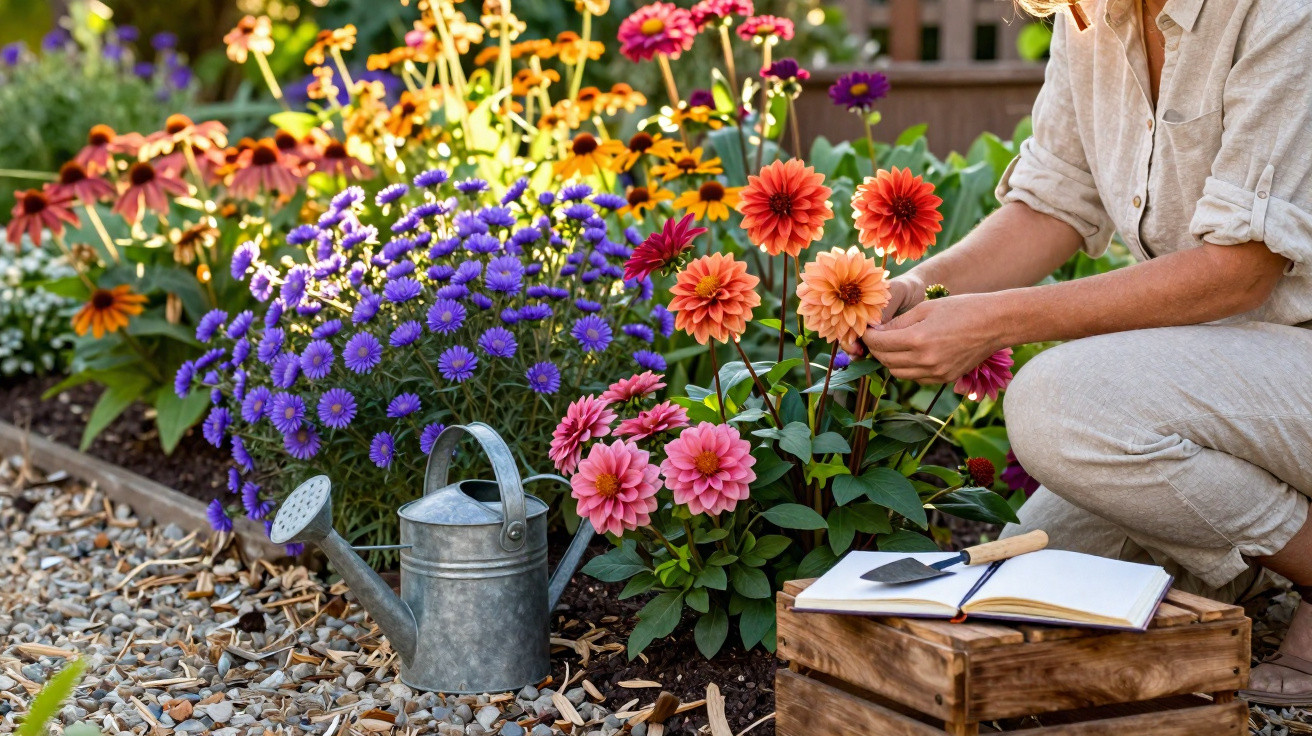
Late afternoon: the light softens, yet the garden suddenly feels brighter than it did a few weeks ago. Back in June, the roses stole the show; now it’s deep purples, sunlit yellows and that cheeky fuchsia you can spot from the other end of the street. A neighbour leans on the fence, looks over and asks, half under their breath: “What on earth is still flowering in your garden now?” We all know that moment. Summer starts tipping into autumn and you can already sense the days shrinking. And right then, your mood can hinge on whether the garden makes one more big effort - or whether it simply… fades.
Why late summer is made for bold colour
August brings a subtle shift. As the worst of the heat eases, many early summer bloomers run out of steam and the long-distance perennials step forward. The air smells drier, the light comes in at a lower angle, lawns look more straw-like - and that’s exactly why strong flower colours hit harder. Suddenly, vivid asters and yellow coneflowers read like little spotlights in the border. A late-summer garden that’s planted with intention doesn’t look tired; it looks unexpectedly alert. Almost like a second spring, just with a deeper, richer mood.
You notice it most in those evening seconds when the sun is already low. A dark blue-violet delphinium that barely registered in June can look as if it’s glowing in the golden-hour light. Insects move more slowly now, yet there are still surprising numbers of them about. One single dahlia, with its dense, saturated petals, can rescue a corner that would otherwise have slipped into full “autumn mode”. Anyone who has walked through a border packed with asters, coneflowers and stonecrop on a dry late-summer day won’t forget the sight in a hurry. The colours feel thicker, more concentrated - almost more serious than they do in May.
There’s a straightforward logic behind it. When the surrounding greens lose their punch, any patch of colour looks stronger by comparison. Cooler light emphasises blues and violets, while gold-yellow and orange seem to glow from within. Many late-summer perennials build pigments that reflect UV light differently - a signal to insects and a wow effect for us. And there’s another point: plants that flower at this time are often hardy, drought-tolerant and impressively long-lived. Late-summer colour isn’t an accident; it’s nature’s strategy - and it can be ours too.
These flowers bring serious colour right now
If you want punchy colour late in the season, begin with proven performers: coneflower (Echinacea), tall stonecrop (Sedum), asters, dahlias and sneezeweed (Helenium). Together they cover everything from bold pink and warm orange to deep violet. Coneflower brings those iconic, radiant daisy-like blooms you can see from a distance. Stonecrop shifts from rich rose to dark red, and the colour only intensifies as the days cool. Asters handle the blue-and-lilac side of things, like small stars scattered across the border. If you’ve got space, add a few sneezeweed varieties in red-brown and gold-yellow and the bed can glow like a late-summer sunset.
A familiar scene in plenty of front gardens: unremarkable in June, suddenly camera-ready by September. Picture a narrow border along a path, planted with two coneflower varieties, three dahlias in deep red, and a clump of Sedum ‘Herbstfreude’. In high summer, hardly anyone looks because everything is “just” green. Then late summer arrives and it all kicks off. Children stop to touch the thick stonecrop flowerheads. Passers-by pull out their phones. One single strip of border, if it’s built for late summer, can give an entire garden the dramatic colour point it’s been missing. And yes - neighbours start asking for plant names they never cared about before.
The impact follows a clear pattern. Coneflowers and sneezeweed have strongly contrasting centres that automatically pull the eye in. Dahlias contribute large, geometric shapes that still read clearly even at dusk. Stonecrop and asters fill gaps without becoming heavy, and they can keep the colour going comfortably into October. On top of that, they act as magnets for bees and butterflies when much else has finished. Let’s be honest: hardly anyone maintains an elaborate colour scheme day in, day out. With these plants, though, late-summer drama more or less happens by itself - year after year.
How to plan a late-summer garden with intense colours
The key is thinking in layers. Start with a dependable base of grasses and structural plants, then weave late-summer bloomers through as bright “islands” of colour. Begin with 2–3 taller lead players: for example, sneezeweed towards the back, with a backdrop such as Miscanthus (Chinese silver grass) or switchgrass as a soft, moving curtain. In front of that, plant coneflowers and dahlias in groups - never as lonely singles, always in clusters of at least three plants. Along the front edge, use lower asters and smaller Sedum varieties. That way you create depth almost automatically. For colour mixing, stick to a simple rule: one dominant tone (for instance, violet), one complementary accent (yellow or orange) and one calmer partner such as white or a pale pink.
Many home gardeners trip up in the same place: too much at once, all shouting in the same colour fireworks. Instead of looking intense, the border ends up feeling jittery. Another classic mistake is the lone specimen in the middle of the lawn - a single dahlia bravely trying, but visually getting lost. Or perennials that are lovely individually yet never peak together. That can be frustrating, especially after you’ve invested a year or two of patience. A blunt, practical suggestion: start with one bed of 2 x 3 metres, design it specifically for late-summer colour, and ignore the rest of the garden for the time being. Once that small section works, the appetite for more tends to grow on its own.
A garden designer said something in conversation recently that stuck:
“A garden without a strong late summer is like a film without a finale - technically fine, but it rarely stays with you emotionally.”
Once you’ve seen it, you never plant only for June again. To make it work, keep three simple guiding ideas in mind:
- Choose no more than three main colours per bed, rather than wedging every lovely plant into the gaps.
- Watch the flowering window: pick varieties that genuinely hold from August to October, not just a brief peak.
- Pair every intense flower colour with something calming - for example grasses, silvery foliage or white accents.
What this colour surge does to us - and how to share it
A late-summer garden that’s overflowing with colour is more than decoration. It does something to your head. When the first days turn cooler and the news starts talking about the “start of autumn”, a glowing border feels like a counter-design - a quiet refusal to retreat early into blankets and indoor life. Many people realise how much they need that colour surge, especially as everyday life tightens up again: school starts, work ramps up, the year turns serious. Sitting on the steps in the evening with a cup of tea, looking into dahlias, coneflowers and asters, can feel like a small act of self-care.
And yes, late-summer colour is contagious. When people visit, conversations quickly move from “How are you?” to “What’s that plant called?” Cuttings get swapped, variety names get hoarded on scraps of paper or saved on phones, quick photos get taken “so I can do that next year”. A bed full of intense late-summer flowers becomes a talking point - sometimes even a neighbourhood project. Someone passes on dahlia tubers, someone else shares stonecrop, another person digs up a tough old clump of asters that once grew in their grandmother’s garden. At that point, the garden doesn’t stop at the fence; it carries on in other beds, in other streets, in other towns.
Perhaps that’s the quietest luxury of all: in a season officially associated with endings, you build your own finale. Not a frantic, noisy firework display, but a slow, deep film of colour that looks slightly different each day. Once you plan for this phase on purpose, you start seeing summer differently. It no longer finishes in July; it stretches well into October. And if one cool morning you walk through your garden - clear air, dense, saturated colour - you might think: everyday life may be turning greyer, but out here something is pushing back. Quietly, flowering, stubbornly.
| Key point | Detail | Benefit for the reader |
|---|---|---|
| Choose late-summer bloomers on purpose | Coneflower, asters, dahlias, stonecrop, sneezeweed as the colour foundation | A concrete plant list that reliably delivers intense colour |
| Build the border in layers | Tall structural plants at the back, colour groups in the middle, lower species at the front | A calmer-looking, more effective garden without planning stress |
| Colour harmony instead of chaos | No more than three main colours, combined with grasses and “calming anchors” | The garden looks cohesive and photo-ready rather than overloaded and unsettled |
FAQ:
- Which flowers truly bloom reliably in late summer? Coneflower (Echinacea), stonecrop (Sedum ‘Herbstfreude’), autumn asters, sneezeweed (Helenium) and many single-flowered dahlia varieties are particularly dependable. They cope well with heat and keep the colour going into autumn.
- Can I grow late-summer bloomers in pots as well? Yes - especially dahlias, shorter asters and compact Echinacea varieties do well in containers. Use large pots, ensure good drainage, and water regularly during hot spells.
- When is the best time to plant for a colourful late summer? Perennials such as asters and stonecrop are best planted in spring or early autumn. Dahlia tubers go into the ground after the last frosts, and coneflowers are available as potted plants for most of the growing season.
- What if my garden is very dry? That’s exactly when Sedum, many Echinacea varieties, Gaura and grasses make sense. Improve the soil with compost, mulch, and water less often but more deeply.
- How do I combine strong colours without it looking garish? Show restraint: one base colour (e.g. violet), plus a contrast (yellow/orange), and plenty of green or silvery foliage as a calm zone. Repetition rather than scattered one-offs creates structure.




Comments
No comments yet. Be the first to comment!
Leave a Comment