
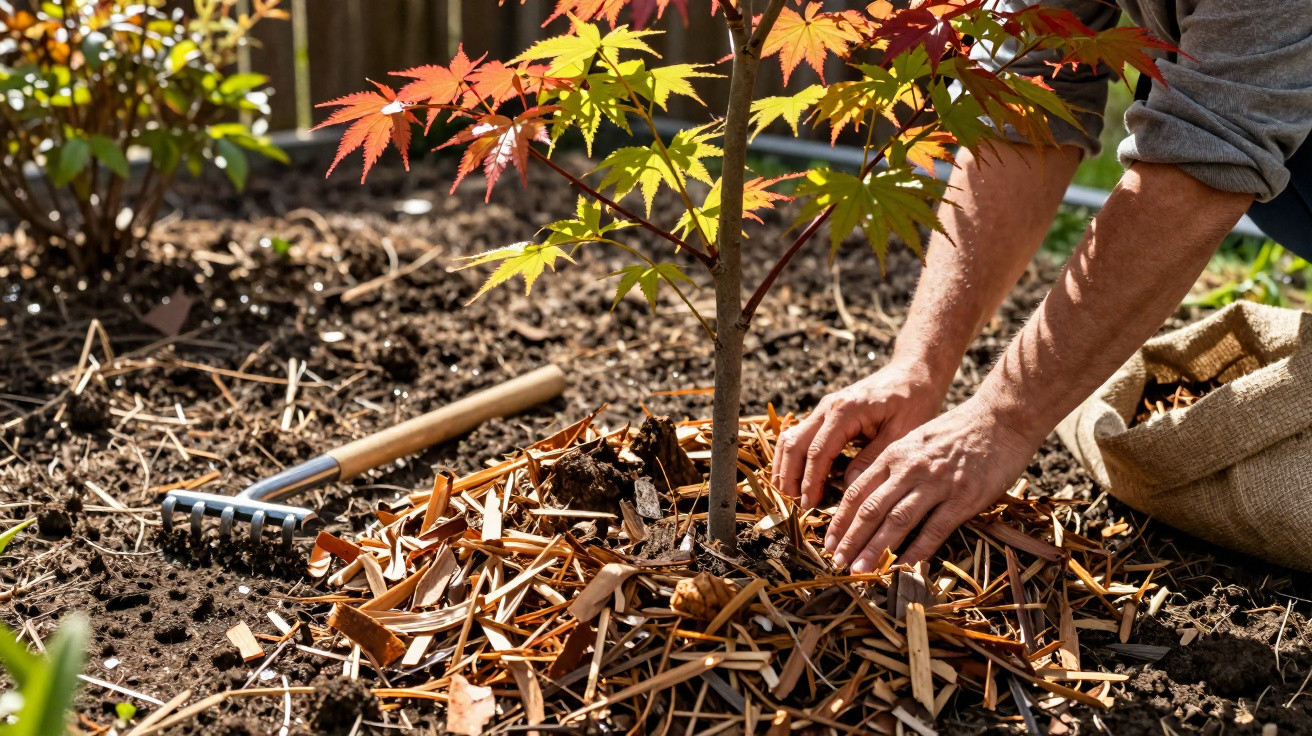
Leaf edges that crisp up, hardly any fresh shoots, and despite diligent watering the Japanese maple still looks weary. Anyone with such a showpiece in the garden or in a container will recognise the frustration. Yet the answer is not pricey specialist compost or fertiliser, but one straightforward step on the soil around the trunk - timed for the moment spring is just getting going.
Why March is the key month for Japanese maples
Japanese maples (Acer palmatum) originate from light woodland, where the soil is never left bare. In their natural habitat, they sit in a deep layer of fallen leaves, fine bark and humus. In many UK gardens, by contrast, the tree ends up in full sun, set into lawn or thin, impoverished soil. The roots are the first to feel the difference.
These ornamental shrubs and small trees form very shallow roots that run just a few centimetres below the surface. That makes them particularly sensitive to:
- late spring night frosts
- sudden heat and intense sunshine
- alternating wetness and drought
- compaction from foot traffic or heavy soils
The result is predictable: stressed roots, little new growth, a sparse crown, and leaves that develop brown edges or look tired as early as summer.
"Wer im März den Wurzelbereich eines japanischen Ahorns schützt, schafft die Basis für ein gesünderes Wachstum und dichteres Laub."
The most effective lever is also the least dramatic: a purposeful layer of organic cover - mulch - laid at the base of the tree. It recreates the woodland floor and shields the roots from extremes.
Mulching in March: the simple care plan for healthy roots
Step 1: Clear and gently loosen the soil
As soon as the ground has thawed in March and is no longer waterlogged, you can prepare the area:
- Carefully remove weeds by hand within the canopy area.
- Loosen the surface only very lightly - no more than 2 to 3 centimetres deep - using a hand cultivator or a wooden stick.
- Do not use a spade, as it can easily cut the fine roots.
Even this minimal roughening improves air exchange in the root zone and helps water soak in more evenly later.
Step 2: Choose the right mulch
Japanese maples prefer mildly acidic, humus-rich conditions - the kind you find in deciduous woodland. Suitable materials include, for example:
- composted pine bark
- well-rotted, dry leaf mould (for instance from beech or oak)
- mature garden compost applied as a thin layer
- finely chipped, seasoned prunings (woodchip)
Specialists tend to advise against the following around maple roots:
- dark stones or gravel in full sun, as they overheat the soil
- heaps of fresh grass clippings, which can rot and attract slugs
- plastic sheeting or fleece that seals the surface and blocks airflow
Step 3: Apply the mulch correctly
Once you have the material, the application is what matters:
- Use the area beneath the canopy as your guide - the fine roots generally extend that far.
- Spread an even layer around 5 to 8 centimetres deep.
- Leave a clear ring of roughly 10 centimetres around the trunk.
Important: the base of the trunk must not disappear under mulch. The slightly thickened area at the base - the root flare - needs to remain visible. If mulch is piled up against it, it stays constantly damp, which makes fungal problems and rot much more likely.
"Der perfekte Mulch liegt locker wie ein Waldboden-Teppich – nie wie ein angehäufter Wall direkt am Stamm."
What the mulch layer does for water, nutrients and local conditions
A single job in March can noticeably change the microclimate around the tree. The layer works both as insulation and as a buffer:
- It keeps the soil moist for longer without encouraging waterlogging.
- It moderates sharp temperature spikes on hot days.
- It prevents sunshine from drying the uppermost roots.
- It suppresses weeds that would otherwise compete with the maple for water and nutrients.
Over time, the organic layer breaks down. Microorganisms turn it into humus, which feeds the roots. The soil becomes looser, more crumbly and more alive - much like the ground in a natural leaf forest.
Watering properly: how mulched maples benefit most
Mulch does not replace watering; it makes watering more effective. In typical spring and summer conditions, many nurseries recommend for established Japanese maples planted in the ground:
- watering thoroughly about twice a week
- watering less often but more deeply, rather than frequent small amounts
During prolonged dry spells, watering may increase to three or four times per week, depending on the position, soil type and weather. Mulch then helps more of that water reach the roots instead of evaporating at the surface.
"Wer den Boden unter dem Ahorn mulcht, braucht nicht zwangsläufig mehr Wasser – nutzt das vorhandene aber deutlich besser."
Container plants: mulch yes, waterlogging no
Japanese maples grown in pots react even more strongly to changing conditions. Here, a thinner layer is enough:
- 3 to 5 centimetres of mulch is plenty in a container.
- After each watering, pour off excess water from the saucer.
- Never leave the pot standing in water long-term.
Towards late summer, you can gradually reduce the amount of water without letting the rootball dry out completely. This supports leaf colouring and helps the tree prepare for its resting phase.
Common Japanese maple problems - and how mulch helps
Many issues gardeners notice on Japanese maples trace back directly or indirectly to the root zone. Here are some typical examples:
| Problem | Cause in the root zone | How mulch counters it |
|---|---|---|
| Brown leaf edges in summer | Heat stress, drought, shallow roots overheating | cools the soil, holds moisture for longer |
| Hardly any new shoots | ongoing stress, nutrient deficiency, compacted soil | supports humus build-up, improves structure |
| Leaves small and sparse | weak root system, uneven water supply | stabilises moisture, reduces fluctuations |
| Fungal growth at the trunk base | mulch or soil piled against the trunk, constant damp | a clear ring around the trunk prevents rot |
More than looks: why the “woodland floor trick” works long-term
If you refresh the mulch each year in early spring, you gradually build a more stable soil structure. Earthworms and other soil organisms process the material and pull it down into deeper layers over time. This gives the tree a root zone with better aeration and more even water storage.
It also opens up design options in the garden. Under a mulched maple, there is no need to keep a lawn going that will struggle in shade anyway. Instead, you create a calm corner that visually echoes a Japanese garden. If you like, you can add shade-tolerant companions such as hostas, ferns or low grasses - the key point is to keep the base of the trunk clear.
For many owners, this single step feels almost like flipping a switch: the tree puts on stronger growth, looks less stressed in summer, and shows its characteristically intense autumn colours. It is especially well suited to periods of more frequent heat, when sensitive woody plants have to cope with one extreme after another.
One more point that is often underestimated: mulching avoids harsh interference in the root area. Regularly using a scarifier, powered cultivator or spade close to the trunk can cause major damage to fine roots. A quiet, protected zone with a permanent surface cover removes that stress - and turns a problem plant back into a focal point that looks stronger year after year.

Comments
No comments yet. Be the first to comment!
Leave a Comment