
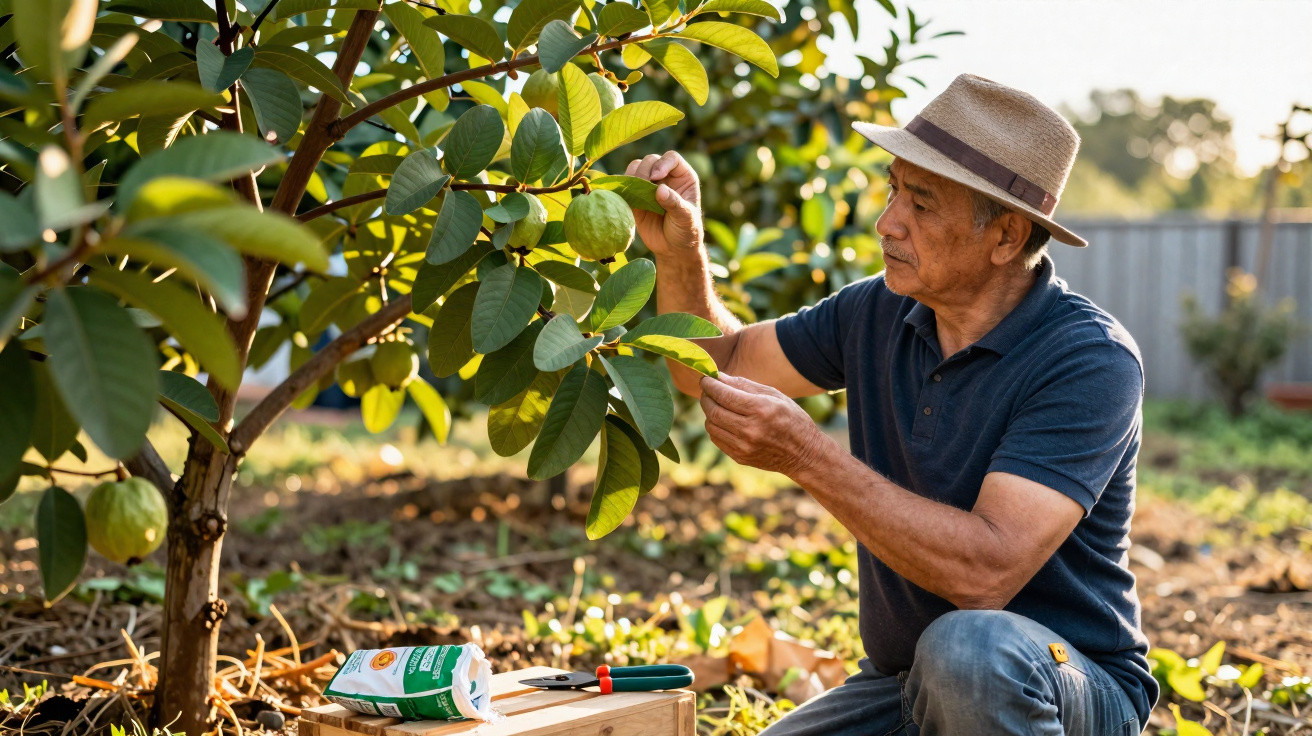
A guava tree with many leaves and few fruits may look as though it is thriving, yet it can be channeling most of its energy into leafy growth. Before increasing fertiliser, it is worth checking light levels, watering, pruning, and nutrients, because either an excess or a shortage in any of these can disrupt flowering and fruit set.
Why does the guava tree become full of leaves and produce few fruits?
Leaves and branches are part of the tree’s vegetative growth, whereas flowers and fruits depend on different physiological conditions. For that reason, a very vigorous canopy does not automatically mean the plant is in the best condition to bear fruit.
Sunlight deserves particular attention. A guava tree needs plenty of direct sun to carry out photosynthesis properly and support its development. If the tree has started to receive more shade-because of a change in the site, for example-yields can drop even when the foliage remains green.
Can too much fertiliser encourage lots of leaves?
Nitrogen drives the production of leaves and shoots. When there is too much of this nutrient available, the plant may grow strongly in a vegetative way, while flowering and fruit production fail to keep pace.
That does not mean the right approach is to stop all feeding, or simply to add more phosphorus and potassium. Nutrient requirements vary according to the soil, the tree’s age, and the growing conditions. A soil test is often more useful than applying fertilisers by guesswork.
How to adjust care to encourage production
Start by checking how much sun the guava tree receives throughout the day, and whether anything has changed recently around the planting spot. Then look at soil moisture: long dry spells can cause stress, while overwatering and poor drainage can damage the roots.
Pruning also needs to be kept in balance. Removing dead, diseased, or badly placed branches can improve canopy structure, but very heavy pruning may trigger a flush of new shoots. The best approach is to tailor management to the variety and to the tree’s stage of development.
When a guava tree with many leaves and few fruits needs attention
A young tree may simply not have reached the maturity required to crop reliably. On the other hand, an established guava tree that flowers sparsely, or regularly drops flowers and fruit, calls for a closer look at its growing conditions.
If the tree has good light, is watered appropriately, and still produces lots of foliage, it is sensible to review the fertilising and pruning history before making further applications. This way, a guava tree with many leaves and few fruits is assessed as a set of conditions, rather than being given a single solution that may not match the true cause.
Comments
No comments yet. Be the first to comment!
Leave a Comment