
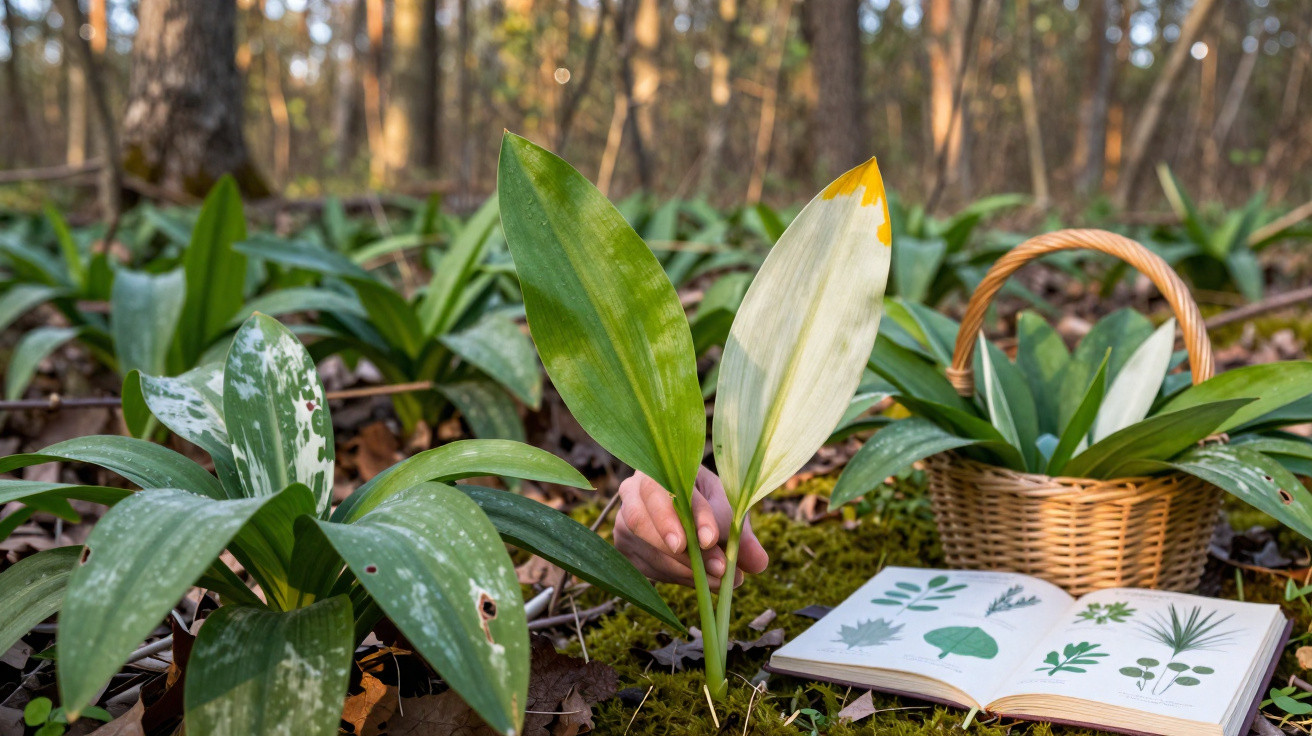
Among lush, green leaves, you may suddenly spot plants with white stripes, washed-out patches or yellowish areas. Many people immediately assume disease or contamination and decide not to pick those leaves. Often, though, it isn’t a problem at all but a completely natural effect that you might only notice this clearly once in your life.
Why some wild garlic leaves look so odd in March
In early spring, wild garlic rarely looks as flawless as it does in food photos or gardening brochures. The plants are only just getting going and have to cope with changeable weather, frost, low light and, in some places, nutrient-poor soil. All of that can show up in the colour of the leaves.
Pale or yellowish wild garlic leaves in March are usually down to site conditions, weather or genetics – not automatically a sign of danger.
The key rule is this: not a single feature – and certainly not colour alone – determines whether something is edible or poisonous. If you forage for wild garlic, you need to assess several identifying characteristics at the same time.
Variegation: when wild garlic naturally grows with white stripes
The most striking examples are leaves with a clearly defined white or cream stripe, often running right along the centre of the leaf. This is known as variegation. In those lighter areas the leaf lacks chlorophyll, the green pigment.
As a result, the leaf develops pale, almost decorative patterns – like you see on some ornamental plants, except here it’s scattered through a wild garlic carpet in the woods. At first glance it can look “diseased”, but in reality it’s a genetic quirk.
- not a sign of mould or fungal infection
- no known toxic effect caused by variegation
- uncommon in large stands
- these plants often reappear in the same spot for years
If you come across striped wild garlic, you’re essentially looking at a small botanical rarity. It is still edible – provided you have identified the plant as wild garlic beyond doubt.
Too little light and too few nutrients: why wild garlic can look washed out
Alongside genetic variation, there are very ordinary reasons for lighter leaves. In dense, gloomy woodland, wild garlic simply doesn’t get enough light in places. The plant then produces less chlorophyll, so the whole leaf appears paler or slightly yellow.
Common locations include:
- deeply shaded dips and hollows in woodland
- areas beneath dense shrubs or old tree canopies
- sites with nutrient-poor, exhausted soil
There’s another factor in March: many leaves have only just emerged. Young wild garlic leaves often start out much lighter than they look later in April. Over the following weeks, the plant builds up more chlorophyll and the colour turns a richer green.
Pale young leaves aren’t a warning sign; they’re a normal spring state – similar to delicate seedlings in the garden.
You’ll also often see paler patches along woodland edges or disturbed ground, for example beside forest tracks or paths. In such spots the soil can be poorer in nutrients, especially after forestry work or erosion. Even if the leaves look lighter, wild garlic remains edible as long as all identification features match.
Frost damage: the typical glassy look and yellowish blotches
March and April often still bring nights with hard frosts. Wild garlic usually copes remarkably well, but individual leaves can change afterwards: glassy, almost water-clear sections, or uneven yellowing.
That’s frost damage – much like lettuce in the garden after a cold snap. The tissue has been affected in patches and some cells have burst. The plant typically recovers quickly once temperatures rise, and new leaves appear normal again.
Many foragers simply cut away badly damaged parts generously or only take unmarked leaves. In terms of flavour, heavily frosted wild garlic can taste a bit watery or less aromatic.
How to recognise wild garlic with confidence
Whether the leaves are pale, dark, striped or slightly yellow, colour is only a minor clue when identifying the plant. What matters is the combination of several features. Anyone gathering wild garlic should learn these characteristics thoroughly:
| Feature | Wild garlic |
|---|---|
| Leaf arrangement | Each leaf grows individually on its own stalk straight from the ground; no paired leaves |
| Leaf surface | Upper side slightly glossy, underside matt; leaf is soft and thin |
| Smell | Distinct garlic scent when a fresh leaf is rubbed |
| Growth habit | Carpet-like stands, usually in damp deciduous woodland, often under beech |
Never rely on just one criterion – safe identification comes from the sum of the features.
Important: always test the smell using a fresh leaf you haven’t touched yet. If you’ve already rubbed other leaves, the garlic scent can linger on your fingers – and it’s easy to fool yourself.
Dangerous lookalikes: plants that can be confused with wild garlic
The biggest risk when picking wild garlic isn’t a slightly lighter leaf colour, but confusing it with poisonous plants. Three species come up again and again:
- Lily of the valley: usually two thicker leaves on a shared stalk. The leaves feel firmer and more leathery. No garlic smell.
- Cuckoo-pint (lords-and-ladies): leaves are often arrow-shaped or irregularly marked, also without a garlic scent. Frequently grows right among wild garlic.
- Autumn crocus: dangerous because it is highly toxic. The leaves can appear early in the year, but grow in a different clustered form and without the characteristic smell.
If you have even the smallest doubt, leave the plant where it is. In a worst-case scenario, poisonous mix-ups can be life-threatening. Beginners in particular are better off foraging at first with experienced plant experts or using reputable courses and well-illustrated identification guides.
How to pick wild garlic safely and sustainably in March
The season often starts in March, and in some years even at the end of February, depending on your area and the weather. At this early stage the leaves are especially tender and aromatic – but they can also vary a lot in appearance.
- Only pick plants that you can identify as wild garlic with complete certainty
- Check multiple leaves, the growth habit and the surroundings, not just a single leaf
- Never pull up whole clumps; cut individual leaves instead
- Leave at least one third to half of the stand so the plant can recover
- Don’t harvest right by roads, busy dog-walking routes or polluted areas
Handled this way, you protect both yourself and the patch you’re collecting from. Wild garlic spreads slowly via bulbs and seed, and it takes years to form dense carpets.
What leaf colour can tell you about flavour and use
Slightly pale or striped leaves generally taste just as aromatic as deep green ones. Some foragers even find that very young, lighter leaves are milder and more delicate. Leaves badly affected by frost, however, can be limp and watery – they’re usually better in cooked dishes than in pesto.
Typical kitchen uses include:
- finely chopped into herb butter, dips or soft cheese
- as the base for pesto, on its own or combined with other herbs
- briefly cooked into soups, risotto or pasta dishes
- thinly sliced and sprinkled over potatoes, scrambled eggs or roasted vegetables
If you have a sensitive stomach, start with small amounts. The garlic character is pronounced, especially when raw – some people react to it much as they do to ordinary garlic.
Why nature sometimes looks “messy” with wild garlic
Many of us are used to supermarket produce that looks uniform: same-sized, unblemished, dark green leaves. Woodland doesn’t work that way. It responds to frost, shade, competition, soil compaction and browsing by wildlife – and the plants show it.
Wild garlic is a great example of how adaptable a wild plant can be. Pale stripes, light spring growth, frost-marked patches or shifting shades of green are all part of the picture. If you regularly crouch down and look closely, you’ll gradually learn to read those subtle differences.
If you want to truly understand wild garlic, don’t just look at the green – look at the entire site, from the forest floor up to the canopy.
In March, that closer look is particularly rewarding. You don’t only take home a delicious wild herb; you also gain a better feel for woodland dynamics: how light, temperature and soil can visibly change plants from day to day.
That’s how the question “What’s wrong with these leaves?” quickly becomes: “What is this wild garlic carpet telling me about the place I’m standing?” And that’s exactly what makes spring foraging so compelling.
Comments
No comments yet. Be the first to comment!
Leave a Comment