
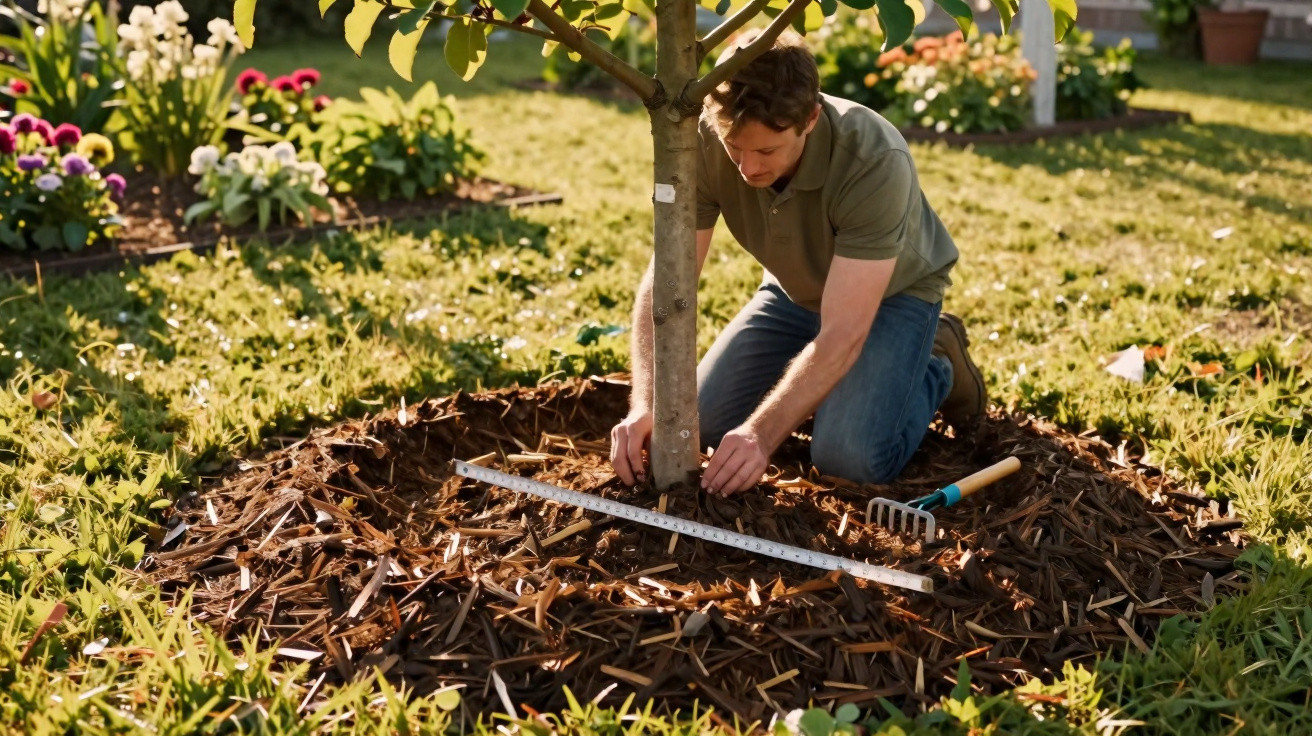
Mulch helps retain soil moisture and cuts down competition from weeds, but how you lay it matters too. The Royal Horticultural Society advises keeping a mulch layer over the soil while leaving roughly 10 cm clear around the trunk, because damp material sitting directly against the bark can encourage rot.
Why shouldn’t mulch touch the trunk?
Mulch often stays wet for a long time. If it is piled right up against the base of a tree or other woody shrub, the bark remains in constant contact with moisture. Over time this can soften the bark and make the plant more prone to decay-related problems.
That is why the “right” look is not a heaped cone around the trunk. A better approach is to spread mulch as a flat ring, keeping a bare gap immediately around the base.
How thick should the mulch layer be?
The Royal Horticultural Society suggests a layer of at least 5 cm and, in different guidance, refers to depths reaching about 7.5 to 10 cm depending on the purpose and application. For a typical home garden, 5 to 8 cm is a practical benchmark that sits within those recommendations.
Mulching can be done with materials such as well-rotted compost, composted leaves, straw or chipped bark, depending on what you are trying to achieve. As well as helping the soil hold on to water, mulch can also help limit the growth of unwanted plants.
How to make a mulching ring around the tree?
Start by spreading the material over the soil around the plant in an even layer. Then pull the mulch back from the trunk to form a clear circle of about 10 cm. This spacing helps ensure the mulch is not left touching woody stems.
There is no need to build up a mound against the trunk either. An even layer across the root area does a better job, and it avoids trapping moisture where the plant is most vulnerable.
Who needs to be most careful about this?
This detail matters most for trees, shrubs and any plants with woody stems. The same guidance applies in gardens where leaves, bark and other organic materials are added to the soil on a regular basis.
If mulch is already banked up against the trunk, simply ease it back to create the clear strip. That way, mulch against the trunk stops forming the familiar “volcano” shape and instead works as a protective layer over the soil, without keeping the base of the plant continually damp.





Comments
No comments yet. Be the first to comment!
Leave a Comment