
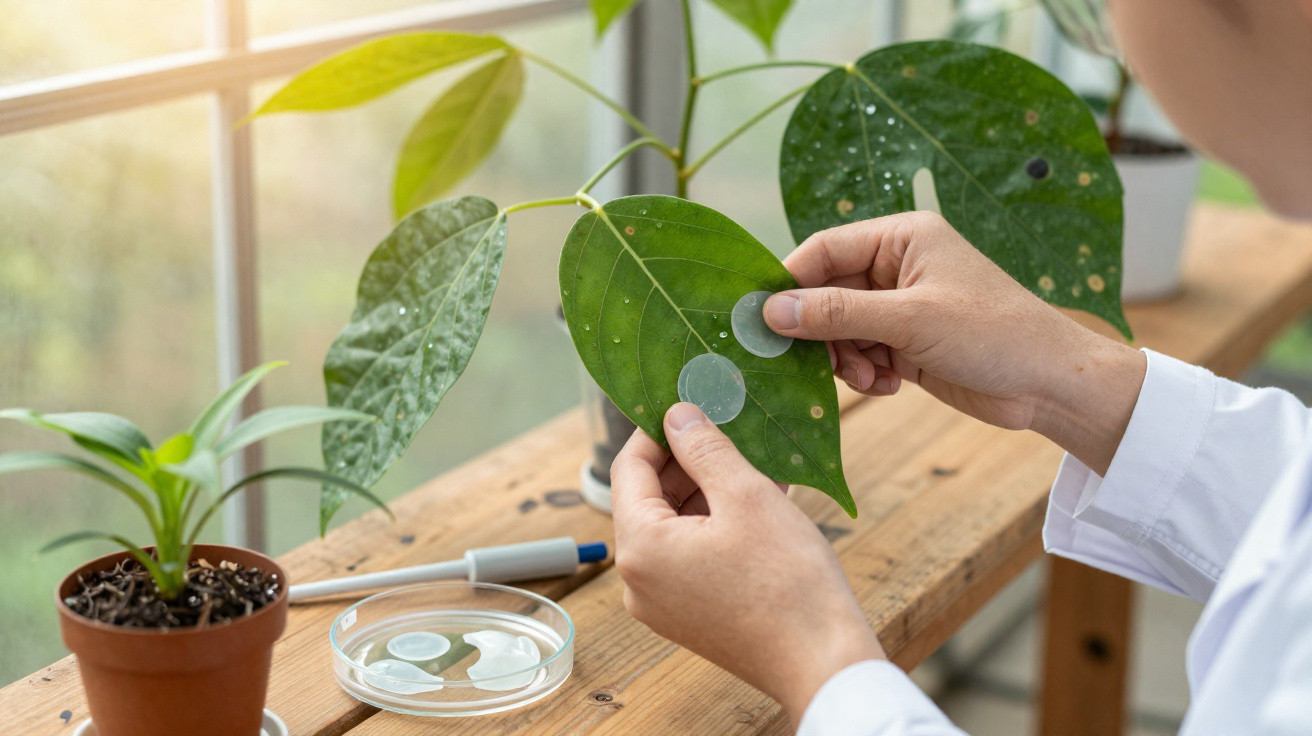
A recent study reports that a transparent gel patch can transport antibiotics into infected plant leaves and curb bacterial disease in about 48 hours.
The finding suggests a shift towards plant care that works more like precise medicine, rather than broad sprays that end up across crops, soil and nearby ecosystems.
Gel patch and plant medicine
In lab-grown leaves, the pliable patch turned a tiny point of contact into a treatment spot that can be removed later, while still affecting tissue beyond its immediate footprint.
By simply pressing the material onto leaves, engineers at the University of California San Diego (UCSD) demonstrated that the patch can push its payload inwards without cutting or puncturing the plant.
The impact was not limited to the outer surface: once loaded, the material moved through leaf veins within hours.
This ability to reach beyond the surface underpins the gel patch’s potential, although real-world use will still rely on how well it performs outside controlled plant conditions.
Why leaves resist
Leaves are protected by a cuticle - a waxy outer coating - and this barrier slows many chemicals before they can enter the plant.
Because waxy surfaces repel water, sprayed liquids often bead, run off, or evaporate before enough of the active ingredient gets inside.
Leaves with hairy surfaces create a further obstacle: trichomes (tiny plant hairs) make the surface uneven and can prevent many materials from properly contacting the leaf.
As a result, any effective plant “sticker” must cling to irregular living tissue without causing damage that could increase stress or open the door to disease.
Gel patch doesn’t damage plants
To achieve reliable adhesion, the engineers combined chitosan - a naturally sourced, sugar-based material - with another soft component.
Chitosan can form dynamic covalent bonds: chemical links that can break and reform, allowing interaction with molecules found on plant surfaces.
They also incorporated polyacrylamide, a flexible polymer commonly used in soft gels, so the patch can deform around leaf hairs and accommodate growth.
When removal begins, water can weaken imine bonds - reversible links created during adhesion - helping the patch peel off.
Medicine quickly enters leaf veins
To track movement, the team loaded the adhesive patch with quantum dots, small bright particles used as tracers, and observed the signal spreading into the leaf’s vein network.
After four hours, the tracer signal appeared in inner veins rather than staying close to the outer skin.
Against a stiffer, non-adhesive gel, the firmly attached version produced 1.87 times stronger internal glow in treated leaf sections.
This contrast indicated that adhesion was not merely superficial: improved contact gave small cargo a more consistent route into living tissue.
Gel patch reduces plant infections
To assess disease control, researchers loaded the patch with oxytetracycline - an antibiotic used against many bacteria - and placed it on leaves.
They then exposed the treated tissue to Agrobacterium tumefaciens, a bacterium capable of infecting plants; here, the bacteria were engineered to carry a glowing chemical marker.
In leaves that were not treated, green fluorescent protein - a marker that fluoresces under ultraviolet light - showed infection after two days.
Patches containing the antibiotic markedly reduced that fluorescence after four hours, consistent with oxytetracycline entering the tissue and stopping bacterial growth.
Patch stays on even during rain
Rain resistance matters, because a plant patch that fails in wet conditions would offer little value to farmers, gardeners or field researchers.
In tests using simulated light drizzle and heavy rain, the gel remained attached, although water directly reaching the leaf–gel interface did reduce bonding strength.
With transparency of close to 90 per cent, the patch still allowed light to reach the leaf, and plant-health measurements indicated no lasting damage over seven days.
However, one higher antibiotic dose did harm tissue, indicating that safe application will require careful limits for each payload and crop.
Gel patch can send signals in plants
To examine signalling capability, the patch was used as a gentle electrical contact on a Venus flytrap, known for its rapid snap-shut traps.
A wearable triboelectric nanogenerator - a device that converts tapping into voltage - delivered a mild signal via wires held in place by the gel.
Previous research has shown that flytraps can close when action potentials - fast electrical pulses in living tissue - trigger the plant’s natural mechanism.
This closure did not demonstrate that plants can communicate, but it did show that the gel can maintain a stable electrical connection on living tissue.
Promise with caution
Current crop protection loses substantial material because sprays drift, bounce off leaves or wash away before crossing the leaf surface.
A targeted patch could reduce wastage by keeping medicine in place and releasing it gradually into nearby tissue.
“This kind of technology has tremendous potential for improving how we protect crops and monitor the environment,” said Nicole F. Steinmetz, Ph.D., a chemical and nano engineering professor at UC San Diego.
The material is also attracting commercial attention, with a pending US patent application naming several inventors.
More uses beyond spraying crops
Later studies may explore loading the gel with genetic material - biological instructions carried by cells - enabling plants to produce useful compounds more cheaply.
These ideas remain preliminary, because plant growth, weather, microbes and dose can all alter how a payload moves.
On farms, the most immediate role may be precise treatment for high-value plants, rather than wide-area application across acres.
Monitoring could be equally important, since consistent contact may allow sensors to detect stress before leaves show visible failure.
Future of precise plant treatment
This removable plant patch ties together three challenges that are usually handled separately: adhering to leaves, delivering measured doses into plant tissue, and transmitting signals.
Its strongest fit may be situations where growers need targeted intervention, while broader adoption will depend on safety, cost and durability in the field.



Comments
No comments yet. Be the first to comment!
Leave a Comment