
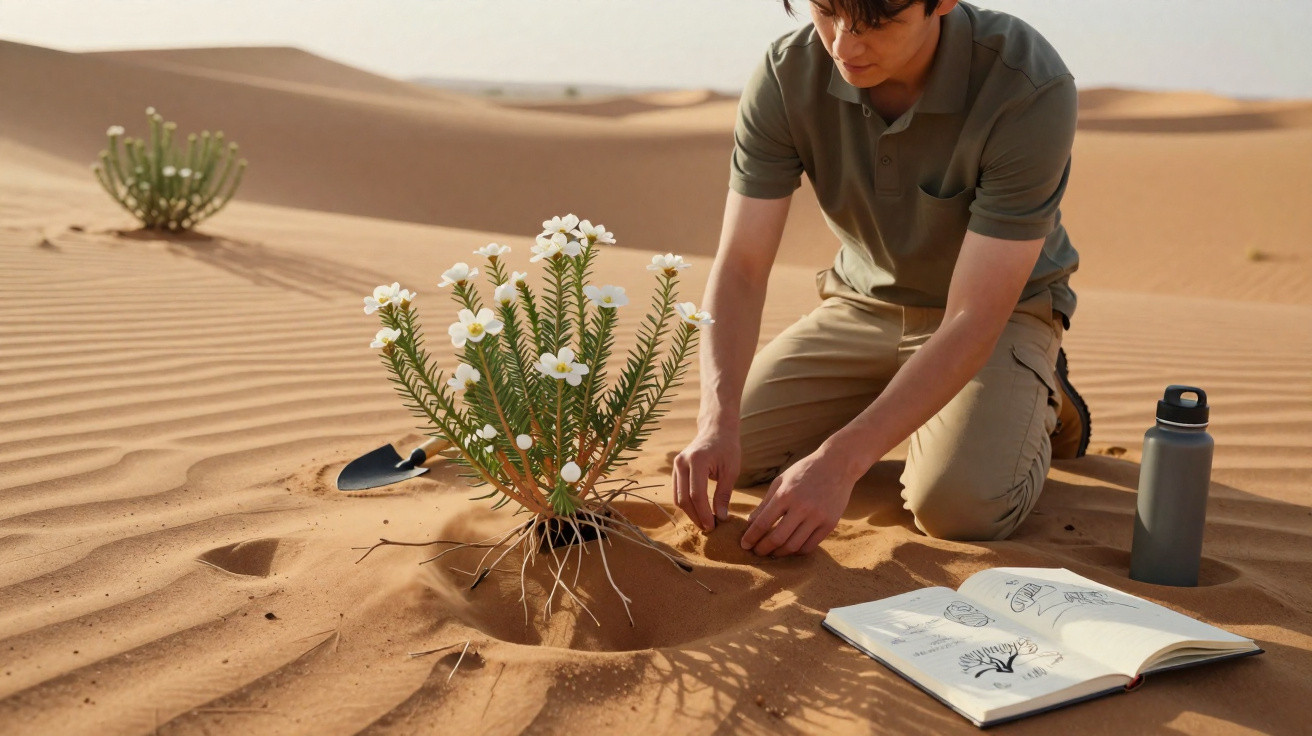
In desert regions where sand seems to leave no room for life, a handful of plants stand out for their ability to reshape the landscape. One of the most striking examples is the genus Calligonum, which includes species such as Calligonum arborescens, recognised for surviving harsh conditions and even supporting the restoration of sand dunes.
How can a plant grow in pure sand?
Calligonum is built for desert habitats and can thrive with almost no fertile soil. It is able to establish itself directly in sand-something only a small number of plant species manage to do effectively.
Its advantage lies in an exceptionally efficient root system. The roots spread quickly in multiple directions, creating a natural mesh that grips sand grains and lessens the impact of wind. In doing so, it helps stabilise dunes and makes it harder for them to shift.
- Grows in almost pure sand
- Has deep, highly branched roots
- Helps stabilise moving dunes
- Withstands strong winds and very low humidity
- Survives on extremely little water
How does this plant manage to flower in the desert?
Even in intensely dry environments with high temperatures, Calligonum can produce small flowers. Flowering is vital for reproduction and for keeping the species going in places where conditions are hostile.
Although modest in appearance, these flowers matter to the ecosystem because they attract pollinating insects. That support from pollinators helps the plant’s life cycle continue, even where few organisms can persist.
- Produces small but functional flowers
- Attracts pollinating insects in the desert
- Maintains its reproductive cycle even during extreme drought
- Flowers in soils that contain virtually no nutrients
- Helps sustain local biodiversity
Why is Calligonum important for combating desertification?
Calligonum does more than endure extreme environments: it also plays a key ecological role by helping to limit the spread of sand dunes. This is particularly significant in areas where the advance of the desert threatens communities and ecosystems.
By stabilising sandy ground, the plant gradually creates more favourable conditions in which other species can establish and grow over time.
- Reduces dune movement
- Creates more stable micro-environments
- Makes it easier for other plants to grow
- Protects against erosion and strong winds
- Supports desert reforestation projects
What does this plant teach us about nature?
Calligonum is a clear example of how nature can adapt to some of the most extreme environments on Earth. Its toughness-and its ability to turn shifting dunes into more stable areas-highlights the potential of plants to help restore degraded ecosystems.
- Life can thrive even in extreme conditions
- Roots are essential for stabilising ecosystems
- Small plants can have a major environmental impact
- Vegetation is key in combating desertification
- Nature adapts in surprising ways
The story of Calligonum shows that even the most inhospitable places can change when nature has the minimum conditions it needs to act. A single, resilient plant can be the first step towards bringing life back to wide stretches of sand and wind.





Comments
No comments yet. Be the first to comment!
Leave a Comment