
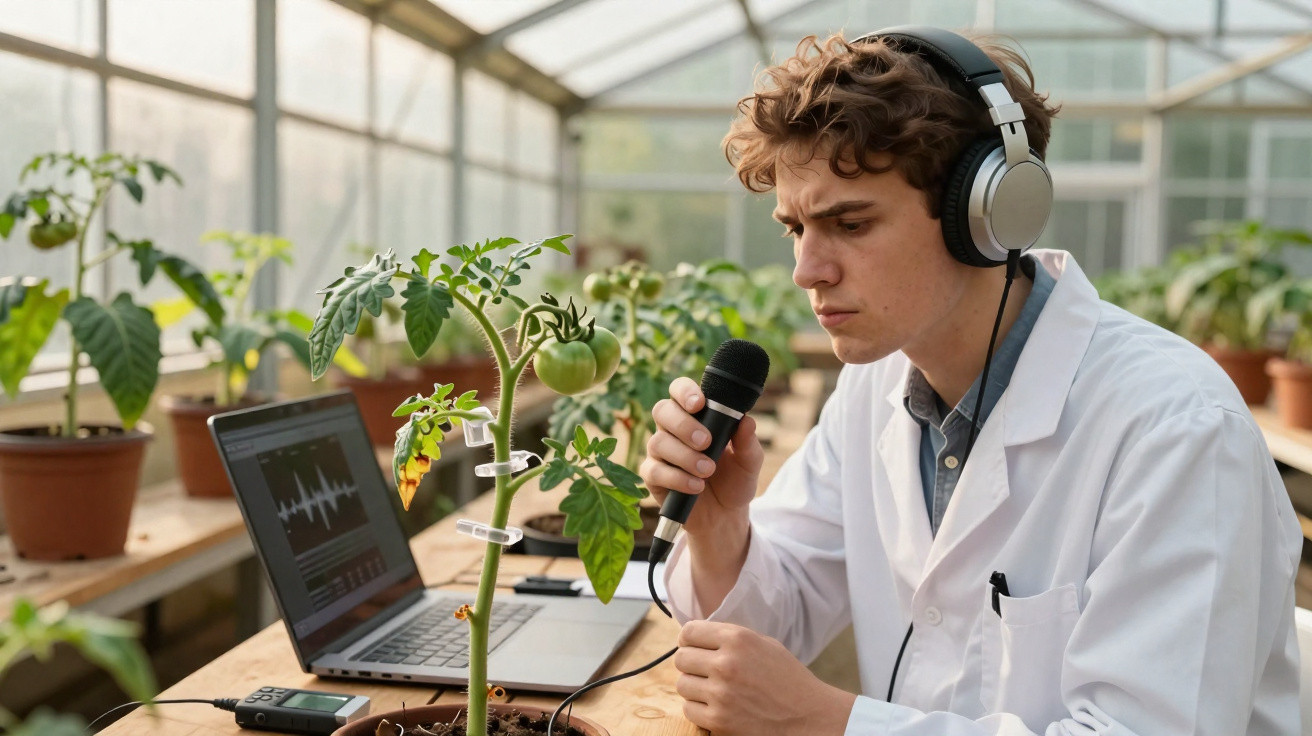
Roald Dahl might not have been entirely off the mark: when a plant is harmed, it can “scream”.
Not as you or I would, of course. Instead, plants give off popping or clicking noises at ultrasonic frequencies beyond human hearing, and those sounds become more frequent when the plant is under stress.
This behaviour could be one way plants broadcast distress to their surroundings, according to research published in 2023.
"Even in a quiet field, there are actually sounds that we don't hear, and those sounds carry information. There are animals that can hear these sounds, so there is the possibility that a lot of acoustic interaction is occurring," explained evolutionary biologist Lilach Hadany of Tel Aviv University in Israel when the findings were released.
"Plants interact with insects and other animals all the time, and many of these organisms use sound for communication, so it would be very suboptimal for plants to not use sound at all."
Plants under stress: more signals than we notice
Stressed plants are far from inert. They can go through striking shifts, and one of the most obvious to humans is the release of potent scents. They may also change their colour and their shape.
Those changes can serve as warnings to neighbouring plants, prompting them to strengthen their own defences. They can also help recruit animals that can tackle the pests damaging the plant.
Even so, the possibility that plants might send other signals - including sound - had not been comprehensively investigated. Hadany and colleagues had previously shown that plants can detect sound. The natural follow-up was whether plants can generate sound as well.
What Lilach Hadany and Tel Aviv University recorded
To answer that, the researchers made recordings of tomato and tobacco plants under several scenarios. They began with healthy, unstressed plants to establish a baseline. They then recorded plants that were dehydrated, as well as plants whose stems had been cut.
The work was carried out in two settings: first in a soundproof acoustic chamber, and then again in a standard greenhouse environment.
After gathering the recordings, the team trained a machine learning algorithm to tell apart the sounds associated with unstressed plants, cut plants, and dehydrated plants.
Ultrasonic clicks, and what the algorithm could distinguish
The noises produced by plants resemble pops or clicks at frequencies far too high for people to perceive. The sounds can be detected from more than a metre away.
Unstressed plants produced very little noise; they largely remained quiet while going about normal plant processes.
Plants experiencing stress, however, were markedly louder, producing on average up to about 40 clicks per hour depending on the species. Plants lacking water also showed a distinctive sound pattern: their clicking increased before any obvious outward signs of dehydration appeared, intensified as drying worsened, and then diminished as the plant ultimately withered.
The trained algorithm could separate these sound signatures and also identify which plant species made them. The phenomenon was not limited to tomato and tobacco: when the team expanded their tests, they found sound production seems to be widespread across plants. Recordings captured wheat, maize, grape, cactus, and henbit making noise as well.
Open questions: how the sounds are made, and who might listen
Plenty remains uncertain. One unresolved issue is the physical mechanism behind the sounds. Earlier studies have linked dehydration in plants with cavitation - a process in which air bubbles form in the stem, grow, and collapse. In people, an analogous process during knuckle-cracking can create an audible pop; something comparable may be happening in plants.
It is also not yet known whether other forms of distress trigger similar sounds. Infection by pathogens, physical attack, UV exposure, extreme temperatures, and other unfavourable conditions might also lead plants to pop and click.
Another unknown is whether plant sound production is an adaptation shaped by evolution, or simply a by-product of stress physiology. Even so, the team demonstrated that an algorithm can learn to detect and classify plant sounds - and it is plausible other organisms could do something similar.
Those organisms might also have learned to react to the sounds of a distressed plant.
"For example, a moth that intends to lay eggs on a plant or an animal that intends to eat a plant could use the sounds to help guide their decision," Hadany said.
For humans, the potential applications are straightforward: if we can pick up the distress calls of thirsty crops, we could irrigate earlier, before the situation becomes severe.
Whether other plants themselves detect and respond to these sounds is still unclear. Past work has shown that plants can increase drought tolerance in response to sound, so the idea is certainly feasible - and it is a direction the researchers have highlighted for what comes next.
"Now that we know that plants do emit sounds, the next question is – 'who might be listening?'" Hadany said.
"We are currently investigating the responses of other organisms, both animals and plants, to these sounds, and we're also exploring our ability to identify and interpret the sounds in completely natural environments."
The research was published in Cell.
An earlier version of this article was published in March 2023.




Comments
No comments yet. Be the first to comment!
Leave a Comment