
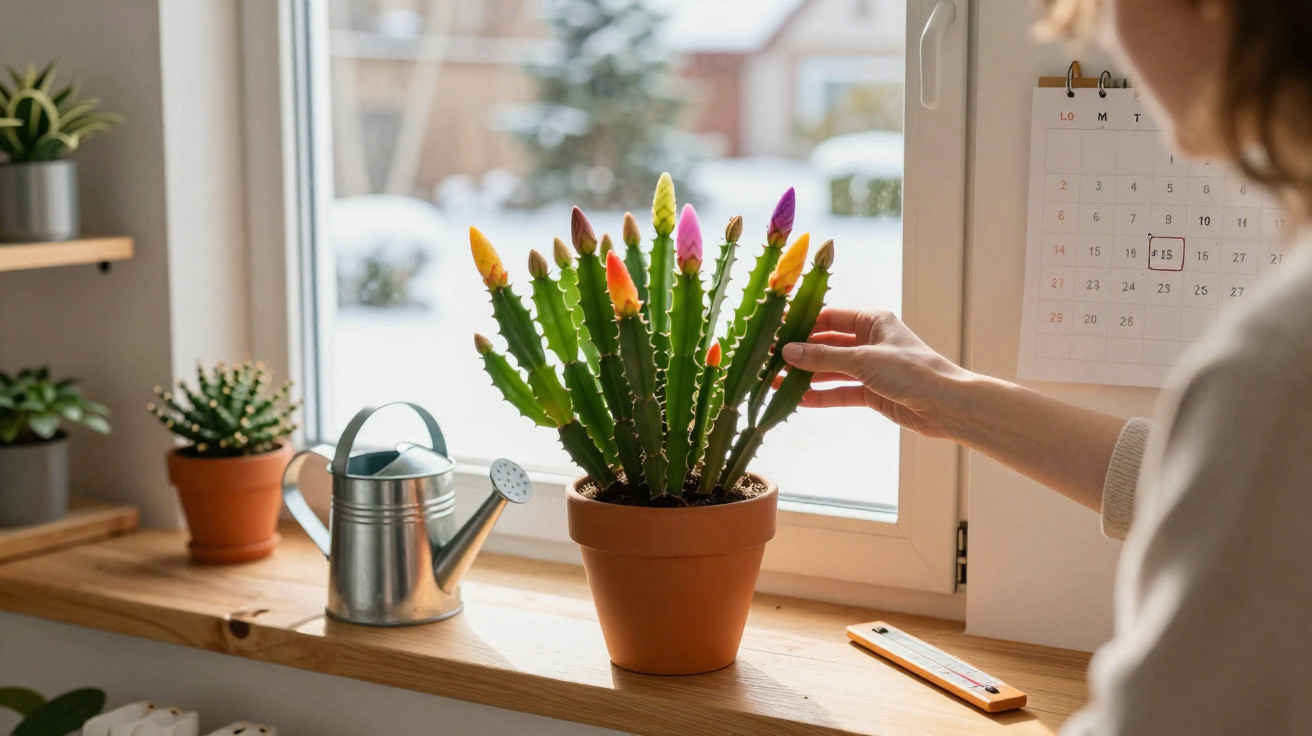
Often, it is not a “black thumb” at all, but one single winter care mistake.
Plenty of houseplant lovers know the situation: in the garden centre, the Easter cactus is covered in star-like blooms; at home it delights you for one season – and the following year, nothing happens. The segments stay plump and green, the plant looks healthy, but buds simply never appear. Once you understand how this unusual cactus works, the pattern becomes obvious: what matters is not spring, but what you did in the months beforehand.
Why the Easter cactus is different from other cacti
The Easter cactus (most commonly sold under the botanical name Rhipsalidopsis) comes from humid forests in South America. In the wild, it does not grow in hot desert sand; instead, it lives high up in trees as an epiphyte. That origin shapes its care requirements.
- Not a desert plant: it cannot cope with harsh midday sun like a desert cactus.
- Airy, not heavy: its roots need a loose, free-draining compost.
- Even moisture: it prefers slightly damp compost, but never waterlogged.
Indoors, it does best in a bright room out of direct midday sun, for example on an east- or west-facing windowsill. In that position it grows compactly and builds up energy over the year for its spring display.
Confusing it with the Christmas cactus
It is common to come home with a Christmas cactus instead of an Easter cactus – or the other way around. They look similar, but their flowering times do not match.
| Feature | Easter cactus | Christmas cactus |
|---|---|---|
| Flowering period | Spring, usually March to May | Winter, usually November to January |
| Stem segments | More rounded, with softer edges | Clearly toothed or more pointed |
| Typical time to buy | February to April | October to December |
If you expect blooms at the wrong time, you often shift the dormancy period without meaning to – and later wonder why flowers fail to appear.
The key point: the Easter cactus needs a real winter rest
The most important message for anyone whose plant stays stubbornly green: an Easter cactus forms buds reliably only if it gets a cool break in winter. A permanently warm spot on a windowsill above a radiator is its biggest enemy.
“No frost, but distinctly cooler: if you give your Easter cactus fresh temperatures from November to January, you lay the foundation for an explosion of blooms in spring.”
The ideal winter timetable
To get flowers around Easter, experienced indoor gardeners tend to follow a simple schedule:
- Late autumn to early winter (late October to November): gradually lower temperatures, reduce watering, and stop feeding.
- Winter rest (November to January, around 8–12 weeks): a cool area at about 10–15 °C, noticeably less light, and almost no water.
- Waking phase (February): move it step by step to a warmer, brighter place; water a little more often, but do not overdo it.
During this cooler spell, the plant essentially “decides” whether to set buds. If conditions stay warm throughout, it may keep growing and look perfectly healthy – but the flowers you are waiting for do not arrive.
The role of light, temperature and darkness
Temperature is not the only trigger; light also influences flowering. In its natural habitat, the plant experiences long nights and cooler periods before it gets going in spring.
How much light does an Easter cactus need in winter?
During dormancy, about eight hours of indirect daylight per day is enough. Even more important are long, uninterrupted nights.
- Daytime light: a bright but not sunny spot, such as a north-facing window or a position slightly back from the glass.
- Darkness at night: at least twelve hours of true darkness, with no lamp, television glow or constant lighting.
If the living room lights are on late every evening, it can throw off the Easter cactus’s internal calendar. The plant then “thinks” the dark phase has not arrived yet, and delays forming buds.
Watering: the most common mistake happens in the pot
Many people “spoil” their Easter cactus with water in winter because they worry it might dry out. In reality, that is exactly what holds flowering back and can harm the roots.
Watering correctly through the year
- Spring and summer: water every one to two weeks once the top layer of compost has dried. Avoid standing water at all costs.
- Autumn: extend the intervals and cut back the amount, preparing the plant for rest.
- Winter rest: only give a small amount every three to four weeks – just enough to stop the segments becoming limp.
Checking the pot after watering and pouring away excess water from the saucer helps prevent root rot. A loose mix of good-quality potting compost with about one third coarse material such as perlite, lava grit or coarse sand improves drainage.
Typical mistakes that ruin flowering
The same issues crop up again and again in homes and conservatories. Once you know them, they are easy to avoid.
These pitfalls cost the Easter cactus its buds
- Wintering too warm: a constant 20 °C or more, for example directly above a radiator.
- Artificial light late into the night: an open-plan living area with permanent lighting.
- Moving it too often: changing location, especially once buds are already visible.
- Draughts and temperature shocks: winter ventilation right next to the plant.
- Constantly wet compost: dense, soggy soil that barely dries.
“If you ‘protect’ your Easter cactus in winter by keeping it warm, bright and damp, you mean well – but you remove exactly the signals the plant needs in order to flower.”
How to rescue a green but reluctant plant
If your Easter cactus has not flowered for years, a reset over several months can be worthwhile.
Practical rescue plan
In autumn, repot the plant into fresh, airy compost and choose a slightly smaller pot (but not one that is tight). Then move it to a cool, bright spot, such as a stairwell window or an unheated guest room. The rules there are: minimal water, no fertiliser, and long dark periods.
When the first buds show in late winter, the pot can be moved to a slightly warmer room (but not a hot one). At that point, stability matters: do not rotate it and do not keep carrying it between windowsill and table. Even a brief cold shock or a draught can cause buds to drop before they open.
Why humidity and placement affect the number of flowers
While it is in bloom, the Easter cactus can be sensitive to dry air from central heating. The stem segments may shrivel, and buds can dry out or fall off early.
A straightforward fix is to stand the pot on a tray filled with damp clay granules or gravel, making sure the root ball is not sitting in water. That allows moisture to rise gradually without leaving the compost wet.
A lightly sheltered position – not directly above a radiator and not in a draught from patio doors – also supports better flowering. If you rotate the plant during flowering, do so at most once a week to stop it leaning too strongly towards the light without stressing it.
What “dormancy” really means botanically
Behind the scenes, the Easter cactus responds to day length, temperature and water availability. Specialists describe it as a photoperiodic plant: it uses the balance of light and dark hours as a cue to set buds. Cooler temperatures and reduced watering strengthen that signal. In nature, this helps the plant avoid flowering at an unfavourable time.
Recreating this pattern in a living room is often what turns a long “stubborn” plant into a reliable bloomer. The green cactus was never inherently difficult – it was simply missing the right winter.

Comments
No comments yet. Be the first to comment!
Leave a Comment