
Many amateur gardeners assume a new fig tree costs money, takes up space and, above all, demands experience. In reality, one well-timed job in late winter is enough to turn a single established tree into a second one. If you know when to do it and how, you can build up your own little fig grove - even if you are starting from scratch.
Why late winter is the perfect time
In February, fig trees often look lifeless: bare branches, a crown that seems paused in time. Yet inside the wood, the season is already shifting. Sap begins to rise and stored reserves concentrate in the shoots.
"The best moment for new roots is just before the tree ‘wakes up’ - in other words, shortly before the buds break."
That brief transition is exactly when it makes sense to take hardwood cuttings and get them rooting. If you remove the branch before growth starts, the energy in the cutting is more likely to go into making roots. If you wait until leaves are already appearing, some of that energy is diverted into new top growth - and establishment becomes harder.
In milder areas, February is usually ideal. In colder parts of the country, aim to make the cuts by early March at the latest, while the buds are still closed and there is no persistent hard frost.
Choosing the right branch: without a healthy base, there is no new tree
Figs can be propagated extremely reliably using hardwood cuttings. That makes selecting the right shoot the single most important step.
How to spot the ideal shoot
- It grew last year, so it is not a fresh, soft green shoot.
- It has already turned woody - firm, and grey to brown in colour.
- It looks healthy, with no cracks, wounds or dark patches.
- It has several clearly visible buds along its length.
Very young shoots that are still green and soft are prone to rotting and dry out quickly. They are far less suitable than sturdy, properly woody branches.
Cutting your hardwood cuttings to the right size
From a suitable branch, cut several pieces, each around 20 to 25 centimetres long. As a guide, the thickness should be roughly that of a pencil. Each piece needs three to four visible buds.
For the cuts themselves:
- Bottom: a straight, horizontal cut just below a bud.
- Top: an angled cut about 1 centimetre above the final bud.
The slanted cut at the top is useful for one simple reason: later, you can immediately see which end is “up”, avoiding the common mistake of planting the cutting upside down.
The ideal potting mix: open-textured, but not too rich
Figs can root directly in the ground, but using a deep pot is generally more dependable. You can manage moisture, frost protection and placement much more easily.
Substrate for strong root growth
"A loose, well-aerated substrate stimulates root formation and prevents waterlogging - figs really do not like wet feet."
A straightforward mix works particularly well:
- 2 parts potting compost or garden soil with a high humus content
- 1 part sand or perlite for drainage
In a 5-litre pot, that works out at roughly 3.3 litres of soil and 1.7 litres of sand. The finished mix should feel light and crumbly rather than sticky.
Planting the cutting and watering properly
Make a planting hole first with a stick or your finger so the wood does not split when you insert it. Push the cutting in deep enough that about two thirds to three quarters sits below the surface. At least one bud must remain above the compost.
Firm the compost gently and water carefully. It should be moist, but never soaking. Any extra water must be able to drain away from the bottom. A pot without drainage holes is a reliable recipe for rot.
A mini greenhouse for figs: a bottle becomes your own nursery
To get your future fig tree off to a strong start, it needs higher humidity around the shoot - but not soggy compost around the base. A simple method can achieve this, even on a balcony.
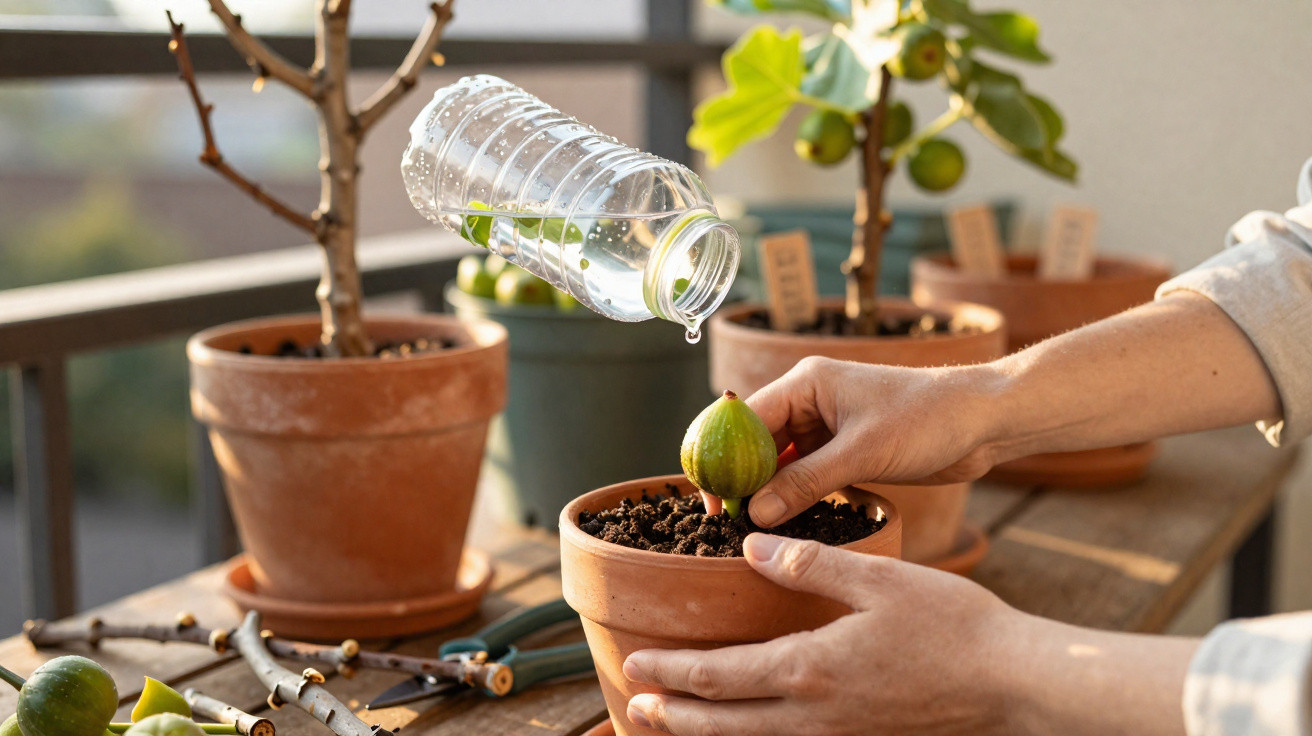
A plastic bottle as a protective cover
Cut the base off a large PET bottle and place it over the cutting like a cloche. Loosen the cap slightly or make a small hole in it. This creates a mini greenhouse:
- The air inside stays humid for longer.
- The cutting is less likely to dry out.
- It is better protected from wind and temperature swings.
If too much condensation builds up inside, open the cap a little more or remove the cover temporarily. Mould on the compost is a sign conditions are too wet.
Mistakes many people make - and how to avoid them
Hardwood fig cuttings are tough, but plenty of attempts fail for the same beginner reasons.
Too much water, not enough patience
"The most common cause of failed hardwood cuttings is not dryness, but constant damp."
Keep the compost only lightly moist. If the pot feels noticeably heavy, it often already contains enough water. Let the surface dry before watering again.
Another classic mistake is tugging on the cutting to “check” whether roots have formed. That can tear delicate new roots and set the plant back. Instead, watch for clear signs. If several fresh leaves appear in spring and the shoot starts growing visibly, rooting is usually progressing well.
When to plant out
Even if the cutting is putting on growth by early summer, it is still not ready for its final position. Figs need time to build a stable root system. Wait until the following autumn:
- The plant has completed a full growing season.
- The roots fill the pot more thoroughly.
- The young tree copes more robustly with winter outdoors.
Only then should you plant the young fig tree into the ground or move it into a larger container.
Suitable varieties for balconies, gardens and colder regions
A cutting is a genetic clone of the parent plant. So if you propagate a particular variety, you will get the same characteristics: eventual height, fruit colour, yield and ripening time.
Two crops a year, or one - but reliable?
Broadly speaking, fig trees fall into two groups: those with one crop and those with two harvest waves each year:
- Varieties with two harvest times usually crop in early summer and again from late summer into autumn. They are best suited to warmer spots with long, sunny summers.
- Varieties with a main crop often produce more dependable results in cooler regions, because the fruit is more likely to ripen before the first frosts.
For small gardens or terraces, a compact-growing variety is worth choosing, as it stays manageable in a pot. If you have plenty of space, a more vigorous, strongly growing type can become genuinely impressive after a few years.
Better odds for beginners
If you are not feeling confident, let probability help you. Rather than taking a single cutting, take several from the same tree. Three or four cuttings in one pot, or spread across multiple pots, greatly improves the chance that at least one will thrive.
A quick hygiene step before you start is also worthwhile: wipe cutting tools with alcohol or a disinfectant solution. This reduces the risk of introducing fungal spores or bacteria into fresh cuts.
What fig fans should also know
If you are new to figs, specialist terms can be confusing. When people talk about “woody shoots”, they simply mean branches that have moved beyond the soft green phase and now carry firm, brown bark. These shoots hold plenty of stored reserves - which is exactly why they are so good for propagation by hardwood cuttings.
Hardiness and siting matter too. In its first year, a young fig in a pot is best kept sheltered from wind, for example against a house wall. In very cold areas, once the young tree has been planted into the garden, a light winter covering with horticultural fleece or a thick layer of leaves over the root zone can help.
Another interesting option is companion planting. If you later grow the fig in the ground, you can let low herbs such as thyme or oregano cover the soil beneath it. They keep the surface slightly shaded, but dry quickly in summer and encourage the warm, dry microclimate that figs enjoy.
Over time, a single fig tree can become a small collection. From one good fruiting specimen, several offspring can be produced from hardwood cuttings - for gifting, swapping, or planting in other parts of your own garden. And it all starts with one simple cut on a grey winter day.
Comments
No comments yet. Be the first to comment!
Leave a Comment