
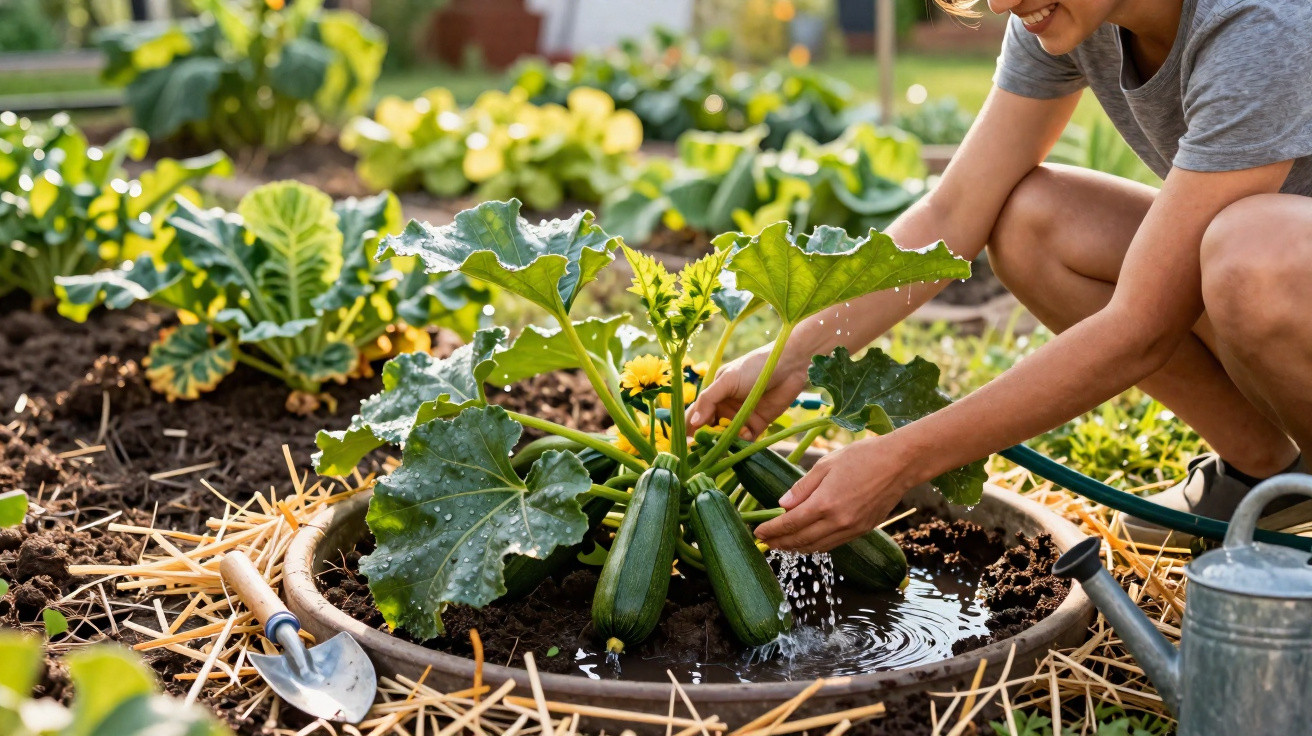
Courgettes are often seen as an easy crop, yet the gap between a handful of fruits and crates full of harvest usually comes down to watering. With a simple, tailored watering technique, you can add several extra kilos per plant - without overdoing fertiliser or buying expensive kit.
Why courgettes demand so much water - and yet can quickly “drown”
Courgette plants put on growth at speed, producing lots of leaves and fruits. That takes energy - and, above all, water. In midsummer they typically need, on average, around a 5-litre watering-can’s worth per plant two to three times a week.
"Courgettes love even moisture, but they hate waterlogging and leaves that stay wet."
If you simply tip the can over the plant, you can trigger several issues at once:
- The soil silts up and forms a hard crust.
- Water runs off to the sides instead of reaching the roots.
- Leaves stay wet, making fungal diseases far more likely.
- Roots get too little oxygen, leaving them weakened.
The result is fewer flowers, more rot, small or misshapen fruits - and noticeably lower yields.
The heart of the method: apply water slowly instead of all at once
The key trick is not changing the total amount of water, but changing how it arrives in the soil. The aim is a deep, consistently moist root zone, without “flooding” the plant.
A smart approach relies on three simple building blocks:
- A small watering basin around the plant
- Several short watering passes rather than one big pour
- Leaves kept as dry as possible and the soil surface shaded
Create a watering basin: the “water crater” around the courgette
Around each plant, shape a shallow basin by hand or with a small hoe, roughly 30–40 cm across. The rim should sit a few centimetres higher than the surrounding soil.
This basin works like a mini cistern:
- Water stays right over the root zone.
- It doesn’t disappear sideways and go to waste.
- Moisture soaks in gradually.
"The watering basin makes sure every litre ends up where the courgette needs it - deep in the soil, not on the surface."
How progressive watering works in practice
Instead of dumping a full 5-litre can in one go, water in stages:
- First, let 1–2 litres run slowly into the basin.
- Wait a few minutes for it to soak in.
- Water again, still in small portions.
- Spread the planned 5 litres per plant over one to two rounds.
If you have several plants, work in a loop: a pass at plant 1, then plant 2, 3 and so on - then start again.
This stops the soil sealing over and prevents water from skimming off across the surface. Instead, an even “cone” of moisture forms beneath the plant, encouraging roots to grow downwards and making them tougher.
Timing: when courgettes are genuinely thirsty
Success depends on timing as well as quantity.
- Water in the morning: Best option, because leaves dry quickly and the soil can hold moisture through the day.
- Water in the evening: Only if you consistently water at soil level and keep the foliage dry.
- Never in full midday sun: Water evaporates before it helps, and droplets can act like tiny magnifying glasses on leaves.
In spring - shortly after planting out - a moderate watering rhythm is often enough. As temperatures rise and growth accelerates, demand increases sharply.
"A good rule of thumb: water less often but thoroughly, rather than just giving a small splash every day."
How to get started: from seed to a strong courgette plant
Many gardeners start courgettes in small pots. Young plants should only go into the bed once nights are frost-free and the soil has reached at least 12–15 °C.
For a strong start, these steps help:
- Choose a sunny site.
- Prepare loose, humus-rich soil.
- Work in plenty of compost so nutrients are available.
- Set up a watering basin from day one.
After planting, water deeply once so the soil settles firmly around the roots. After that, switch to progressive watering: fewer sessions, but deeper soakings that draw the root ball downwards.
Boosting the harvest: don’t “forget” the courgettes
Courgettes are among the vegetables that keep producing as long as the plant stays in good condition. Regular picking encourages fresh flowers and new fruits.
"If you harvest, you reward the plant: it sets more flowers - and therefore more courgettes."
A few practical rules help you get the most from each plant:
- Don’t let courgettes get too large - medium fruits are more tender and prompt further fruiting.
- Never yank them off roughly; cut with a knife or secateurs just above the stem.
- Check often so no “clubs” are missed in the tangle of leaves.
That said, don’t harvest too early either: underripe fruits store poorly and taste watery. You can recognise ripe courgettes by a firm yet still tender skin and a clearly shaped fruit that releases easily.
Mulch, nutrients, diseases: what complements the watering method
Progressive watering delivers the best results when paired with a few simple supporting measures.
Mulching to prevent drying out and crusting
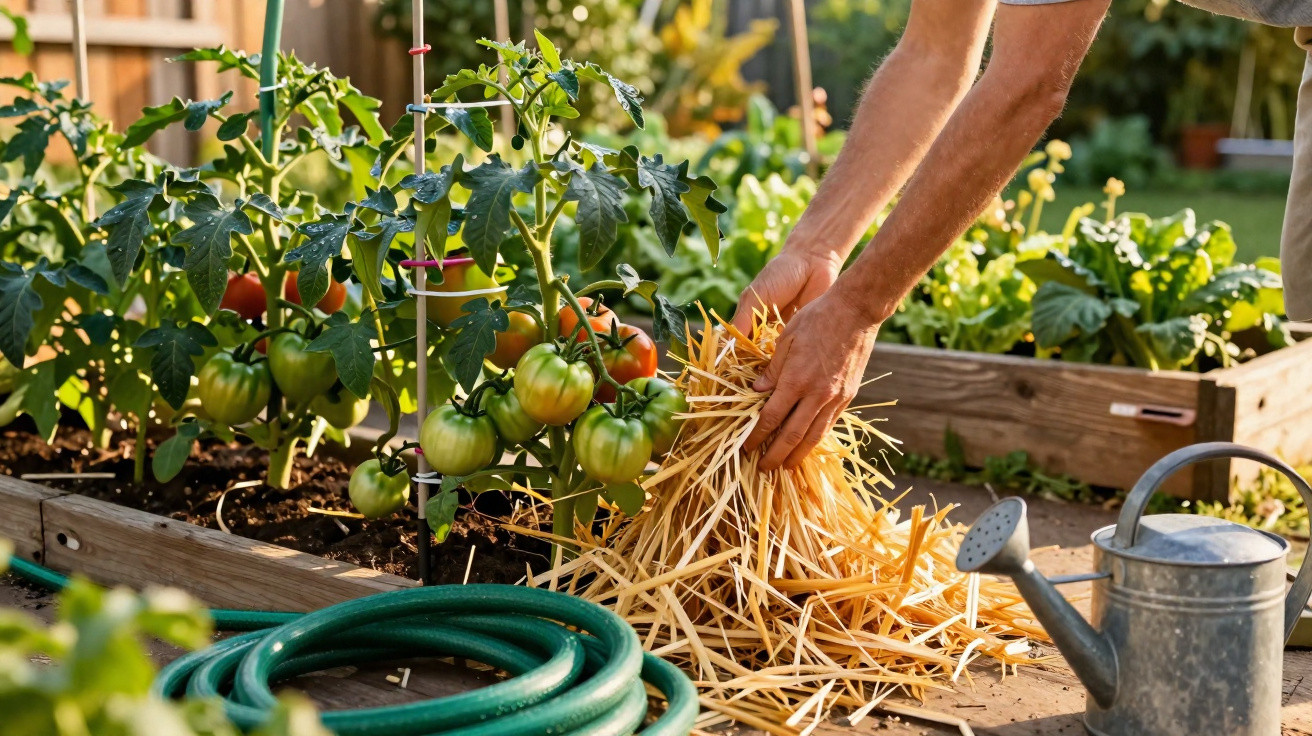
Bare soil heats up quickly and can easily form a hard surface. A thin mulch layer of grass clippings, straw or leaves slows evaporation and keeps the structure open.
- Less watering effort because moisture lasts longer.
- No dense crust that makes water run off sideways.
- Less competition from weeds.
Combined with the watering basin, this creates a moist, crumbly environment where courgette roots have plenty of room.
Nutrients: courgettes are real “big eaters”
Even excellent watering won’t help much if the soil is exhausted. Courgettes respond strongly to organic feeding:
- Work in generous compost before planting.
- In summer, top up if needed with plant-based liquid feeds.
- Change the location every few years to avoid soil depletion.
Well-fed plants set more flowers, allowing the full benefit of the watering method to show.
Common mistakes that ruin the harvest
Many gardeners fall well short of the possible 3 to 5 kg per plant because small errors add up.
| Mistake | Consequence |
|---|---|
| only giving a quick “splash” each time | roots stay shallow, the plant dries out faster |
| watering over the leaves | higher risk of fungal disease and rot |
| no mulch, hard crust | water runs off, soil becomes low in air |
| harvesting too late | the plant pours energy into huge fruits instead of forming new ones |
If you keep these points in mind and use progressive watering, you quickly move towards the upper end of what a plant can produce.
How to spot problems and correct them in time
A quick look at leaves and fruits tells you a lot about watering:
- drooping leaves in the evening - check the soil; it may simply have been an exceptionally hot day.
- yellowing leaves with constantly wet soil - extend the interval between watering and loosen the soil.
- fruits with soft, rotting ends - irregular watering encourages blossom end rot.
Here, the progressive approach acts like insurance: it reduces extreme swings and keeps conditions steadier, which the plant clearly benefits from.
More than just water: why the system strengthens the whole garden
Once you start watering courgettes with this much intention, you often apply the same principle to other crops: pumpkins, cucumbers, tomatoes and even berry bushes benefit from adapted watering basins and water delivered in stages.
Over time, the soil structure improves too, because the ground is not repeatedly sealed over. Earthworms and soil life thrive in soil that is loose and moist without becoming waterlogged - and you notice that again in the growth and flavour of what you harvest.
With the method described, an apparently “ordinary” courgette plant becomes a small production hub: from early summer right into autumn it keeps supplying fruit, as long as water, nutrients and harvest timing work together.
Comments
No comments yet. Be the first to comment!
Leave a Comment