
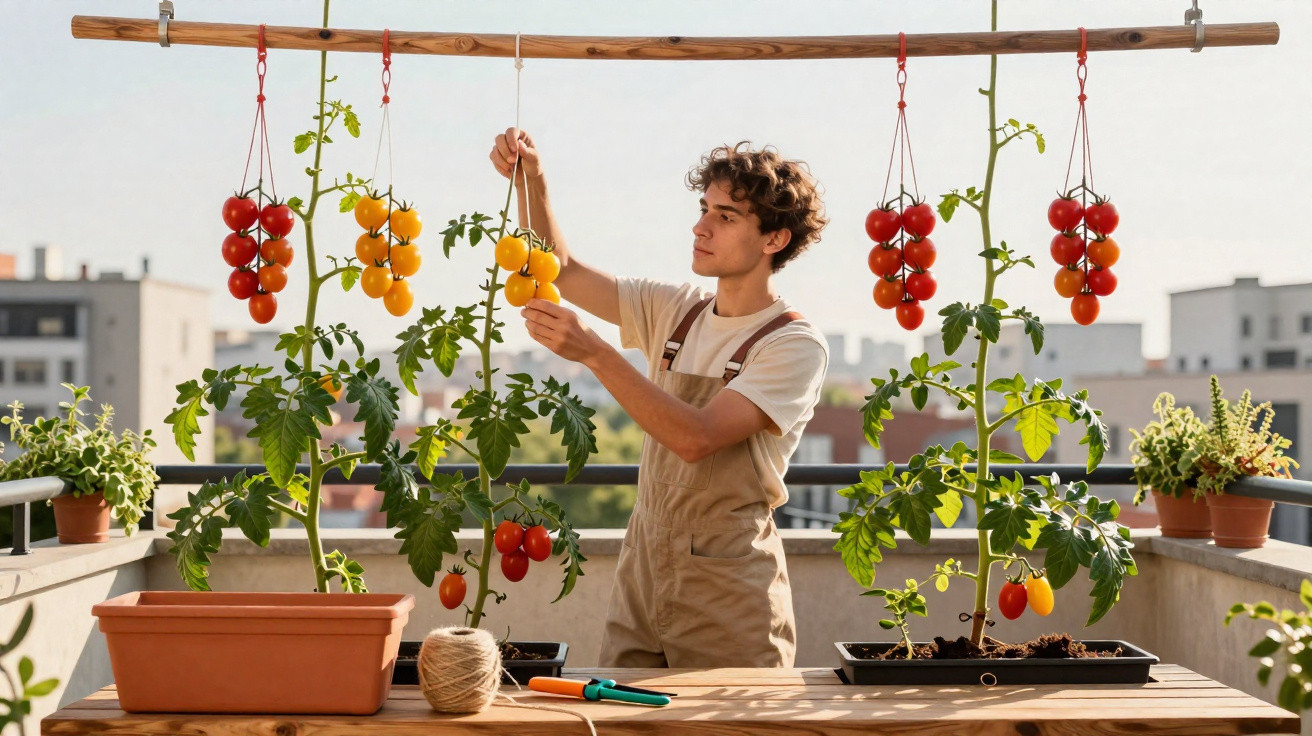
Many hobby gardeners know the same headache: canes everywhere in the bed, paths blocked, and after the first strong wind half the set-up ends up leaning or toppled. A growing method that used to be seen mainly in professional greenhouses is now catching on - and it works brilliantly in small gardens, on balconies, and even in raised beds.
Why the classic tomato cane reaches its limits
For decades, the vertical wooden or metal cane pushed into the soil has been the go-to solution. One cane per plant, tie it on with string - job done. In reality, it often looks and performs less neatly than it sounds.
- Canes take up space in the bed and get in the way of walkways.
- They need to be set deep and firm, otherwise everything can blow over in windy weather.
- Heavy fruiting stems can snap easily if the plant is tied poorly.
- In tightly packed rows, air gets trapped and fungal diseases spread more quickly.
Especially in small gardens, on city balconies, or in compact mini raised beds, this “cane jungle” can feel cluttered fast. That is why many gardeners look for a way to let tomatoes grow upwards while using noticeably less ground space.
The alternative: growing tomatoes on string or a hanging trellis
The idea comes straight from professional vegetable production: instead of tying each plant to a rigid cane, tomatoes are trained up a taut string or on a suspended trellis. The plant’s weight is carried by a structure above, rather than relying on support in the ground.
"The tomato plant is no longer propped up from below, but guided elegantly from above - like in a greenhouse, only in your own garden."
You will often hear this described as hanging training, cord growing, or a hanging trellis system. The principle is always the same: the plant climbs upwards along a flexible, tensioned line. This works particularly well with varieties that keep growing vigorously.
How the hanging method works, step by step
The basic concept is straightforward, but in practice a few established steps make it reliable:
- Install a sturdy structure above the tomatoes - for example a pergola, a crossbeam, a metal frame, or the roof frame of a small canopy.
- From that point, hang one durable string (or a purpose-made garden line) down for each plant.
- Secure the string loosely near ground level, for instance to a peg or to the rim of the container.
- As the plant grows, wind the main stems around the string or attach them with soft clips.
With each burst of growth, you guide the shoots another turn around the line. The result is a tall, slim tomato plant held securely, without a rigid cane taking up space at soil level.
More yield from less space: where the extra room comes from
The biggest advantage is the clear split of roles: stability at the top, usable space at the bottom. Plants grow upward in a narrow column and need very little footprint. Between rows you gain room for other crops - or simply for walking through comfortably.
- On a balcony, you can fit more tomato plants along a railing or under a roof.
- In a raised bed, the front edge stays free for lettuce, radishes, or herbs.
- In the garden, paths can be made wider and easier to use.
Air circulation also improves. When foliage hangs freely instead of being crammed together, it dries faster after rain or watering. That noticeably reduces the risk of fungal problems such as blight.
"Many gardeners report that with the hanging method they can plant more closely - while the plants stay healthier."
Harvesting becomes easier too: the trusses often hang at eye level or just below. You can see what is ripe at a glance, and you do not have to bend as much or squeeze between wobbling canes.
Which materials work for hanging tomatoes
If you assume you need expensive specialist kit, you do not. What matters is a dependable overhead support and a suitable string.
- Overhead frame: wooden crossbeam, metal framework, pergola, the roof structure of a small canopy, or the supports of an existing arbour.
- String or line: garden cord, coir twine, strong jute twine, or greenhouse-style training lines.
- Attaching the stems: soft clips, rubber ties, fabric strips, or other flexible holders that will not cut into the stems.
- Optional netting: a light mesh or net to catch early side shoots until the plant is properly established on the line.
A major plus: most parts can be reused year after year. Once the structure is in place, you usually only need to replace the strings and adapt the planting for the new season.
Practical tips to make string training succeed
The system is not maintenance-free. However, if you follow a few simple rules you will get very stable plants and often a better yield.
- Remove side shoots regularly: pinch out side shoots to stop the plant becoming too bushy and heavy.
- Guide gently: about once a week, loosely wrap the main stems around the string or re-clip them without bending or kinking.
- Check tension: the line should be taut, but not over-tight, so nothing tears out.
- Keep an eye on watering: vertically trained tomatoes, especially in pots, dry out faster. Regular, thorough watering prevents stress.
Timing matters. The support should already be installed when you plant out into the bed or pot. That way, the tomatoes get used to being trained from above right from the start and are easier to shape.
Ideal for greenhouses, polytunnels and city balconies
In professional greenhouses, growing tomatoes on string has been standard for years. Dozens of plants hang from a single wire system and produce high yields in a very small area. The same logic can be replicated at home on a smaller scale.
If you already have a greenhouse, you can use the roof bars as the hanging point. In a polytunnel, one sturdy crossbar per row is usually enough. On a balcony, ceiling hooks, beams, or a simple DIY frame made from timber battens can deliver the same result.
"What matters is not the size of the space, but the courage to think upwards."
When productivity and design come together
The hanging approach has another welcome benefit: it looks far more attractive than a jumble of crooked canes. An arch covered in tomatoes or a green “curtain” by the patio can become a real feature.
Many gardeners pair tomatoes with climbing herbs or edible flowers. This creates a kind of edible wall that doubles as screening and looks decorative. Even a narrow balcony can take on its own distinctive, Mediterranean feel.
Which varieties are best - and where the limits are
String training works best with tall cordon tomatoes that keep reaching upwards. Bush tomatoes and very compact balcony varieties gain less from it, but they can still be guided well on a light trellis.
If your site is very exposed, the overhead structure must be anchored securely. For heavy varieties with large fruits, extra side lines or a supporting net can add safety so stems do not break under the weight.
How beginners can start with hanging tomato training
If you are trying the system for the first time, start with just a few plants and a simple set-up - for example a wooden frame over a raised bed, or a crossbeam fixed to a house wall. This makes it easy to see how your chosen varieties behave, how much water they need, and how tall they really get.
With a little experience, many people quickly want to include more crops: cucumbers, some types of beans, or even small squashes can do well with similar systems - provided the frame is strong enough. The garden shifts more into the vertical, and suddenly even a small area can feel surprisingly spacious.

Comments
No comments yet. Be the first to comment!
Leave a Comment