
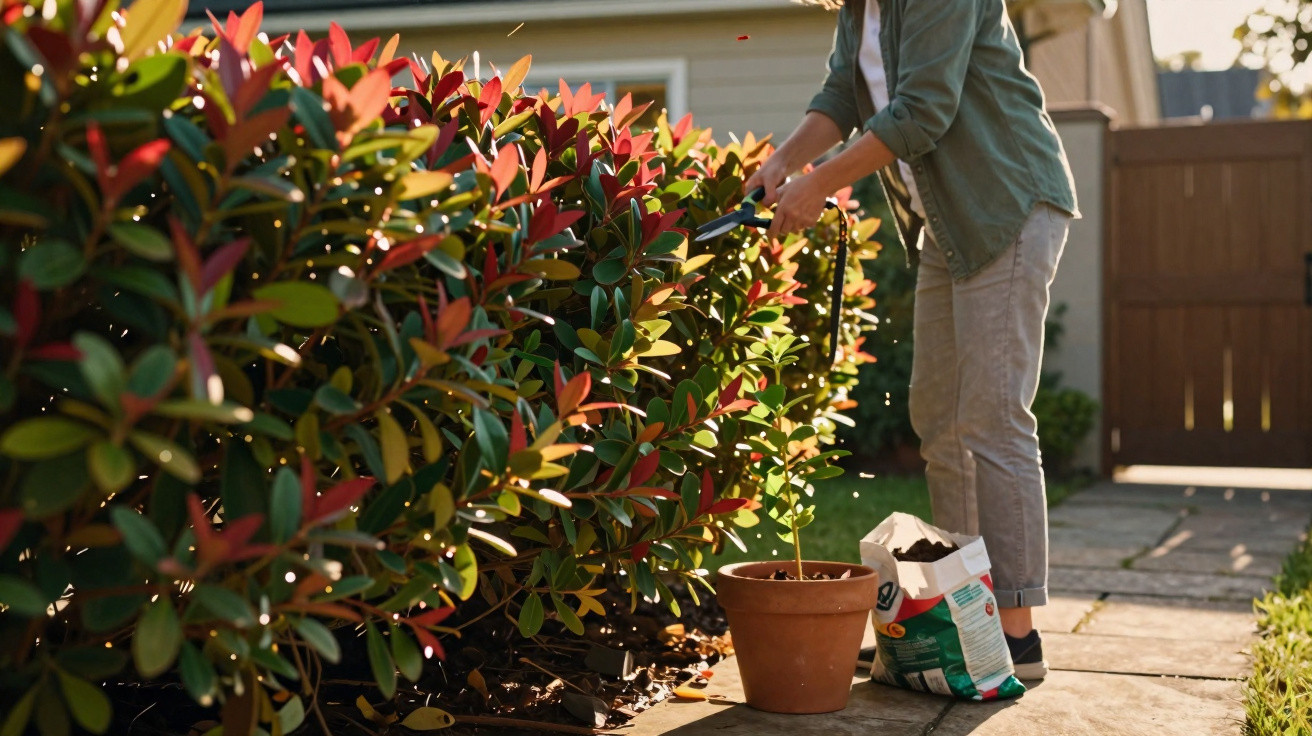
In countless housing estates, the evergreen hedge with bright red new growth was considered the perfect privacy screen for years. It grew quickly, stayed green all year, and was available in every garden centre. Now specialists are predicting a genuine replacement wave for spring 2026. A colourful, surprisingly low-maintenance shrub is moving into front gardens - and it could finally push the familiar standard hedge aside.
Why the red standard hedge is collapsing in gardens right now
Anyone who moved into a new-build home in the 2010s and planted a “modern” hedge often chose an evergreen shrub with vivid red young shoots. In a short time, it formed a thick, uniform “green fence” and was seen as a smart alternative to the old monocultures of thuja.
With the milder winters of recent years, the downside is becoming clear. Plant-protection specialists are tracking a fungal disease that visibly damages the foliage within a few months. Those attractive red shoots turn into speckled leaves, then brown ones, which eventually drop.
"Fachleute schätzen, dass betroffene Hecken in nur einer Saison 15 bis 30 Prozent ihres Blattvolumens verlieren – und sich optisch kaum noch retten lassen."
The fungal spores persist on fallen leaves and in the soil. In damp, mild springs, infections can surge dramatically. Whole streets lined with identical hedges lose their screening effect and start to look patchy - in places, almost bare.
From the thuja problem straight into the next dilemma
The situation strongly echoes the rise - and later collapse - of thuja hedges. For decades they bordered new housing areas for kilometres, until fungal diseases and tired soils led to major losses. Then the red alternative arrived, once again promoted as a widely used one-size-fits-all solution.
Garden advisers are now warning against this continued focus on a single species. Monocultures are extremely sensitive to emerging diseases and weather extremes. When a pest or pathogen hits the plant of the decade, an entire generation of estate hedges can fail at once.
The new favourite: why Pittosporum is taking over hedges in 2026
More and more landscape gardeners and local authority planners are now turning to Pittosporum, which is often sold under variety names featuring attractive leaf patterns. The shrub has long been used in mild climates, and it is now spreading into transitional areas as well.
So what makes it so appealing?
- evergreen, dense foliage
- annual growth usually 20–30 centimetres - easy to keep under control
- significantly less prone to the fungal issues affecting the red hedges
- moderate water needs once established
- very low ongoing effort: a light trim once a year is often enough
Depending on the variety, Pittosporum can have glossy dark green leaves, grey-green foliage, or white-edged leaves. Combined with other shrubs, it creates a modern, graphic look - without the hassle of cutting and spraying every few weeks.
"Pittosporum liefert das, wonach viele Hobbygärtner seit Jahren suchen: einen dauerhaften Sichtschutz, der nicht zum Vollzeitjob ausartet."
A real-world example from a terraced-house estate
In a typical terraced-house development, a homeowner planted a 20-metre-long hedge of red-shooting shrubs almost ten years ago. After three unusually mild winters, it had become little more than a framework of bare branches, with a few weak shoots in between. The view straight into the neighbour’s patio was completely open again.
A specialist contractor set out the options: “saving” the old hedge would mean several years of intensive care - frequent cutting dates, strict disposal of diseased leaves, and targeted fungicide treatments. The costs quickly exceeded the price of a complete replant with something else.
The answer was to remove the diseased hedge and replace it with a mix of Pittosporum, robust Elaeagnus ebbingei and native shrubs. After two years, there was a dense privacy screen again, maintained with just one shaping or maintenance cut per year.
Making the switch: from a problem hedge to a mixed hedge
As soon as red hedges develop obvious bare patches and spotted foliage, it pays to look ahead. Many homeowners ask themselves the same question: remove everything, or wait and hope it “sorts itself out”? Plant pathologists are doubtful.
"Wer stark geschädigte Hecken einfach ersetzt, ohne das Konzept zu ändern, lädt den nächsten Ausfall direkt ein – die Sporen bleiben ja im Umfeld."
Step by step to your new hedge
- Check the condition: If large sections are bare, heavily discoloured or looking old and greyed, renovation is usually no longer worthwhile.
- Remove the old plants: Dig out root stumps; do not compost diseased material - dispose of it via household waste or your local authority waste site.
- Improve the soil: Remove thick roots and leaf debris, loosen the ground, and, if needed, add compost or other structure-rich material.
- Choose diversity: Rather than relying on one species, combine several - Pittosporum, Elaeagnus ebbingei, native hazel, cornelian cherry or red-stem dogwood.
- Keep an eye on spacing: Plant a little closer together (depending on species, 60–100 centimetres) so the hedge closes within three to four years.
With a mixed hedge like this, the risk of one fungus or pest wiping out the entire planting drops significantly. At the same time, the garden feels more alive, and birds and insects gain more food sources and shelter.
Care tips for a new hedge with Pittosporum
Even though Pittosporum is considered easy-going, it responds well to a few basic rules. The key points are:
- Position: Sun to partial shade; shelter from wind is an advantage, especially in more exposed areas.
- Soil: Free-draining and not permanently wet. Avoid waterlogging in winter, otherwise root damage can occur.
- Watering: Water regularly in the first two years after planting, then only during extended dry spells.
- Pruning: Lightly trim once a year after the main growth period to keep the hedge dense and neatly shaped.
- Feeding: A layer of well-rotted compost in spring is usually more than enough for most soils.
In colder, higher-lying areas, a sheltered spot is advisable, or pair Pittosporum with tougher native shrubs. That way the hedge copes better with icy easterly winds and stays more stable overall.
What hobby gardeners can learn from the hedge disaster
The looming retreat of the red standard hedge is about more than fashion. It highlights how sensitive gardens become when planting decisions are based purely on appearance and short-lived trends. Climate change, new diseases and more extreme weather hit uniform plantings far harder than diverse structures.
Anyone planning now can respond deliberately: Pittosporum as a calm, low-maintenance backbone, supplemented with native flowering shrubs, adds colour, structure and habitat - while keeping upkeep manageable. Many councils already support such climate-resilient planting because it saves money over the long term and improves the urban climate.
The same applies to private gardens: a well-planned mixed hedge brings lower follow-on costs, stays steadier when disease strikes, and looks lively throughout the year. Pittosporum plays a central role here - not as the next monoculture, but as one component of a resilient, future-ready garden.

Comments
No comments yet. Be the first to comment!
Leave a Comment