
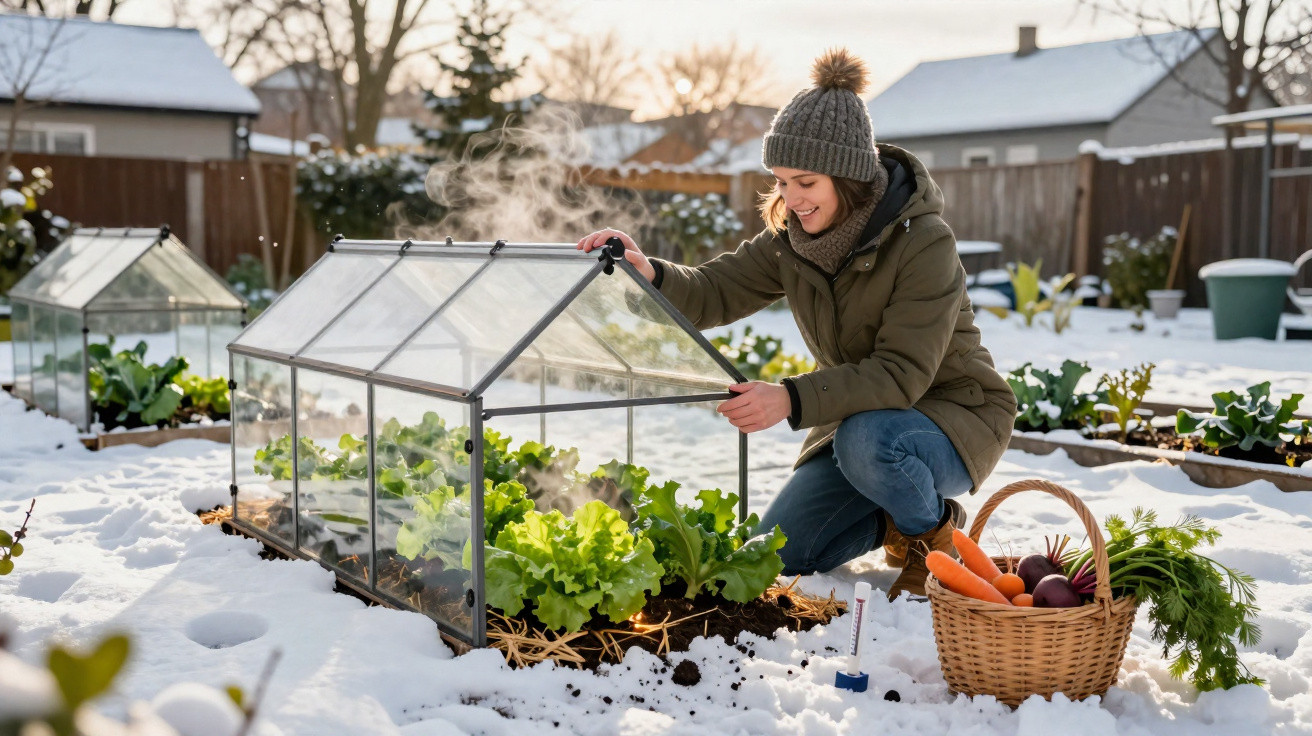
Across Europe’s colder regions, a small gardening revolution is unfolding beneath the snow. While plenty of growers pack things in for the season, others are still cutting crisp greens and lifting solid cabbages from what, at first glance, seems like a frozen wasteland. The surprise is that it isn’t powered by high-tech glasshouses or costly kit, but by techniques that are almost deceptively straightforward.
Winter gardens that won’t die: why the north keeps growing when others give up
The myth of the sleeping vegetable patch
Many gardeners treat winter as a write-off. Seed trays get swapped for seed catalogues, and the plot becomes a muddy afterthought. But in northern places-Scandinavia, and even parts of Canada-winter gardening has long been part of normal life. It helps feed households when daylight is scarce and shops mainly offer weary produce hauled in from far away.
For these growers, cold doesn’t signal a finish line; it signals a change of pace. The workload eases, yet it carries on. The aim shifts from maximum harvests to steady continuity: enough fresh food to keep meals feeling alive, even when the sun barely edges above the horizon.
Winter gardening is less about defeating the cold and more about bending it just enough to keep life moving.
Little glass lids in the snow
In villages across Norway and Sweden, you can still see low glass frames half swallowed by drifts, their edges brushed clean each morning. Children knock the snow away, adults lift a pane, and inside sit rows of lamb’s lettuce, kale, winter radish and sometimes even young cabbages, tucked under a shallow roof of glass.
The structures look humble: offcuts of timber, old window panes, a bit of straw packed around the sides. Yet that simplicity reflects a wider culture of making do. Families pass down more than seed-there are shared rules of thumb too: where the frame should sit, how thick the base needs to be, and when to sow so the soil keeps enough warmth as the light ebbs away.
The “hot bed” that makes frozen soil feel alive
Turning compost heat into a furnace under your feet
The real trick is happening underneath the plants rather than above them. Northern gardeners warm the ground itself with what’s often called a hot bed. The approach reaches back to pre-industrial Europe, when market gardeners in places such as Paris used huge heaps of horse manure to bring on vegetables well ahead of spring.
The same principle is used now. A substantial layer of fresh organic matter is packed into a shallow pit or a framed box. Manure, shredded straw, fallen leaves and small branches are built up into a thick mattress. As microbes break it down, heat is released. That warmth rises into the thinner layer of soil above, keeping the root zone several degrees warmer than the surrounding air.
A well-built hot bed can sit in a landscape at –5 °C while holding soil close to +10 °C just a few centimetres below the surface.
That modest difference in temperature transforms what’s possible. Seeds that would otherwise rot in icy sludge can germinate. Roots remain active. Leaves put on growth slowly, but reliably. Frost stops being the enemy and starts acting more like a protective barrier, reducing pests and disease pressure.
Glass frames that trap every weak ray of light
A simple glazed frame sits over the hot bed-typically a timber rectangle with an old window fixed on hinges. There are no heating cables, fans or electronics. The glass earns its keep in three ways: it blocks wind, makes the most of limited winter sun, and holds humidity close to the plants.
Gardeners commonly angle the frame slightly towards the south to capture more light. Any gaps at the edges are packed with wool, cardboard or straw. On the coldest nights, an old blanket or a piece of carpet may be thrown over the glass, then pulled off again at daybreak so the weak winter light can do its job.
- Wind protection lowers the chilling effect and reduces moisture loss.
- Glass captures solar warmth during the short daylight window.
- Higher humidity eases plant stress and means less watering.
How the northern method actually works, step by step
Building the living heater under your crops
For gardeners in the UK, the United States or France, the basic build looks like this:
| Layer | Material | Approx. thickness | Role |
|---|---|---|---|
| Base | Small branches, coarse straw | 5–10 cm | Drainage, airflow for microbes |
| Core | Fresh horse manure mixed with straw | 20–30 cm | Main heat source |
| Cover | Leaves, half-finished compost | 5–10 cm | Stabilises fermentation |
| Topsoil | Good garden soil | 15 cm | Bed for roots and seeds |
Horse manure is especially effective thanks to its balance of fibre and nitrogen. That said, growers also use cattle manure, deep litter from chicken coops, or thick layers of shredded plant waste-provided the material is fresh enough to heat up as it decomposes.
Timing the build before real winter bites
In temperate areas, hot beds are usually put together in late autumn. Like a compost heap, the bed needs a couple of weeks to “fire up”. During this stage, the internal temperature can rise quickly, sometimes above 50 °C at the core. To avoid scorching seeds, gardeners often hold off sowing until the heat has fallen back into the 20–30 °C range.
The trick is to build early enough for the bed to warm up, but not so early that it cools down before deep winter sets in.
Once the temperature has settled, they sow reliable cold-weather crops: lamb’s lettuce, spinach, winter radish, Asian greens, kale, turnips, and sometimes even carrots if the bed is built deep enough. Growth crawls through the darkest weeks, then surges as the days lengthen-while the bed still provides a steady, gentle warmth.
The vegetables that actually thrive under snow
Cold lovers that taste better in frost
This system doesn’t suit everything. Tomatoes and peppers simply won’t play along. Courgettes give up. Instead, northern gardeners rely on varieties selected for resilience rather than showiness.
- Lamb’s lettuce (corn salad) for soft winter salads.
- Kale and other leafy brassicas that taste sweeter after a freeze.
- Winter radishes with firm, crisp flesh.
- Turnips and late carrots that hold more sugar in cold soil.
- Hardy Asian greens such as mizuna or pak choi.
- Spring onions and chives to add bite to otherwise bland plates.
A number of these crops don’t merely endure frost-they improve with it. Plant sap becomes more concentrated, bitterness eases, and the texture firms up. Kale harvested in January doesn’t taste like the same plant cut in July; it develops a deeper flavour, almost like food that’s been slowly matured.
Tuning choices to your own backyard climate
Microclimates often decide whether winter growing works. A sheltered courtyard in a town will stay milder than an exposed hillside. A south-facing wall can store warmth and release it overnight. Gardeners who try it quickly learn which corner of the plot behaves like a natural winter refuge.
In milder parts of Britain or the United States Pacific Northwest, some growers pair hot beds with unheated polytunnels to push the season on for salads, rocket or even early peas. In tougher inland climates, they focus on the hardiest crops, keep frames low to the soil, and add an extra layer of defence by using floating row covers inside the glazed box.
Why this “low-tech greenhouse” humbles modern growers
Fresh food when the world feels grey
Taking a bite from a leaf harvested at –5 °C can feel oddly indulgent. The contrast between the bitter air and a living plant lands differently. Households that keep winter beds going often notice changes beyond the plate, including in mood. Salad cut from your own soil in January breaks up the sameness of tins, roots and grains stored for months.
Nutrition matters too. Many winter greens are rich in vitamins and antioxidants. Because growth is slow, the tissues stay dense and less watery, which can help both flavour and keeping quality.
Fewer pests, fewer sprays, calmer work
This approach quietly removes many of the hassles that drain summer gardeners. Insects are largely inactive. Fungal diseases find it harder going under cold, short days. Weeds either sprout very slowly or not at all in the low light and under tight cover.
Winter beds ask for attention, not constant firefighting: small openings for air, an eye on condensation, and a quick brush of snow from the glass.
Watering needs also drop dramatically. Meltwater, condensation and the sealed environment can keep the soil damp for long periods. That becomes increasingly important where water restrictions bite or rainfall patterns grow less predictable as seasons change.
What this northern trick means in the age of climate anxiety
For growers concerned about energy costs and fragile food supply chains, the northern method makes a blunt point: year-round vegetables don’t have to depend on heated glasshouses, artificial lighting or imported produce. A mound of manure, some scrap timber and a sheet of glass can keep a household supplied with fresh leaves and roots even when the wider landscape looks lifeless.
It also works as a gentle learning curve. A beginner can start with one small frame rather than investing in a full greenhouse. From there, they can trial varieties, understand how their garden behaves through winter, and adjust the build. Over time, some households develop a rotation of hot beds that bridges early winter into spring without a long gap in fresh picking.
There are constraints, naturally: strong winds can wreck frames, heavy snow needs clearing to prevent collapse, and some urban gardeners find fresh manure hard to come by. Even so, those hurdles often prompt more ingenuity-from neighbours sharing manure collection runs to allotment groups or schools building winter beds together.
For anyone who’s used to bolting the gate in October, the northern technique poses a quiet, slightly uncomfortable question: if vegetables can grow under snow, without a powered greenhouse and with barely any equipment, how much potential do we leave sitting on the table each winter?

Comments
No comments yet. Be the first to comment!
Leave a Comment