
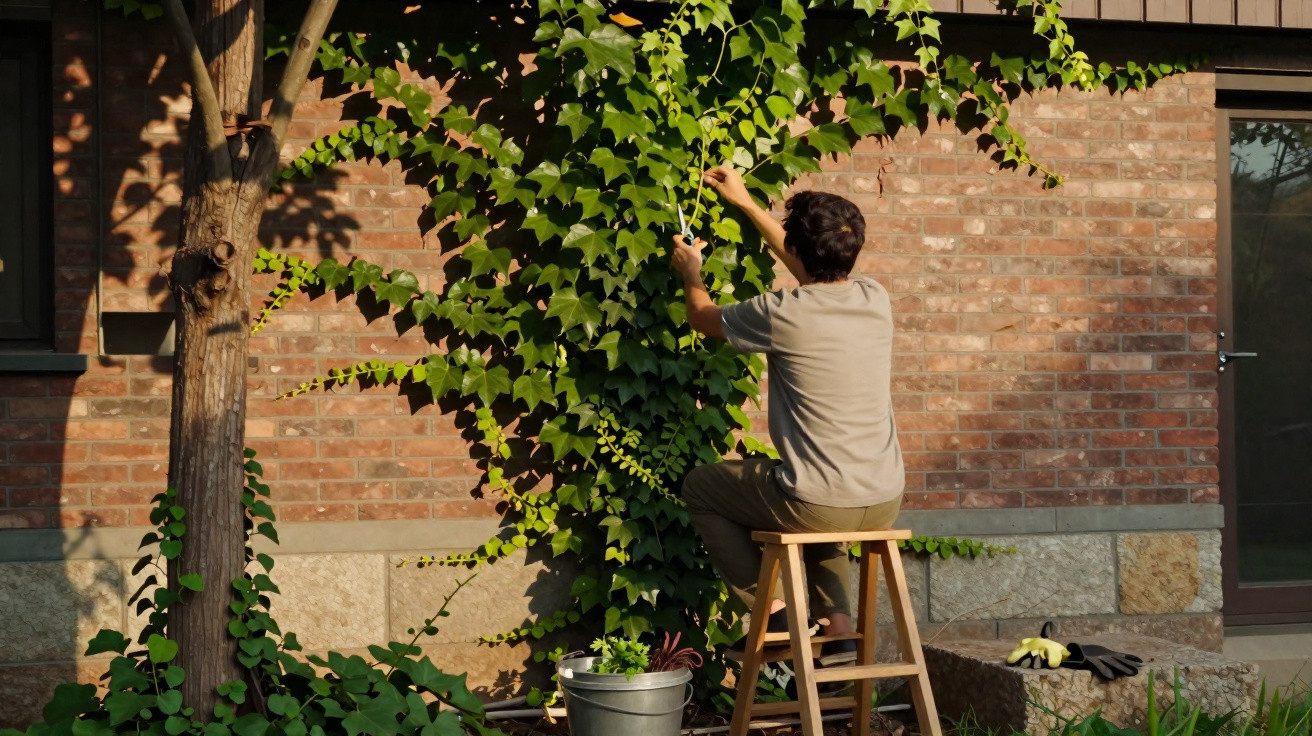
That instinct can turn into a genuine mistake.
In countless gardens, the same scene plays out every year: you notice a tree trunk or a house wall thickly covered in ivy, and the loppers come straight out. The reasoning seems sound at first glance: ivy is often labelled a “parasite” that weakens trees and damages façades. Specialists take a far more nuanced view and warn that stripping away every ivy runner can mean giving up a powerful ally in the garden.
Ivy is not a parasite - and it often acts as a shield
The key point first: common ivy (Hedera helix) does not feed off its host. Unlike mistletoe and other true parasites, it does not send sucking roots into the trunk or masonry. Its clinging roots sit on the outside and serve purely as a climbing aid. The plant takes water and nutrients solely from the soil.
“Ivy doesn’t live off a tree or a wall - it simply uses them as a framework to climb, forming a protective cloak over the top.”
On robust, healthy trees, that green cloak can behave like a natural protective layer. The foliage breaks the wind, reduces harsh sunlight and softens frost. That helps keep the bark at a more even temperature, which can lower the risk of tension and cracking. Around the base, dense growth also keeps moisture in the soil for longer and helps prevent erosion.
From an ecological standpoint, ivy is hard to beat. Birds nest within its network of stems and leaves, small mammals gain safer shelter, and many insects use ivy as both habitat and food source. Estimates suggest up to around 200 species benefit directly or indirectly.
When ivy really does cause problems for trees
Despite the advantages, there are situations where ivy on trees can become a risk - and those are times when action makes sense. The deciding factor is not the ivy itself, but the condition of the tree.
A risky mix: weak tree, heavy growth
Ivy becomes particularly problematic when:
- the tree is already in poor health (rot, fungal infection, major damage),
- it is a very old specimen,
- it is a young tree or a fruit tree,
- the crown is already visibly thinning.
In these cases, ivy can:
- cast heavy shade over the crown and push back new shoots in the competition for light,
- conceal rotten branches so damage goes unnoticed,
- add weight and increase the load within the crown,
- significantly increase wind resistance during storms.
That last point is often underestimated. A crown densely covered in greenery catches strong gusts much more readily, increasing leverage forces on the trunk. A compromised tree can then snap or topple more quickly.
How to tell whether ivy can stay on your tree
If you are unsure whether your tree can comfortably cope with the weight of ivy, a few straightforward checks can help:
| Criterion | Sign that “ivy is fine” | Sign that “better to control it” |
|---|---|---|
| Trunk and stability | straight, strong trunk, firmly rooted | visibly leaning, loose footing, cracks in the trunk |
| Crown | lots of vigorous shoots, dense foliage | thinning crown, dead branches, deformities |
| Tree age | middle-aged, grown steadily and stable | very old, fruit tree, or still a young tree |
| Ivy height | stops below the main crown | climbs all the way up through the entire crown |
If the tree looks vigorous overall, moderate ivy growth can remain. In that case, it is sensible to prune every few years and prevent the runners from wrapping around and engulfing the whole crown.
Ivy on a house wall: risk or natural climate control?
Ivy has also divided opinion on façades for decades. Some people love the romantic look; others immediately picture crumbling stonework and peeling render. Experts draw clear distinctions - above all based on the state of the wall.
Sound façade: ivy can work like a green air conditioner
On stable, crack-free walls, ivy’s clinging roots generally adhere to the surface only. They do not push through solid render or tight joints. Rather than causing damage, a thin protective layer can develop.
“On a sound wall, ivy forms a living protective shield: less driving rain, gentler temperature extremes, cleaner air around the façade.”
The benefits at a glance:
- Weather buffer: leaves intercept driving rain and channel water downwards, so the wall stays drier.
- Heat protection: the green layer shades the façade; behind the ivy, the surface warms up far less.
- Heat loss: in winter, the foliage reduces direct wind pressure on the wall, slightly slowing how quickly the masonry cools.
- Air quality: the leaves trap dust and pollutants that would otherwise settle directly on the surface.
In this way, ivy on a sound house can act almost like free, low-maintenance insulation and filtration - not perfect, but with noticeable effects, especially in summer.
Damaged walls: where ivy genuinely becomes hazardous
It is a different story if render and joints are already crumbling, or the brickwork is old and porous. In loose material and fine cracks, the clinging roots find purchase - and over time can force the structure further apart.
Typical problem areas include:
- crumbling mortar joints,
- hairline cracks and flaking render,
- poorly fitted or old, leaking window sills,
- gutters and downpipes that are already clogged with weeds.
Where wind and moisture help ivy work into these weak points, cracks can widen, mortar can loosen, and individual bricks may even shift. Excessively dense growth in gutters can quickly cause blockages and water damage.
The practical rule for homeowners is therefore: inspect and repair the façade first, then allow ivy - not the other way round.
How to manage ivy sensibly instead of fighting it blindly
A balanced approach protects trees and houses while still keeping the ecological benefits. The aim is to use ivy to your advantage, rather than leaving it to chance.
Practical tips for trees
- Check the tree’s condition: once a year, take a critical look at the trunk area and crown. If you are unsure, bring in a qualified tree-care professional.
- Keep the crown clear: prune ivy regularly so it does not take over the whole top. The lower trunk can usually remain covered.
- Reduce the load on weak trees: if a tree is visibly damaged, cut ivy back gradually rather than ripping it all off at once. This avoids shock effects and the risk of sudden light stress.
Practical tips for façades
- Inspect before it takes hold: check render, joints and junctions. Repair cracks and crumbling areas first.
- Set firm limits: do not let ivy climb into the guttering or under roof tiles. Cut back the upper sections once a year.
- Keep windows clear: always leave an ivy-free margin around windows and doors. This makes maintenance easier and helps prevent damp pockets.
Why ivy is a wildcard for climate and biodiversity
Leaving ivy in place also boosts biodiversity in the garden. Among its leaves and runners, songbirds such as blackbirds and wrens find secure nesting sites that are difficult for cats to reach. Small mammals use the root network as cover.
Ivy also scores for flowering time: its modest blooms appear very late in the year, when many other plants have already finished. It is often still buzzing with activity in ivy while the rest of the garden is nearly quiet. Bees, hoverflies and other insects collect some of their last nectar reserves there before winter.
In densely built-up residential areas, there is another factor: ivy-covered walls can help cool streets and courtyards. They absorb some of the sun’s energy, evaporate water and reduce how quickly the surroundings heat up - a small but noticeable contribution against urban heatwaves.
A conclusion without going to war in the garden: a calmer approach to ivy
Ivy is neither the villain many people assume nor a harmless decorative extra. It can protect trees and houses, but it can also worsen issues where structures are already weakened. Anyone who keeps an eye on the condition of both tree and façade will make better decisions: not tearing everything down on impulse, but managing growth deliberately and checking it regularly.
Handled that way, this climbing specialist remains what it can be: a resilient helper for the microclimate and biodiversity - not an enemy that needs to be fought across the garden as a matter of principle.




Comments
No comments yet. Be the first to comment!
Leave a Comment