
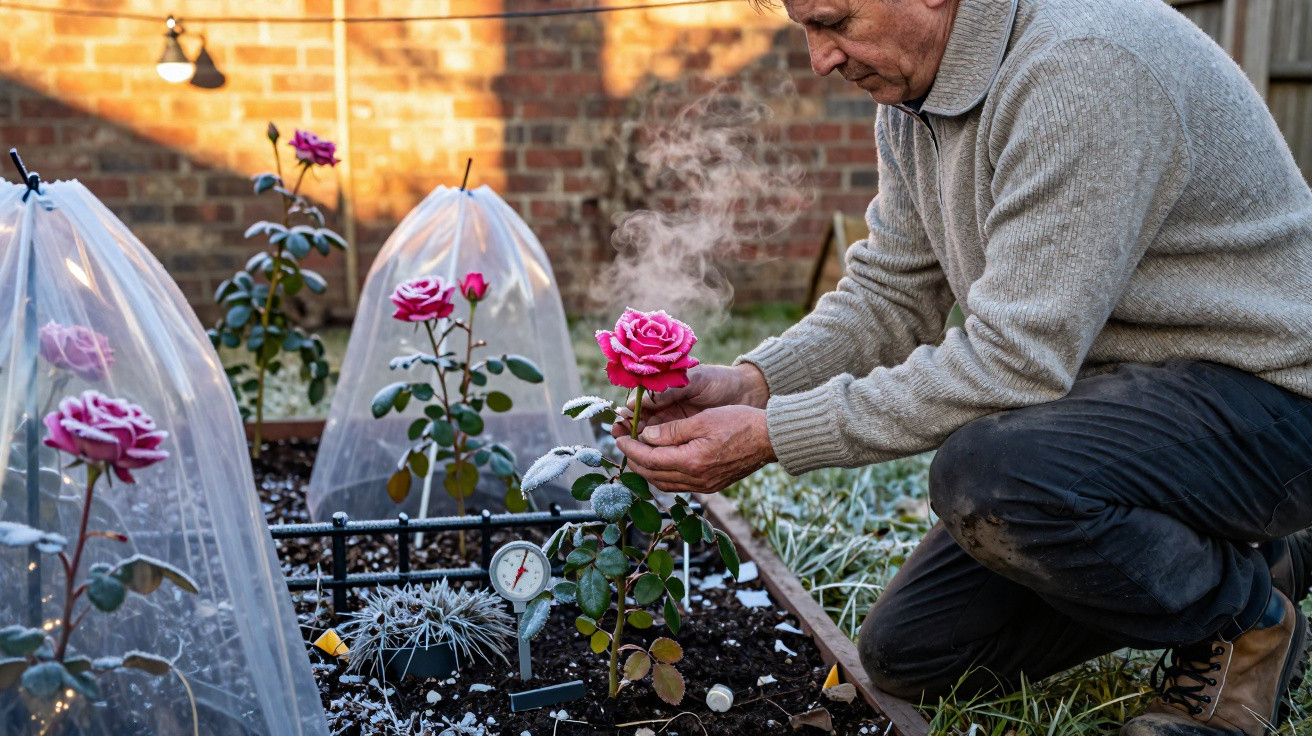
One woman in a small British courtyard refused to accept the usual winter script - and hit on an unexpectedly effective plant-breeding approach that kept her roses flowering through winter.
At 06:15 on a crisp December morning in York, a robin darted off a fence post as Hannah West padded into her courtyard in wool socks and a coat she’d borrowed. A fine skin of frost sparkled across the paving slabs. Yet in the spot where she’d braced herself for bare stems and stillness, blush-pink roses were open, their heads angled towards the mist of her breath. She rested a mug beside a terracotta pot and brushed a petal with her thumb - part habit, part disbelief. Fairy lights woven through the trellis glimmered: not entirely festive, not entirely functional - more like a hint that something deliberate was at work. She hadn’t stopped winter; she’d persuaded it to pause.
The winter rose in York, and the night-break lighting trick behind it
Hannah’s roses aren’t tucked away in a heated greenhouse. They grow in a walled yard that holds a calm pocket of air, with the city’s residual warmth taking the edge off the worst frosts. What looks like a miracle is really method: a practical tweak borrowed from commercial floriculture, paired with slow, deliberate breeding. Those warm LED strings you notice in December aren’t hung for Christmas - they’re the switch that keeps the plants from properly powering down.
Seven winters ago, she started crossing tough, salt-tolerant Rosa rugosa with modern shrubs bred to flower repeatedly. The whole setup was half kitchen table, half cold frame - entirely improvised. In year one she sowed 620 seeds, brought on 402 seedlings, and set 180 into 5-litre pots along the brickwork. By January, most had slipped into dormancy. Eleven, however, kept pushing buds despite the cold. She marked them with masking tape, scribbled notes on a dog-eared index card, and then crossed the best back into the line again. The maths was messy, but the trend was clear.
At the centre of this is a straightforward, old-fashioned technique that’s easy to overlook: night-break lighting. A modest burst of light partway through the night disrupts the long, uninterrupted darkness that signals to many plants that it’s time to sleep. Roses aren’t classic long-day plants, but their growth still responds to how long the dark stretch lasts. A two-hour “blink” slows the build-up of dormancy chemistry, keeps meristems working, and allows repeat-blooming genetics to carry on even when the air bites. It won’t override a hard freeze - but on a typical mild British winter night it can tip things in your favour.
How to try it at home without turning your garden into Blackpool
You don’t need laboratory kit. Begin with roses that are bred to flower over and over - remontant genetics such as modern shrub roses, certain floribundas, and even some compact climbers. Run a low-intensity warm-white LED string along the canes, anywhere from knee height up to shoulder height, and plug it into a basic timer. Set a “night break” for 23:00 to 01:00, or 00:30 to 02:30. Keep the crown just above the mulch, aim for soil that’s barely moist rather than wet, and feed sparingly with a balanced fertiliser in autumn. A light prune in August can prompt an autumn flush that may keep going if the nights stay gentle.
Avoid blasting the plants with floodlights. They’re looking for a nudge, not a false midday at midnight. Two to five watts per square metre is plenty; one string of 100 warm LEDs often covers a small bed. Maintain decent airflow to reduce the risk of mildew. Slightly tighter pots can help as well: roots that are a touch snug often shift into flowering sooner than plants given endless compost to roam through. Most of us have had the moment where we lavish attention and the plant responds by sulking. Ease off. Let the rhythm do the work. Not magic, just timing.
And, honestly, nobody keeps it perfect every night. You’ll forget the timer. You’ll water just before a cold snap and regret the slush. Winter roses are a compromise, not a medal. Aim for “the odd flower in December and January”, not a June-sized bouquet in a snow globe. The key idea is recurrent selection under short, cold days. Even without hybridising, you can still notice which plants set buds when others stall, keep those, and propagate them. Add a small push from light and shelter, and the calendar starts to wobble.
“I wasn’t trying to beat winter,” Hannah told me, blowing steam off a mug. “I was just trying to find the ones that don’t mind getting up early.”
- Toolbox: warm-white LED fairy lights, outdoor-rated timer, two bricks for a wind baffle, mulch.
- Timing: 60–120 minutes of light in the middle of the night from late October to late February.
- Genetics: pick repeat-flowering shrubs; trial rugosa hybrids for grit.
- Microclimate: walls, hedges, or a south-facing fence to hold still air.
- Care: light August prune, low-nitrogen feed in autumn, water sparingly on cold weeks.
Why this works, and where it doesn’t
Picture dormancy as a slow hormonal tide. Long nights combined with persistent cold increase ABA and other signals that tell buds to clamp shut and wait it out. A night break interrupts that messaging. You’re not using heat to force flowers; you’re simply encouraging the plant to stay awake a little longer. Repeat that pattern, and you end up favouring individuals that are already inclined to bud under short days and cool nights. Over a few seasons, the planting quietly shifts towards winter tolerance - no drama required.
But it has boundaries. If your garden sits in a frost hollow and often drops below –5°C, no brief pulse of light will override basic biology. The goal is to take advantage of the UK’s increasingly erratic winters: a cold snap, then a soft week, drizzle, then a bright day. The lighting keeps buds poised for those mild gaps. If the ground is waterlogged, roots slow down and buds can abort. If nitrogen levels are high, you’ll push leaves at the expense of flowers. The method is about small advantages - shelter, drainage, and timing.
There’s a quiet ethical angle too. You’re not burning through kilowatts; you’re using a whisper of electricity to work with the plant’s internal clock. And you’re gradually building local strains that match your own spot, winter by winter. After three or four seasons, your notes start to matter more than anything in a catalogue. That’s how Hannah’s eleven keepers became twenty-two, then settled into a reliable handful that pop open in January like confetti after a shy speech. It feels homemade because it is.
What to take away on a cold morning with muddy boots
A rose in winter isn’t really about conquering the season; it’s about understanding where the season has seams. Used lightly, light can discourage sleep without bullying a plant into submission. Breeding - even on a kitchen-table scale - is mostly attentive noticing: which ones shrug at sleet, which ones keep forming small clenched buds of colour. In a warmer, more unpredictable climate, those minor adjustments can hand back a sliver of control that’s both practical and gentle.
It also demands patience. Winter blooms come from decisions made in August, cables taped up in October, and a January mug of tea while you check bud scales with numb fingers. Share what works, laugh at what doesn’t, and keep the timers inexpensive. The roses won’t act like June - and that’s fine. When a flower opens against frost, it reads like a handwritten note slipped under a door you were sure had been locked.
| Key point | Detail | Why it matters to you |
|---|---|---|
| Night-break lighting | 1–2 hours of low-intensity light around midnight | Simple, low-cost way to delay dormancy and sustain buds |
| Choose and keep | Repeat-flowering varieties, select the ones that bud in cold spells | Build your own winter-tolerant strain over seasons |
| Microclimate matters | Walls, drainage, lean feeding, light August prune | Stack the deck without a greenhouse or big bills |
FAQ:
- Will this work in Scotland or the North of England? It can, especially in urban or coastal spots where nights are cold but not brutal. If your site routinely drops below –5°C, focus on shelter, drainage, and hardy genetics; expect sporadic blooms rather than steady sprays.
- What kind of lights should I use? Warm-white, outdoor-rated LED strings or a low-wattage strip. You’re aiming for a soft glow, not daylight. Put them on a timer for a 60–120 minute pulse in the middle of the night.
- Do I need to start hybridising to see results? No. Start by trialling several repeat-blooming cultivars and keep the ones that set buds in November–January. Propagate those via cuttings. Breeding speeds it up, but careful selection still moves the needle.
- Is this safe for wildlife and neighbours? Keep lights dim, shielded, and off most of the night except the brief pulse. Aim the glow inward. Choose warm-white rather than harsh blue tones. A thoughtful setup is gentle on moths and won’t light up the street.
- How many flowers should I realistically expect? Think handfuls, not armfuls. A couple of buds opening each week during mild spells is a win. Some weeks you’ll get nothing, then a sudden flush when a southerly wind brushes the garden.






Comments
No comments yet. Be the first to comment!
Leave a Comment