
You’re standing in front of your favourite plant - the one you proudly put on Instagram the day you brought it home. The foliage looks healthy. The pot is lovely. The light seems spot on. And yet… nothing happens. No flowers. Week after week, it stays stubbornly leafy, with no show at all.
You rotate the pot, have a little chat with it, maybe even move it somewhere “better”. Still nothing - just a quiet wall of green.
Meanwhile, your neighbour’s balcony looks like a botanical firework display, packed with blooms that seem to pop out every time you glance away. It’s hard not to suspect they’ve got some magic fertiliser - or a secret greenhouse tucked behind the door.
Here’s the surprise: what your plant is missing may already be in your kitchen. More precisely, it may be what you’re currently putting in the bin.
The quiet reason your plants refuse to bloom
Plants don’t usually stop flowering to be awkward. They aren’t being “difficult”. More often, they’re simply underfed.
Flowering takes a huge amount out of a plant. Bright petals, repeated flushes of buds, a long blooming period - it all demands serious energy and a steady supply of nutrients. When the soil can’t provide what’s needed, the plant abandons the effort. It focuses on leaves first and postpones flowers.
Many houseplants and balcony plants remain in the same container for months - sometimes years. The compost may look fine from above, but beneath the surface it can be like a fridge after a long weekend: bare shelves. Phosphorus is missing, potassium is scarce, and trace nutrients get rinsed away with every watering. Flowering is typically the first “extra” the plant cuts.
Rosa, a reader from Lisbon, sent me a photo last spring: on the left, a geranium covered in blooms; on the right, its near-identical twin, planted the same day in the same type of pot, with barely a flower to show.
What changed the outcome? Rosa’s mother had been topping up the geranium using whatever was to hand: cooled coffee grounds, crushed eggshells, and banana peels soaked in water. No measuring. Nothing particularly scientific. Just a pinch here and a peel there.
Next door, the struggling geranium belonged to someone who watered diligently - but threw all that potential compost straight into the rubbish. Same sun, same variety, two completely different balconies. One looked like a postcard; the other looked like a plant on strike.
The reasoning is straightforward. Pot compost is a closed system. Each time you water, nutrients wash out through the drainage holes. Each time the plant produces a new leaf, stem or flower, it draws minerals from a limited supply.
In the ground, roots can roam, fungi assist, and worms constantly redistribute organic matter. In containers, once nutrients are depleted, that’s it. And if a plant is short on phosphorus or potassium, it won’t invest in flowering. It will simply tick over and survive.
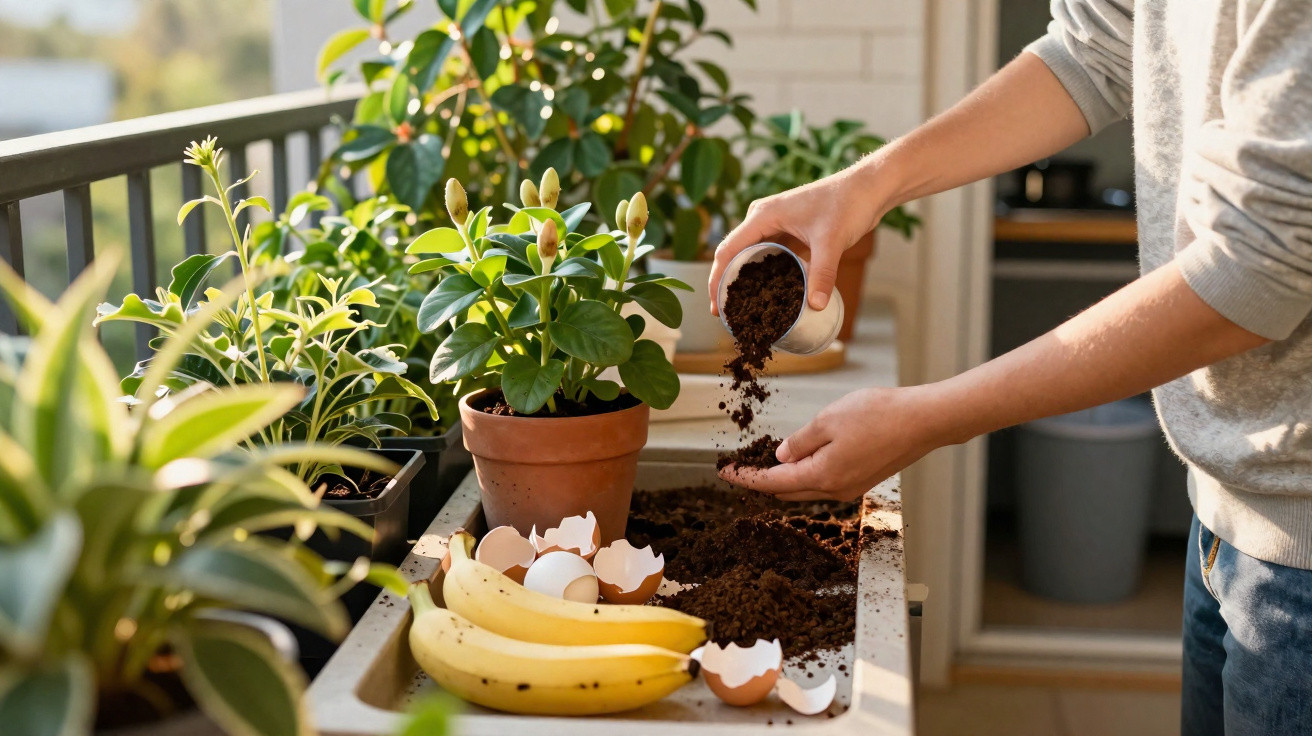
That’s where organic kitchen scraps can help. Coffee grounds supply nitrogen, eggshells add calcium, and banana peels contribute potassium. They won’t replace every fertiliser under the sun, but they can bring tired compost closer to something living again.
What’s hiding in your bin that your plants are begging for
If you make coffee at home, you’re likely discarding a gentle, slow-release fertiliser almost daily. Once used coffee grounds have been rinsed and dried slightly, you can stir them into potting compost or dust them over the surface in a very thin layer.
You only need a little. For a medium pot, a teaspoon or two - lightly worked into the top few centimetres - is plenty. The aim isn’t to blanket the surface in a brown layer, but to give the compost a modest nutrient lift.
Banana peels are another small treasure. Chop them into small pieces and let them dry a little, then tuck a couple of bits into the compost around flowering plants. Over time they break down and release potassium, which supports blooming and sturdy stems. It’s gradual, but it can be surprisingly effective.
We’ve all had that moment: you crack an egg, peel it, and the shell goes straight into the bin without a second thought. But eggshells are largely calcium carbonate. Once fully dried and crushed to a fine powder, they improve the compost and, over the long term, can gently reduce acidity.
Think of a balcony geranium that flowers itself to exhaustion every summer. When the compost is drained, the plant tends to weaken year after year. With a bit of eggshell powder and other organic scraps quietly working away in the pot, it can stay sturdier, more resilient, and more generous with its blooms.
I spoke to a balcony gardener in Berlin who insists her rescue begonias only started flowering properly once she began using “trash tea” - a jar of water in which she steeps banana peels and a spoonful of coffee grounds for a few days, then dilutes the liquid and waters with it once a month. Perfect? Not at all. Useful? Her windowsills suggest it is.
Using kitchen waste for plants is simple - but there are a few pitfalls that can ruin the experience.
To begin with, tipping raw, wet scraps straight on top of the compost can encourage mould, attract fruit flies, or temporarily rob the soil of nitrogen while the material decomposes. Always chop, dry, or lightly compost scraps first. Even leaving them for a few days on a plate near a sunny window can make a noticeable difference.
And let’s be realistic: hardly anyone does this daily. Consistency matters more than perfection. A small weekly routine is far easier to keep up. A Saturday morning where you empty the coffee filter into a bowl, crush a couple of eggshells, slice a peel, and share it all between three or four pots is already a quiet revolution.
“Once I stopped seeing my kitchen bin as ‘waste’ and started seeing it as ‘future flowers’, my balcony changed and so did my mood,” confided Ana, a novice gardener who turned a sad row of plastic pots into a mini jungle in one season.
- Coffee grounds (used, rinsed, lightly dried)
Best for: leafy and flowering plants in pots. Apply in tiny quantities and mix into the top layer of compost. - Banana peels (chopped, dried, or steeped in water)
- Eggshells (fully dried, crushed to a fine powder)
- Vegetable scraps (carrot peelings, lettuce leaves, herb stems)
Lightly pre-compost in a small countertop caddy, then add to pots as a thin layer and cover with fresh compost. - Aerated “trash tea” (organic scraps soaked, then diluted)
Use once a month instead of a regular watering for flowering plants.
A different way to look at your plants… and your bin
There’s a small shift in mindset when you realise the fix for a lack of flowers may not be found down the garden centre aisle, but in what you’ve been throwing away without thinking. The plant stops looking “fussy” and starts looking undernourished. Coffee grounds stop looking like mess and start looking like potential blossoms.
This doesn’t require turning your kitchen into a compost laboratory. It’s simply about linking two everyday actions: preparing food and looking after your plants. A peel here, a spoonful of grounds there, a crushed shell over the sink.
Some people will always prefer a neatly measured bottle of fertiliser - and that’s perfectly fine. Others will find genuine satisfaction in a small circular habit, where breakfast becomes next month’s flowers. Somewhere between the two is a middle ground that suits you - and suits your plants.
| Key point | Detail | Value for the reader |
|---|---|---|
| Kitchen waste feeds flowers | Coffee grounds, banana peels and eggshells provide nitrogen, potassium and calcium | A free, accessible way to encourage flowering without specialist products |
| Scraps must be prepared | Chop, dry or lightly compost before adding small amounts to pots | Helps avoid smells, mould and pests while protecting roots |
| Potted compost is quickly exhausted | Limited volume + frequent watering = nutrient loss over time | Explains why plants stop blooming and how to revive them |
FAQ:
- Can I use fresh kitchen scraps directly on my plants? It’s best to avoid it. Fresh scraps can rot, smell, and attract insects. Dry, chop, or pre-compost them, then use only small quantities in pots.
- Are coffee grounds safe for all plants? Used grounds are milder than fresh coffee, but they’re still slightly acidic. Apply tiny amounts, don’t pile them on the surface, and be cautious with very sensitive or desert plants.
- How long does it take to see more flowers? Organic scraps work slowly. You’ll usually see healthier growth first, then improved flowering over several weeks to a couple of months, depending on the plant and the season.
- Do I still need commercial fertiliser? You can use both. Kitchen waste provides gentle, slow nutrition, while a balanced fertiliser can give a more precise and faster boost during active blooming.
- Can I do this with indoor plants too? Yes, but use a lighter touch. Keep doses small, prepare scraps well, and watch closely for mould. Indoor airflow is lower, so moderation helps most.
Comments
No comments yet. Be the first to comment!
Leave a Comment