
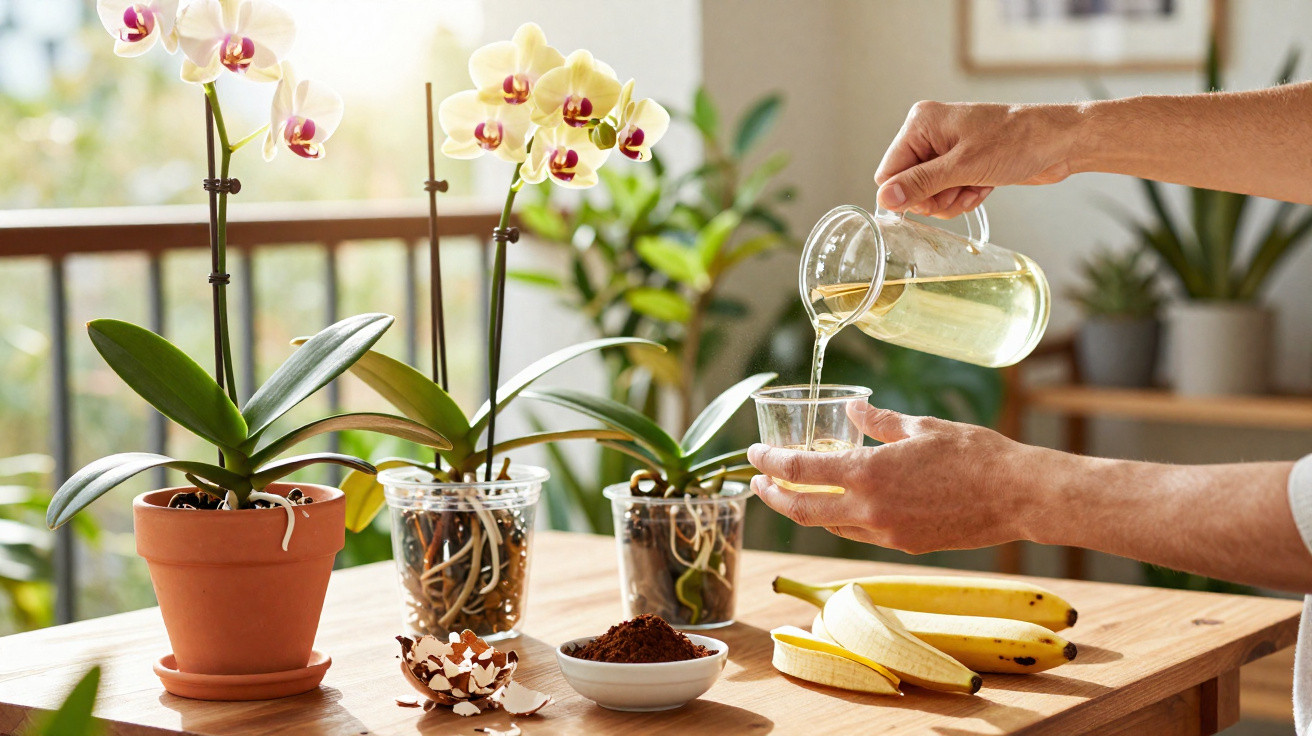
Orchids tend to do best with gentle, natural fertilisers that are heavily diluted and applied carefully to a damp growing medium. Because many varieties have sensitive roots and are grown in pine bark, fibre or charcoal, too much feed can lead to salt build-up, dry tips and scorched roots. The most effective approach is a balance of mild nutrition, controlled frequency and close attention to leaves, roots and flower spikes.
Which natural fertilisers work best for orchids?
Orchids can be fed with natural options such as well-diluted worm castings (vermicompost) tea, bokashi in a very small amount, banana peel tea, unsalted rice water, and bone meal used extremely sparingly. The key is to steer clear of concentrated mixes, over-fermented brews, or anything applied straight onto dry roots.
Of the home options, the safest choices are weak liquid feeds. They distribute nutrients through the medium without creating a heavy layer over the roots. Solid organic fertilisers should only be used in tiny quantities, always fully matured/composted and kept away from direct contact with new shoots.
How do you prepare natural fertiliser without burning the roots?
Preparation follows a simple principle: with orchids, less fertiliser usually works better than more. Roots need oxygen, balanced moisture and a clean medium; an overly strong solution can darken new tips and stall growth.
These ratios are a safe starting point:
- Liquid worm castings: mix 1 tablespoon into 1 litre of water, stir thoroughly, strain, then apply to a medium that is already moist.
- Banana peel tea: leave 1 clean peel in 1 litre of water for 24 hours, strain, and use only a small amount when watering.
- Rice water: take the first water from rinsing rice, with no salt, then dilute it with one additional part of clean water.
- Bokashi: place just a few grains around the edge of the pot, never touching exposed roots or the plant’s crown.
How often should you apply each fertiliser?
Timing depends on the plant’s stage. During active growth-when new roots, leaves or shoots are forming-orchids make better use of light feeding. In dormancy, during severe cold, or immediately after repotting, the amount should be reduced.
A cautious routine helps prevent build-up in the medium:
- Liquid worm castings: every 15 days, always well strained.
- Banana peel tea: once a month, in a small dose.
- Diluted rice water: every 20 or 30 days.
- Bokashi: a very small amount every 45 or 60 days.
- Bone meal: only for mature plants, in a minimal dose and kept away from exposed roots.
What signs show the feeding is working?
A well-fed orchid will not transform overnight. You’ll see results in roots with green or pale tips, firm leaves, active new growth, and fuller pseudobulbs in species that have this structure.
In the run-up to flowering, the plant may produce a stronger flower spike when it has suitable light, correct watering and balanced feeding. Fertiliser can help, but it does not replace filtered brightness, good air movement and a medium that dries at the right pace between waterings.
When should you reduce the dose or stop fertilising?
Cut back if you notice brown root tips, leaves yellowing for no clear reason, crusting on the medium, or a strong smell coming from the pot. These are signs of too much organic matter, poor drainage, or a solution that is too concentrated for roots that need to breathe.
The safest response is to flush the medium with clean water from time to time, pause feeding for a few weeks, then restart at half the previous dose. With orchids, steady growth, pale roots and firm leaves matter more than using a strong feed to try to force faster flowering.



Comments
No comments yet. Be the first to comment!
Leave a Comment