
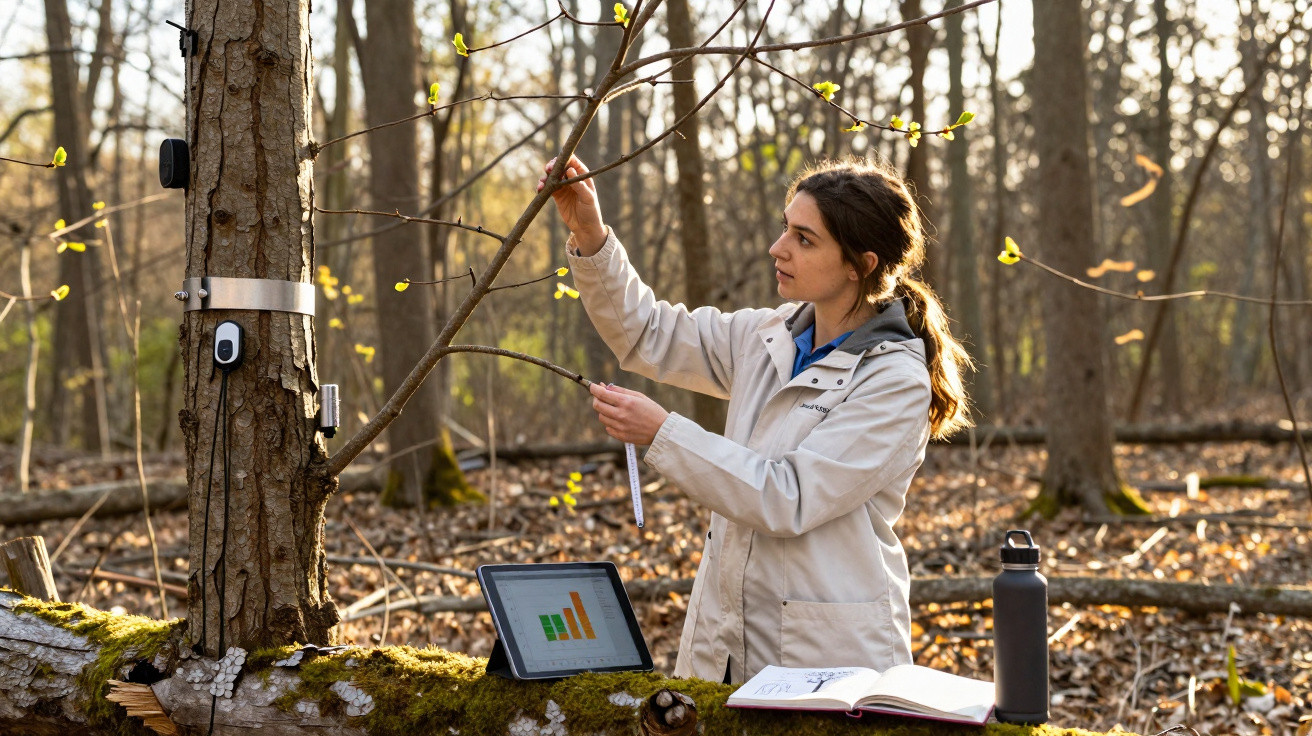
As spring arrives, many people spot the most familiar signals first: swelling buds, brighter colour, and the feeling that the woods are stirring back to life.
A UBC Okanagan researcher says some trees may also display a quieter sign that is, unexpectedly, easy to see. As trees take up water again after winter, certain branches rise. As the trees begin to run short of water, those same branches gradually droop.
Magali Nehemy, a forest hydrology researcher in UBCO’s Department of Earth and Environmental Sciences, has been examining what occurs inside trees as winter gives way to the growing season. Her latest study centres on how branches move during spring rehydration.
“Spring rehydration is one of the key transitions in forest ecosystems,” Nehemy said. “It marks the moment when trees begin to restore internal water reserves and prepare for the growing season.”
Watching balsam fir trees rehydrate in Magali Nehemy’s UBCO study
The research followed balsam fir trees in Ontario’s Muskoka region from early March through to mid-May, when snowmelt and the first rain events began to top up water reserves.
To connect what was happening inside the trees with what could be seen from the outside, Nehemy’s team paired high-resolution sensors attached to tree stems with time-lapse photography, tracking internal water status alongside visible shifts in branch posture.
Using that sensor system, the researchers recorded stem radius every 15 minutes, capturing minute expansions and contractions that indicate water leaving and returning to the tree’s tissues.
In parallel, the time-lapse cameras detected subtle yet repeatable changes in branch angle.
The signal was consistent: branches slowly lifted during periods of snowmelt and rainfall. As conditions became drier, branches sagged.
Stem size tells a story
Stems do not expand and contract by chance; those movements reflect changes in a tree’s water balance.
When water is lost, tissues tighten slightly. When water is restored-through snowmelt, rainfall, and uptake via the roots-those tissues expand again.
Because of this, dendrometers (stem radius sensors) are widely used in forest hydrology and eco-physiology: they provide a high-frequency proxy for water stress and subsequent recovery.
Nehemy’s findings indicate that branch posture closely mirrors these internal shifts. In other words, what appears to be a small slump in a branch may signal a meaningful change in how well hydrated the tree is.
Why water timing matters
This matters in practice because climate change is altering how northern forests receive water. Milder winters can change snowpack. Earlier spring melt can shift the timing of soil moisture. Longer dry spells can arrive at difficult points in the growing season.
Against that backdrop, being able to interpret water status is important-not only for researchers, but also potentially for land managers and others making field observations as they try to gauge how forests are responding.
Nehemy suggests that visible indicators such as branch posture could provide an additional window into forest responses, particularly where conventional measurements are hard to deploy at scale.
Tree branch posture reveals water stress
One important wrinkle is that trees are not responding to water alone. Spring often brings rapid temperature swings, and cold nights followed by warm days can drive freeze–thaw cycles that produce pronounced, short-lived changes in stem size.
Nehemy points out that the study captured those abrupt stem shifts during cold spring nights, yet branch orientation did not change in the same way.
“Interestingly, freeze–thaw cycles on cold spring nights caused sharp changes in stem size but had little effect on branch orientation,” Nehemy said. “This suggests that branch posture reflects longer-term water status rather than short-term temperature fluctuations.”
So when branches droop, it is not simply a case of “it got cold last night”. It may instead be a slow-moving indicator that water stress is building in the tree.
Different trees, different signals
The team also found that this pattern does not apply equally to every type of tree. In the same woodland, nearby leafless deciduous trees showed little to no branch movement, while evergreen conifers displayed much clearer posture changes.
This opens up new questions about how species differ in branch biomechanics, leaf structure, and water-transport strategies.
It also prompts a practical question: in some forests, could branch posture become a broader monitoring tool, while in others it may be far less informative?
A low-cost visual clue
Nehemy is cautious about how far to take the idea. Observing branches is not equivalent to measuring stem water potential or deploying comprehensive sensor networks.
“Branch movement is not a replacement for scientific instruments such as dendrometers or plant water sensors,” she said.
“But it could offer a visual, low-cost indicator of tree hydration, and this is especially useful for field observations or ecosystem monitoring.”
Plants move more than we think
Researchers have been intrigued by plant movement for centuries, yet much remains unclear about how and why plants change shape in response to their surroundings.
This study adds another detail to that picture: at least in some conifers, you may be able to watch the spring “refill” unfold as it happens. Branches rise as water returns, and they droop when the tree begins to run short.
The movement is slight, but as the timing of water becomes more critical each year in a warming climate, it may be a useful signal to pay attention to.





Comments
No comments yet. Be the first to comment!
Leave a Comment